
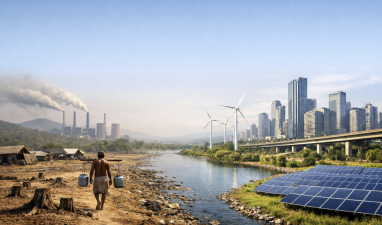
India faces a critical environmental crisis in 2026. Rivers clog, cities struggle with pollution, and farmland productivity declines. Despite this, the economy operates as if the environment is cost-free. The core issue is that environmental damage is not accounted for in economic decisions. This article explains why putting a price on nature is vital for sustainable development.
Environmental Damage as an Economic Externality
Environmental harm is often an externality — a cost not reflected in market prices. Pollution causes health problems and productivity loss but is rarely factored into industrial or urban planning. Groundwater overuse in farming is another example. Subsidised energy encourages excessive water extraction, lowering water tables and increasing future costs. These hidden costs burden society without being recognised in economic models.
Why Pricing Nature Changes Behaviour
When something has a cost, people pay attention. Pricing pollution or resource use motivates cleaner technology and more careful consumption. Forests gain value when their role in carbon storage and soil protection is monetised. This approach does not commodify nature but marks the real costs of environmental damage. It aligns economic incentives with ecological sustainability.
India’s Partial Measures and Challenges
India has introduced mechanisms like compensatory afforestation and environmental impact assessments. However, these efforts are scattered and often treated as formalities. GDP and other economic indicators still fail to reflect natural capital loss adequately. This leads to environmental issues being acknowledged but not effectively addressed in policy or practice.
The Need for Inclusive Environmental Accounting
Monetising nature must be integrated into policymaking. Economic analyses should include environmental costs. Subsidies that encourage resource misuse need reform. Accounting systems must track natural and financial assets together. Importantly, local communities dependent on natural resources must participate in valuing and managing the environment. Without this, monetisation risks being disconnected from reality.
Topics for Prelims:
Environmental Externalities
- Costs of environmental harm not included in market prices.
- Examples – air pollution, water depletion, soil degradation.
- Leads to hidden societal and economic costs.
- Requires policy intervention to internalise costs.
- Key to sustainable economic development.
Environmental Monetisation in India
- Attempts include compensatory afforestation and impact assessments.
- GDP adjustments for environmental damage remain limited.
- Subsidies often encourage resource overuse.
- Need for natural capital accounting systems.
- Community involvement critical for effectiveness.
Groundwater Depletion
- Widespread in agrarian India.
- Caused by unregulated and subsidised water use.
- Leads to falling water tables and scarcity.
- Increases extraction costs and reduces crop yields.
- Requires pricing and regulation to ensure sustainability.
Questions for Mains:
- Critically discuss the concept of environmental externalities and their impact on India’s sustainable development. [GS-III-Economic Development]
- Examine the role of environmental monetisation in policy-making and its challenges in India, and analyse how local community participation can enhance its effectiveness. [GS-II-Governance]
- Estimate the consequences of groundwater depletion in India and point out the economic and social measures needed to address this issue. [GS-III-Environment & DM]
- Analyse the limitations of current environmental accounting methods in India and discuss the potential benefits of integrating natural capital into national economic indicators. [GS-III-Economic Development]
Answer Hints:
1. Critically discuss the concept of environmental externalities and their impact on India’s sustainable development. [GS-III-Economic Development]
- Environmental externalities are costs/benefits of economic activities not reflected in market prices, e.g., pollution, resource depletion.
- In India, pollution (air, water) causes health issues, productivity loss, and ecological damage, but costs are not internalised.
- Groundwater over-extraction and deforestation are classic externalities leading to resource scarcity and ecosystem degradation.
- Ignoring externalities results in unsustainable growth, environmental crises (floods, soil degradation), and long-term economic costs.
- Internalising externalities through pricing and regulation is essential for aligning development with sustainability goals.
- Failure to address externalities perpetuates environmental neglect, undermining India’s sustainable development targets.
2. Examine the role of environmental monetisation in policy-making and its challenges in India, and analyse how local community participation can enhance its effectiveness. [GS-II-Governance]
- Environmental monetisation assigns economic value to ecosystem services and environmental damage, influencing decision-making.
- It incentivises cleaner technologies and sustainable resource use by making environmental costs explicit.
- India’s efforts (compensatory afforestation, impact assessments) are fragmented and often procedural rather than effective.
- Challenges include inadequate integration into GDP, lack of natural capital accounting, and subsidies promoting misuse.
- Local community involvement ensures ground realities and traditional knowledge inform valuation and management.
- Community participation prevents top-down imposition, improves accountability, and enhances policy relevance and success.
3. Estimate the consequences of groundwater depletion in India and point out the economic and social measures needed to address this issue. [GS-III-Environment & DM]
- Groundwater depletion due to unregulated, subsidised extraction leads to falling water tables and scarcity.
- Consequences include increased pumping costs, reduced agricultural yields, and long-term water insecurity.
- Social impacts involve farmer distress, migration, and conflicts over water resources.
- Economic measures – pricing groundwater, removing energy subsidies, promoting water-efficient technologies.
- Social measures – community water management, awareness campaigns, stakeholder participation in regulation.
- Integrated policy combining regulation, incentives, and local involvement is essential for sustainable groundwater use.
4. Analyse the limitations of current environmental accounting methods in India and discuss the potential benefits of integrating natural capital into national economic indicators. [GS-III-Economic Development]
- Current methods like compensatory afforestation and impact assessments are scattered and often treated as formalities.
- GDP and other economic indicators do not adequately reflect depletion of natural capital or environmental degradation.
- Lack of comprehensive natural capital accounting leads to undervaluation of ecosystem services and hidden costs.
- Integrating natural capital would provide a fuller picture of economic health and sustainability.
- Benefits include better policy decisions, incentivising conservation, and aligning growth with ecological limits.
- It helps internalise environmental costs, making development more sustainable and resilient.