
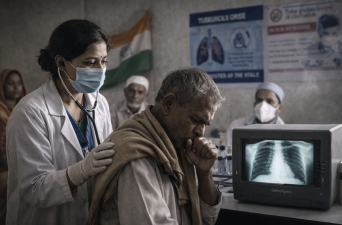
India has renewed its commitment to fight tuberculosis (TB) in 2026 after missing the 2025 elimination deadline. The COVID-19 pandemic had disrupted TB control programmes. To counter this, the government launched an intensive 100-day campaign on World TB Day. This campaign focuses on active TB screening in high-risk areas and vulnerable groups using advanced technology and personalised care.
Intensified Screening Campaign
The campaign targets 1.58 lakh high-risk villages and wards identified using 30 parameters, including TB incidence, anaemia, tobacco use, and malnutrition. Screening extends to vulnerable populations such as smokers, alcoholics, people with HIV or diabetes, and those in congregate settings like prisons and old age homes. Urban informal workers and slum dwellers are also included. Screening uses 2,000 AI-enabled hand-held X-ray devices, a fourfold increase from previous efforts. These devices quickly detect TB signs, even in asymptomatic individuals.
Diagnostic and Preventive Measures
Screening combines AI X-rays with symptom checks covering fever, night sweats, chest pain, weight loss and fatigue. Confirmed cases undergo molecular testing for diagnosis. Those negative for active TB receive a skin test to detect latent infections. Positive latent cases are given preventive treatment. Screening is conducted at health facilities and through mobile medical units in outreach camps.
Nutrition and Patient Support
For the first time, the government ensures nutritional support of Rs 1,000 within 15 days of diagnosis. This timely aid addresses malnutrition, a major factor in TB mortality. Personalised care includes SMS reminders for medication, calls for treatment adherence, and psychosocial support. Patients are encouraged to use the app ‘Khushi aapki E-Sangini’ for information and connect with TB champions and volunteers for guidance throughout treatment.
TB Burden and Progress
India had 27.1 lakh TB cases and over 3 lakh deaths in 2024. The country accounts for nearly a quarter of global TB cases and deaths. Between 2015 and 2024, India reduced TB incidence by 21% and deaths by 28%, surpassing the global average decline of 12%. However, India is still short of the WHO End TB 2025 targets of 50% incidence and 75% death reduction.
Topics for Prelims:
AI-Enabled TB Screening Devices
- Hand-held X-ray devices detect TB early.
- AI analyses X-rays for signs of infection.
- 2,000 devices deployed in 2026 campaign.
- Screening includes asymptomatic individuals.
- Used in remote and high-risk areas.
TB Nutritional Support Programme
- Rs 1,000 monetary aid for nutrition.
- Support given within 15 days of diagnosis.
- Targets malnourished TB patients.
- Reduces early mortality risk.
- Integrated with treatment adherence efforts.
TB Burden in India
- 27.1 lakh cases in 2024.
- Over 3 lakh deaths in 2024.
- India accounts for 25% of global TB cases.
- 21% incidence reduction since 2015.
- 28% death reduction since 2015.
Questions for Mains:
- Discuss in the light of India’s TB control programme, how technology can transform public health interventions. [GS-III-Science & Technology]
- Critically examine the role of nutritional support in managing infectious diseases with reference to tuberculosis in India. [GS-III-Economic Development]
- Explain how social determinants like poverty and malnutrition influence the prevalence of tuberculosis and suggest policy measures to address these factors. [GS-I-Indian Society]
- With suitable examples, discuss the challenges in achieving the WHO End TB targets globally and the strategies to overcome them. [GS-III-Environment & DM]
Answer Hints:
1. Discuss in the light of India’s TB control programme, how technology can transform public health interventions. [GS-III-Science & Technology]
- Use of AI-enabled hand-held X-ray devices enables rapid, early detection of TB, including asymptomatic cases.
- Deployment of 2,000 devices in high-risk and remote areas improves coverage and accessibility of screening.
- Integration of AI reduces diagnostic errors and speeds up decision-making for confirmatory testing and treatment.
- Mobile medical units equipped with technology facilitate outreach in vulnerable populations and hard-to-reach areas.
- Digital tools like the ‘Khushi aapki E-Sangini’ app enhance patient engagement, treatment adherence, and provide real-time support.
- Technology enables data-driven targeting of high-risk zones using 30 parameters, improving resource allocation and monitoring.
2. Critically examine the role of nutritional support in managing infectious diseases with reference to tuberculosis in India. [GS-III-Economic Development]
- Malnutrition weakens immunity, increasing susceptibility and mortality in TB patients, especially within first two months.
- Monetary nutritional support of Rs 1,000 within 15 days ensures timely intervention to reduce early deaths.
- Nutrition support complements medical treatment, improving recovery rates and reducing disease severity.
- Delays in providing nutrition benefits reduce effectiveness and worsen patient outcomes.
- Integrated approach combining nutrition with treatment adherence and psychosocial support enhances overall disease management.
- Addresses social determinants of health, reducing vulnerability among economically disadvantaged groups.
3. Explain how social determinants like poverty and malnutrition influence the prevalence of tuberculosis and suggest policy measures to address these factors. [GS-I-Indian Society]
- Poverty leads to overcrowding, poor living conditions, and limited access to healthcare, increasing TB transmission.
- Malnutrition compromises immune response, elevating risk of TB infection and progression from latent to active disease.
- Social stigma and lack of awareness delay diagnosis and treatment adherence, exacerbating spread.
- Policy measures – Improve nutrition through targeted support programs and timely monetary aid.
- Strengthen social security nets, improve housing, sanitation, and reduce tobacco and alcohol use in vulnerable populations.
- Community engagement, awareness campaigns, and integration of TB care with broader social welfare schemes.
4. With suitable examples, discuss the challenges in achieving the WHO End TB targets globally and the strategies to overcome them. [GS-III-Environment & DM]
- Challenges – COVID-19 pandemic disrupted TB services, causing delays in diagnosis and treatment worldwide.
- High burden countries like India still lag behind targets despite progress (21% incidence and 28% death reduction vs. 50% and 75% targets).
- Social determinants such as poverty, malnutrition, and stigma impede TB control efforts globally.
- Limited access to rapid diagnostics and treatment in remote or vulnerable populations delays case detection.
- Strategies – Intensified active case finding using AI and molecular diagnostics to detect asymptomatic cases early.
- Integrated approaches combining health interventions with nutrition, psychosocial support, and social protection schemes.
- Global collaboration, funding, and political commitment to strengthen health systems and sustain TB programmes.