
Japan lies on the Pacific Ring of Fire and experiences frequent earthquakes because of active plate boundaries near the Pacific Plate, Philippine Sea Plate, Eurasian Plate, and North American Plate. The country uses the Japan Meteorological Agency seismic intensity scale, which measures ground shaking at specific locations rather than only earthquake magnitude.
Recent Major Earthquakes
On 20 April 2026, a magnitude 7.4 earthquake struck about 145 km south-east of Hachinohe in Aomori Prefecture at a depth of about 35 km. The event led to a tsunami warning, aftershocks, and a special advisory from the Japan Meteorological Agency for a possible magnitude 8.0 or stronger earthquake. On 8 December 2025, a magnitude 7.6 earthquake occurred off the east coast of Aomori Prefecture. It produced upper 6 shaking in Hachinohe city on the Japanese seismic intensity scale and led to tsunami warnings for the Pacific coasts of Aomori, Iwate, and central Hokkaido. On 16 March 2022, a magnitude 7.3 earthquake struck off the north-east coast of Japan near Namie in Fukushima Prefecture at about 23:36. It caused blackouts, disrupted train services in areas including Tokyo, and led to at least 3 deaths and 26 severe injuries.
Historic Great Earthquakes
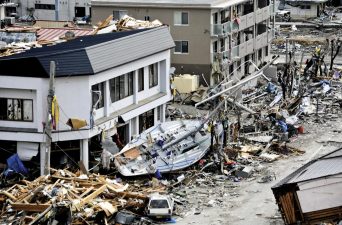
The Great East Japan Earthquake of 11 March 2011 had a magnitude of 9.0–9.1 and occurred off the Oshika Peninsula in Miyagi Prefecture. It was the most powerful earthquake recorded in Japan and the third-largest globally since 1900, and it generated tsunami waves up to 40 metres. The 2011 event caused nearly 20,000 deaths and triggered the Fukushima nuclear accident, which involved reactor meltdowns and radiation release. The Great Hanshin Earthquake of 17 January 1995 had a magnitude of 7.3, killed around 6,400 people, injured 415,000, and destroyed more than 100,000 homes.
Older Major Events
The Great Kantō Earthquake of 1 September 1923 had a magnitude of 7.9 and devastated Tokyo, Yokohama, and the Kantō plain. It caused more than 100,000 deaths and up to 140,000 deaths, with many fatalities linked to fires after the noon-time quake. The Nankaidō Earthquake of 20 December 1946 had a magnitude of 8.1 and caused about 1,400 deaths, 2,600 casualties, and the destruction of at least 36,000 homes. The Mino-Owari Earthquake of 28 October 1891 had a magnitude of 8.0 and caused around 7,200 deaths, 17,000 casualties, and the destruction of more than 140,000 homes.
Earthquake Preparedness in Japan
Japan has one of the world’s most developed earthquake-resistant building systems, and its modern seismic codes were strengthened after the 1995 Kobe earthquake. The country also uses tsunami warnings, emergency alerts, and regular disaster drills as part of its national preparedness framework. The Japan Meteorological Agency is the national body for earthquake and tsunami warnings in Japan. The country’s seismic intensity scale is used in daily disaster response, transport safety, and public evacuation decisions.
Last Modified: April 21, 2026