
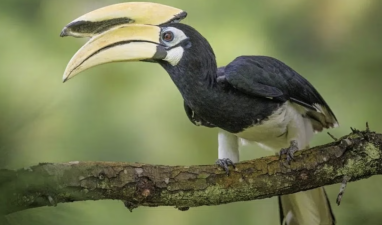
Hornbill conservation efforts have been expanded in the Udanti Sitanadi Tiger Reserve (USTR) in Chhattisgarh through the creation of six hornbill restaurants. The initiative aims to support the rare Malabar Pied Hornbill and strengthen natural forest regeneration by ensuring year-round food availability and nesting support. The species, usually associated with the Western Ghats, has shown a steady rise in sightings in the reserve since its first documentation there in 2017.
What the Initiative Means
Hornbill restaurants are not artificial feeding stations. They are natural clusters of fruit-bearing trees, especially peepal, banyan and other ficus species, which form the hornbill’s main diet. The Forest Department is also planting and monitoring trees needed for nesting. The aim is to create secure habitat conditions and reduce dependence on fragmented forest patches.
Why Udanti Sitanadi Matters
USTR has terrain and climate similar to the moist forests of the Western Ghats. Around 60% of the reserve is mountainous, with elevations reaching 1,000 metres. This has helped the Malabar Pied Hornbill expand its presence in the area. Sightings have increased from one or two per month in 2023 to one or two per week at present. The reserve now has an estimated 400-500 hornbills across the Kulhadighat, Indagaon and South Udanti ranges.
Ecological Importance of Hornbills
Hornbills are recognised as keystone seed dispersers in tropical forests. By eating figs and other fruits and spreading seeds over wide areas, they support forest regeneration, plant diversity and the survival of large-seeded tree species. Their presence is therefore important not only for wildlife conservation but also for maintaining healthy forest ecosystems.
Conservation Measures and Monitoring
The species was listed as Near Threatened in the IUCN Red List in 2024, with an estimated 3,000-32,000 mature individuals in the wild. To protect hornbills and their habitat, forest authorities have intensified anti-poaching action, arrested over 500 poachers, smugglers and encroachers in three years, and deployed drones for monitoring fires and illegal activity. Since 2023, five hornbill tracker teams have also been trained to identify habitats and nests using local ecological knowledge.
Last Modified: April 28, 2026