
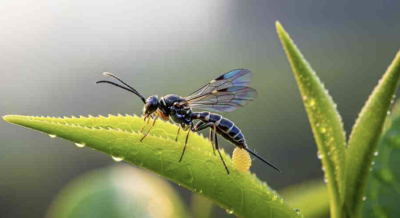
A rare parasitic wasp from the little-known subgenus Carinichelonus has been recorded from a tea estate in Assam. The finding adds to evidence that tea plantations in Northeast India support hidden biodiversity beyond their agricultural role. The species was identified during a taxonomic review of Indian Carinichelonus wasps by researchers associated with the Zoological Survey of India, the Centre for Biodiversity Genomics at the University of Guelph, and the Kalinga Foundation.
New Species from Assam
The study documented a new species, Chelonus (Carinichelonus) mahadeb, from Nahortoli Tea Estate in Assam. It also recorded Chelonus siangensis from Chubwa Tea Estate, extending its known range beyond Arunachal Pradesh. The new species has been named after Lord Mahadeb. The discovery is because only a few species of this rare subgenus have been reported from India.
Ecological Role of Chelonus Wasps
Chelonus wasps are tiny egg-larval parasitoids. They lay eggs inside the eggs of other insects, usually moths and butterflies. The wasp larva develops by consuming the host. This natural process helps regulate insect populations. Since many moth larvae are crop pests, such wasps are considered useful biological control agents in agricultural ecosystems.
Importance for Tea Plantation Biodiversity
Tea estates in Assam are increasingly recognised as important habitats for insects, spiders, birds and other organisms. Although they are cultivated landscapes, they can support complex ecological networks. Parasitoid wasps are often overlooked because of their small size and the difficulty of identifying them. The discovery shows that tea gardens may act as reservoirs of unexplored biodiversity.
Scientific and Conservation Significance
Researchers noted that the Eastern Himalayas remain underexplored for insect diversity. The record of Chelonus (Carinichelonus) mahadeb expands knowledge of the Braconidae family in India. It also marks the need for more systematic biodiversity surveys in tea-growing regions, where many rare or undescribed insect species may still be present.
Last Modified: April 29, 2026