
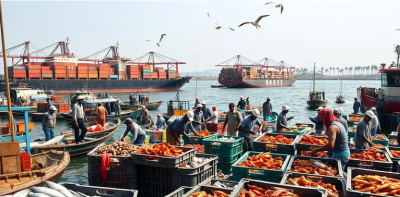
India’s fisheries sector has grown into a major pillar of food security, employment, export earnings and rural livelihoods. Backed by sustained public investment since 2015, the sector has moved from a largely traditional activity to a commercially and globally connected industry. India is now the second-largest aquaculture producer in the world and contributes about 8% of global fish production.
Sector Growth and Production
India supports nearly 30 million fishers and fish farmers at the primary level, with many more engaged across processing, transport and trade. Fish production has risen sharply from 141.64 lakh tonnes in 2019-20 to 197.75 lakh tonnes in 2024-25, reflecting average annual growth of around 7%. This expansion has strengthened domestic supply and improved income opportunities in coastal and inland areas.
Export Performance and Market Reach
Seafood exports have also expanded steadily over the last decade. Marine product exports have more than doubled, rising from ₹30,213 crore in 2013-14 to ₹62,408 crore in 2024-25. Shrimp remains the flagship export item, with exports valued at ₹43,334 crore. India now ships over 350 seafood varieties to nearly 130 markets. The United States is the largest destination, followed by China, the European Union, Southeast Asia, Japan and the Middle East.
Diversification and Value Addition
The export basket is gradually shifting beyond frozen shrimp. Frozen fish, squid, dried items, frozen cuttlefish, surimi-based products, and live and chilled seafood are gaining importance. The share of value-added products has increased from 2.5% to 11%, reaching USD 742 million. The government is promoting high-value species such as tuna, seabass, cobia, pompano, mud crab, GIFT tilapia, scampi and seaweed to reduce dependence on a few commodities.
Policy Support and Global Compliance
Under the Pradhan Mantri Matsya Sampada Yojana, support is being extended for quality seed production, aquaculture expansion, disease management, traceability, cold-chain infrastructure and modern fishing harbours. India has also aligned its fisheries sector with global standards, including compliance with the U.S. Marine Mammal Protection Act. A comparability finding in 2025 secured continued access to the American market. Digitalisation of sanitary import permits and stronger certification systems are further improving ease of doing business and export readiness.
Last Modified: April 28, 2026