
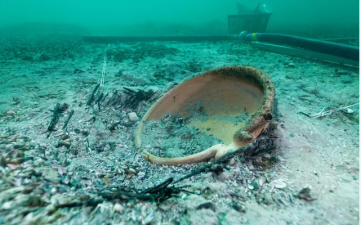
A major underwater archaeological discovery in Lake Neuchâtel, Switzerland, has uncovered more than 1,000 Roman artefacts from a shipwreck believed to date to around 20–50 AD. The find offers rare evidence of Roman trade, transport, and military activity, while also showing the exceptional preservation possible in freshwater lake environments.
Discovery in Lake Neuchâtel
Underwater archaeologists identified a dark area in the lake and initially suspected a shipwreck. On closer inspection, they found round objects that turned out to be pottery. Further excavation revealed a large Roman cargo spread across the site, now known as the Eagle’s Wreck. Lake Neuchâtel is one of the largest lakes in Switzerland.
Artefacts Recovered
The excavation has yielded a wide range of objects, including:
- Ceramics and plates.
- Coins and kitchen implements.
- Swords, a dagger, and military equipment.
- A wicker basket containing ceramic items.
Some vessels were found with traces of food, which are being examined by scientists. The condition of many objects is unusually good despite being underwater for nearly two millennia.
Roman Trade and Military Link
The mix of civilian and military items suggests that the ship was carrying supplies for a Roman military base. Archaeologists believe the cargo may have been intended for a force of about 6,000 soldiers. The presence of weapons and equipment also raises the possibility that Roman legionaries travelled with the shipment.
Significance of the Find
This discovery is important for understanding Roman logistics, trade routes, and daily life. It shows how goods were transported across water routes and how military supply systems functioned in the Roman Empire. The preserved materials may help scholars study packaging methods, food remains, and manufacturing techniques. The artefacts are now being cleaned and restored for detailed analysis and future display in a Swiss archaeological museum.
Last Modified: April 27, 2026