
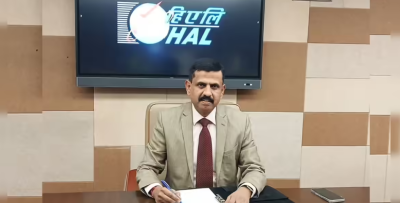
Hindustan Aeronautics Limited (HAL) appointed Kota Ravi as its 22nd Chairman and Managing Director (CMD) on May 1, 2026. He succeeds Dr. D.K. Sunil. The Ministry of Defence issued the official appointment order following selection by the Public Enterprises Selection Board (PESB) and subsequent Cabinet approval. Kota Ravi will serve in this apex role until June 30, 2029, or until further government orders. This leadership transition occurs as the state-owned defence giant expands its domestic production and global export strategies.
Leadership Transition and Executive Role
The Chairman and Managing Director represents the highest executive authority within HAL. This dual position merges board leadership with day-to-day corporate management. Kota Ravi brings more than 30 years of experience across the aerospace, defence, manufacturing, and electronics sectors to this office. Prior to this appointment, he served as the Director (Operations) at HAL. He has also been given additional charge of the Director (Operations) post for a three-month period starting May 1, 2026.
Key Contributions of Kota Ravi
Kota Ravi has held multiple leadership positions within the organization, including Executive Director (Corporate Planning) and General Manager of the LCA Tejas Division. His career includes several programmatic achievements:
Tejas LCA Programme
He served as a key driving force in expanding the indigenous capabilities of the Light Combat Aircraft (LCA) Tejas project. His efforts focused on increasing local component content and scaling up production capacity at the Nashik manufacturing facility. He managed the operationalization of the Tejas fleet within the Indian Air Force (IAF) by setting up a Single Point of Contact (SPOC) for customer support and establishing data communication networks with IAF bases.
Strategic Procurement Contracts
During his executive tenures, HAL finalized major defence contracts. These include the supply of 180 LCA Tejas aircraft to the Indian Air Force and 156 LCH Prachand helicopters divided between the Indian Army and the Indian Air Force.
Ecosystem and Diversification
He initiated the outsourcing of major fuselage assemblies to Indian private sector aerospace firms to build a domestic manufacturing ecosystem. He also led the diversification of HAL into civil aviation manufacturing and Maintenance, Repair, and Overhaul (MRO) services to create alternative revenue streams.
Overview of Hindustan Aeronautics Limited
HAL is a Central Public Sector Enterprise (CPSE) functioning under the administrative control of the Ministry of Defence.
Core Operations
The company designs, develops, manufactures, and maintains fighter aircraft, helicopters, aero-engines, avionics, and related aerospace equipment for the Indian Armed Forces. It operates 11 research and development centres alongside 21 manufacturing divisions across India.
Platform Portfolio
HAL manufactures a wide range of indigenous and licensed platforms:
- Fighter Aircraft: Tejas LCA, Sukhoi Su-30MKI (licensed production).
- Helicopters: Dhruv Advanced Light Helicopter (ALH), Prachand Light Combat Helicopter (LCH), Rudra, Cheetah, and Chetak.
- Trainers and Projects: Hawk 132 (licensed), HTT-40, and upcoming designs like the Advanced Medium Combat Aircraft (AMCA) and Twin Engine Deck Based Fighter (TEDBF).
Transition to Maharatna Status
HAL achieved the prestigious ‘Maharatna’ status in October 2024, becoming the 14th CPSE in India to receive this classification. Kota Ravi played a direct role in corporate planning and strategic shifts that led to this elevation.
Financial Autonomy Performance Criteria
To qualify for Maharatna status, a CPSE must meet specific financial benchmarks over three consecutive years, along with a mandatory listing on Indian stock exchanges under SEBI norms.
| Financial Parameter | Statutory Requirement (Three-Year Average) |
| Annual Net Profit | Greater than ₹5,000 crore |
| Annual Net Worth | Greater than ₹15,000 crore |
| Annual Turnover | Greater than ₹25,000 crore |
Operational Implications
The Maharatna designation grants the HAL Board enhanced financial decentralization. The company can independently execute equity investments in domestic or international joint ventures up to ₹5,000 crore or 15% of its net worth in a single project without seeking prior approval from the Central Government.
Appointment Process for CPSE Leadership
The selection process for board-level positions in premier public sector enterprises follows a structured institutional path:
Public Enterprises Selection Board (PESB)
The PESB conducts interviews, reviews service records, and filters candidates from public and private sectors to recommend the most suitable professional for the CMD post.
Cabinet Committee on Appointments (ACC)
The recommendations made by the PESB undergo scrutiny by the Ministry of Defence and are forwarded to the ACC, headed by the Prime Minister, for final administrative clearance.
Ministerial Order
Following ACC approval, the administrative ministry—the Ministry of Defence in this case—issues the formal notification detailing the tenure, terms, and date of charge assumption.
IASPOINT Booster Facts for UPSC
- Historical Origin: HAL traced its origins back to Hindustan Aircraft Limited, founded in Bengaluru in December 1940 by industrialist Walchand Hirachand in association with the Kingdom of Mysore. The Government of India acquired a stake in 1941 and completely nationalized it later. In 1964, it merged with Aeronautics India Limited to form the modern Hindustan Aeronautics Limited.
- First Indigenous Fighter: HAL designed and manufactured the HF-24 Marut, which was the first indigenous military aircraft developed by India to enter serial production and operational service with the Indian Air Force in the 1960s.
- Current Maharatna Cohort: With HAL’s inclusion, India features 14 Maharatna CPSEs, which include companies like ONGC, Indian Oil Corporation Limited (IOCL), NTPC, SAIL, and BHEL.
- The Three-Tier Classification: The Department of Public Enterprises under the Ministry of Finance classifies CPSEs into Maharatna, Navratna, and Miniratna (Category-I and Category-II) status based on profitability, net worth, autonomy limits, and global footprint.