
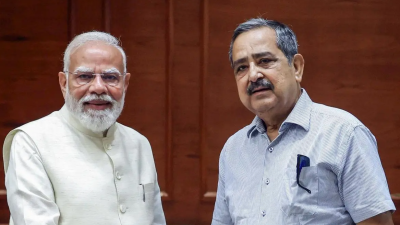
Economist Ashok Kumar Lahiri was appointed as the Vice Chairman of NITI Aayog on 25 April 2026 and officially assumed office on 8 May 2026. He succeeds Suman K. Bery, who held the post from May 2022. Established on 1 January 2015 to replace the 65-year-old Planning Commission, NITI Aayog is the apex policy think tank of the Government of India. The Vice Chairman serves as the functional and executive head of the institution. Alongside this high-level appointment, the government named four new full-time members to strengthen the policy framework across diverse socio-economic sectors.
Profile of the New Vice Chairman
The appointment brings a wealth of fiscal and macroeconomic expertise to India’s premier policy body.
Professional Background and Public Service
- Chief Economic Advisor (CEA): Ashok Kumar Lahiri served as the Chief Economic Advisor to the Government of India between 2002 and 2007, spanning administrations led by Atal Bihari Vajpayee and Manmohan Singh.
- 15th Finance Commission: He served as a full-time member of the 15th Finance Commission chaired by N. K. Singh, helping design the vertical and horizontal tax devolution formula for states.
- International Financial Institutions: He worked in senior executive roles at the Asian Development Bank (ADB) as Executive Director, and as an economist at the World Bank and the International Monetary Fund (IMF).
Restructuring and New Organizational Structure
The 2026 reconstitution includes the induction of specialized domain experts as full-time members and the retention of senior administrative leadership.
New Full-Time Members
- Prof. K. V. Raju: An expert in agricultural economics, rural development, and sustainable resource management.
- Prof. Gobardhan Das: A prominent immunologist and academic, focusing on healthcare policy, biotechnology, and public health research.
- Prof. Abhay Karandikar: Former Secretary of the Department of Science and Technology (DST) and former Director of IIT Kanpur, driving telecom, artificial intelligence, and digital infrastructure policies.
- Dr. M. Srinivas: Director of the All India Institute of Medical Sciences (AIIMS), New Delhi, bringing expertise in medical education and healthcare delivery.
- Rajiv Gauba: The former Cabinet Secretary to the Government of India has been retained as a full-time member to guide administrative reforms and governance logic.
Structural Composition of NITI Aayog
The organizational design ensures representation from both central ministries and state leadership.
| Position | Current Holder / Composition |
| Chairperson | Prime Minister of India (Ex-officio) |
| Vice Chairman | Ashok Kumar Lahiri (Appointed by the Prime Minister) |
| Full-Time Members | Domain experts from science, medicine, agriculture, and administration |
| Ex-officio Members | Up to four Union Ministers nominated by the Prime Minister |
| Special Invitees | Union Ministers and experts with domain knowledge nominated by the PM |
| Chief Executive Officer (CEO) | Appointed by the Prime Minister for a fixed tenure in the rank of Secretary |
Core Mandate and Functional Hubs
NITI Aayog acts as a non-constitutional, non-statutory body created via a Union Cabinet resolution. It operates through two distinct pillars to implement its mandate.
Team India Hub
This hub leads the interface between the states and the central government. It ensures that every state has a direct channel to voice its development needs, challenges, and policy preferences at the central level, preventing a one-size-fits-all policy approach.
Knowledge and Innovation Hub
This branch builds the repository of policy research, technical expertise, and innovation strategies. It analyzes successful global practices and adapts them to the Indian context while designing long-term strategic blueprints for the economy.
Operational Frameworks and Indices
The institution monitors development progress through competitive benchmarks and collaborative governance.
Cooperative vs. Competitive Federalism
- Cooperative Federalism: Driven by the Governing Council, which includes the Prime Minister, Chief Ministers of all states, and Lieutenant Governors of Union Territories. It offers a structured platform for joint center-state policy formulation.
- Competitive Federalism: Promoted through performance-based rankings. NITI Aayog publishes specialized metrics such as the SDG India Index, State Health Index, Composite Water Management Index, and India Innovation Index to spur healthy policy competition among states.
IASPOINT Booster Facts for UPSC
- Legal Status: NITI Aayog is an extra-constitutional, non-statutory body. It was created through an executive resolution of the Union Cabinet and does not possess powers to allocate public funds, a power that rested with the former Planning Commission.
- Rank Equivalency: The Vice Chairman of NITI Aayog enjoys the rank and status of a Cabinet Minister in the Union Table of Precedence, while full-time members hold the status of a Minister of State.
- The e-AMRIT Portal: NITI Aayog manages the e-AMRIT (Accelerated e-Mobility Revolution for India’s Transportation) web portal, acting as a one-stop destination for all information regarding electric vehicles in India.
- State Support Mission: This initiative helps states build institutional capacities to create state-level think tanks, ensuring the decentralization of development planning down to the district and block levels.