
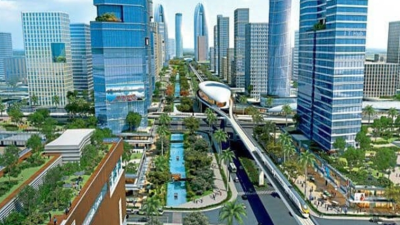
The capital city of Andhra Pradesh, Amaravati, is undergoing structural development as an integrated greenfield township under the Amaravati Integrated Urban Development Program. Inspired by Singapore’s eco-friendly Punggol district, the project aims to establish a climate-resilient economic center with the technical assistance of the Singapore government. In November 2025, the Andhra Pradesh government signed a Memorandum of Understanding with Singapore to collaborate on township development, digital transformation, and the creation of the Amaravati Economic Region. Backed by financial assistance from global institutions, the project relies on a massive land consolidation framework to realize its smart, blue-green urban design masterplan.
Institutional Framework and Financial Architecture
The execution of the Amaravati capital project involves a blend of multilateral funding, institutional governance, and technical cross-border collaborations.
Financing Mechanisms
- World Bank Loan Approval: The World Bank Board of Executive Directors approved an USD 800 million loan in December 2024 for the Amaravati Integrated Urban Development Program. The initial financial disbursement commenced in March 2025 to kickstart Phase-1 infrastructure activities.
- Co-financing Partnership: The Asian Development Bank operates as a co-financing partner, contributing parallel funding for basic trunk infrastructure, public administrative buildings, and neighborhood services.
- Private Capital Mobilization: The institutional funding framework aims to catalyze more than USD 600 million in private sector investment to ensure the long-term financial viability of the urban center.
Governance and Administrative Agencies
- Andhra Pradesh Capital Region Development Authority (APCRDA): Operating as the apex planning body, APCRDA manages zone-wise development, land allocation, and masterplan enforcement.
- Amaravati Development Corporation (ADC): This specialized agency supervises the operational execution of engineering works, smart city infrastructure placement, and green environment projects.
- Joint Implementation Steering Committee (JISC): A bilateral body working alongside Singapore’s Ministry of Trade and Industry to monitor monthly progress, digital twin models, and real-time governance integrations.
Land Pooling Scheme and Spatial Design
The geographical establishment of Amaravati stands out due to its unique land procurement strategy and sustainable planning paradigms.
The Land Pooling Scheme (LPS)
- Mechanics: Landowners voluntarily surrendered agricultural land parcels to the state government in exchange for smaller, fully developed commercial and residential plots within the future city, alongside an annuity payment for ten years.
- Scale of Contribution: Under the initial phases of the scheme, farmers from local villages contributed thousands of acres. The pooling network encompasses over 35,000 acres contributed by more than 30,000 farmers across the region.
- Plot Registration Status: By May 2026, APCRDA completed the allotment of returnable plots to 97% of the participating farmers through a transparent lottery system, with registration executed for nearly 90% of those plots.
Blue-Green Masterplan Concept
- Blue Infrastructure: The city integrates the Krishna Riverfront with an extensive network of internal canals, water bodies, and structural reservoirs designed for natural flood mitigation, stormwater storage, and active water recycling.
- Green Infrastructure: Urban forests, linear parks, and dedicated non-motorized transport corridors form a green grid. The masterplan mandates that 22% of the total residential layout area be reserved exclusively for affordable housing.
Infrastructure Focus and Field Challenges
The actualization of the mega-city requires complex logistical management while addressing grassroot execution bottlenecks.
Core Development Vectors
- Administrative Infrastructure: Construction works are prioritizing iconic legislative, executive, and judicial towers alongside 4,026 housing units meant for government employees, MLAs, and ministers, targeting structural delivery by August 2028.
- MICE Infrastructure: The state is setting up special bureaus in Amaravati, Visakhapatnam, and Tirupati to develop convention centers and hotels on the model of Singapore’s Suntec City to transform the region into a global Meetings, Incentives, Conferences, and Exhibitions destination.
- Digital Trade Corridor: Collaborations with the Commodities Intelligence Centre leverage blockchain-based platforms to connect regional agricultural exporters, especially Guntur chili traders, with East Asian commodity markets.
Ground-Level Challenges
- Labor Management: Project sites face an acute shortage of specialized construction workers required for high-rise and precision engineering works.
- On-Site Amenities: Upgrading infrastructure within labor camps, including sanitation, clean drinking water supply, and medical facilities, presents an operational challenge for contractors.
- Legal and Family Disputes: Final plot allotment remains pending for a small fraction of land parcels due to ongoing local family litigations, court stays, and eligibility verifications for assigned lands.
Comparative Profile: Punggol vs. Amaravati Focus Areas
| Urban Sector | Punggol District Model (Singapore) | Amaravati Adaptation Framework (India) |
| Primary Theme | Eco-Town with integrated digital waterfront housing. | Sustainable capital city with a port-led industrial hinterland. |
| Environmental Matrix | Rainwater harvesting through local landscape features. | Macro flood-mitigation reservoirs based on Krishna River dynamics. |
| Mobility Solution | Sub-surface automated heavy rail networks. | Dedicated rapid transit corridors linked to national highways. |
| Governance Engine | Smart grid energy trackers and pneumatic waste collection. | Real-Time Governance Center powered by open-source tech stacks. |
IASPOINT Booster Facts for UPSC
- Amaravati Economic Region: A designated geographical zone within the capital region planned to house non-polluting clean manufacturing, agro-processing, services, and IT industries.
- Punggol District: Located in northeast Singapore, it is celebrated globally as the country’s first smart, eco-friendly residential township featuring integrated water property designs and a digital district hub.
- S Sage Program: The Singapore-Andhra Pradesh Governance Excellence initiative under which civil servants and public education teachers receive training in public policy management and urban planning frameworks.
- Environmental and Social Systems Assessment (ESSA): A mandatory evaluation protocol executed by the World Bank to review structural environmental impacts and resettlement safety frameworks prior to loan disbursals.