
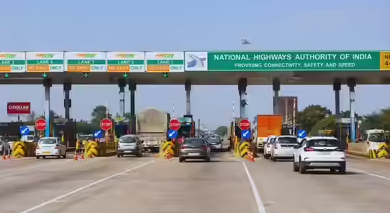
Delhi introduced the Multi-Lane Free Flow barrier-less tolling system on the Urban Extension Road-II at the Mundka-Bakkarwala Toll Plaza on 11 May 2026. This system uses Automatic Number Plate Recognition technology and FASTag for electronic toll collection without stopping vehicles, eliminating physical toll booths and barriers. The National Highway Authority of India manages toll collection on national highways and plans to implement this system at 17 fee plazas across nine states by September 2026 and over 108 plazas by March 2027. The second Indian MLFF system began operation on 1 May 2026 at the Chorayasi Toll Plaza in Gujarat.
Working Mechanism of Multi-Lane Free Flow Technology
The Multi-Lane Free Flow (MLFF) system removes physical checkpoints, allowing vehicles to cruise through toll zones at highway speeds.
Gantry Infrastructure and Sensors
Instead of concrete booths and drop-down barriers, the system uses overhead metallic gantries spanning across the highway. These gantries host an array of high-speed cameras, Radio Frequency Identification (RFID) readers, and laser sensors. As a vehicle passes underneath, the sensors calculate its dimensions to classify its vehicle type, while the RFID readers scan the windscreen-mounted tag.
Image Processing and Number Plate Recognition
If an RFID tag is damaged or missing, the Automatic Number Plate Recognition (ANPR) system captures high-definition photographs of the front and rear registration plates. Optical Character Recognition (OCR) software converts these images into digital text, cross-referencing it with the central vehicle database maintained by the Ministry of Road Transport and Highways.
Evolution of Electronic Toll Collection in India
Toll collection in India has evolved from manual cash transactions to passive radio waves, and now to free-flow camera recognition.
| Timeline | Technology Used | Operational Efficiency | Key Challenges |
| Pre-2016 | Manual Cash Collection | High processing time per vehicle (30-60 seconds), leading to long queues. | Cash handling leakages, fuel wastage, and high idle emissions. |
| 2016 – 2021 | Hybrid FASTag & Cash Lanes | Moderate processing time; introduction of dedicated RFID lanes alongside cash lanes. | Congestion caused by non-tagged vehicles entering electronic lanes. |
| 2021 – 2026 | Mandatory FASTag with Physical Barriers | Processing time reduced to 2-5 seconds per vehicle; cash lanes penalized with double fees. | Mechanical barrier delays, tag scanner misread errors, and local law-and-order issues at booths. |
| May 2026 Onward | Multi-Lane Free Flow (MLFF) | Zero stopping time; vehicles maintain speeds up to 100 km/h during toll deduction. | Enforcement of non-payment fines and dependence on high-speed data networks. |
Financial Compliance and Legal Enforcement
The transition to barrier-less tolling requires strict enforcement protocols to prevent toll evasion since there are no physical means to stop a non-compliant vehicle.
Balance Maintenance and Electronic Notices
Commuters must maintain a sufficient monetary balance in their linked bank accounts or digital wallets. If a vehicle transits an MLFF gantry with an insufficient balance or a blacklisted tag, the system generates an automated Electronic Notice. This notification is delivered via SMS and email to the registered vehicle owner.
Penalties for Non-Compliance
The vehicle owner must clear the pending toll amount through an online payment portal within 72 hours of receiving the Electronic Notice. Failure to pay within this statutory window triggers an automatic block on the vehicle’s FASTag profile and alerts regional transport offices to withhold fitness certificates during annual vehicle re-registration.
Infrastructure Expansion and Roadways Connectivity
The National Highway Authority of India (NHAI) is executing a phased roll-out of MLFF technology to modernize high-density economic corridors.
Urban Extension Road-II (UER-II)
The UER-II serves as a third ring road for the National Capital Region (NCR), connecting Alipur in North Delhi with the Delhi-Gurgaon Expressway. Implementing barrier-less tolling at the Mundka-Bakkarwala plaza on this stretch aims to reduce heavy commercial freight congestion bypassing central Delhi.
National Roll-out Plan
Following the initial deployments in Gujarat and Delhi, NHAI intends to upgrade 17 high-traffic toll plazas across nine states by September 2026. The master plan aims to convert over 108 plazas by March 2027, focusing on golden quadrilateral routes and newly constructed expressways.
IASPOINT Booster Facts for UPSC
- National Electronic Toll Collection (NETC) Program: The FASTag system operates under the NETC umbrella, which was developed jointly by the National Payments Corporation of India (NPCI), NHAI, and the Indian Highways Management Company Limited (IHMCL).
- RFID Frequency Allocation: FASTag technology utilizes passive RFID tags operating in the Ultra-High Frequency (UHF) band, specifically between 865 MHz and 867 MHz, to ensure long-range scanning capabilities.
- Central Motor Vehicles Rules, 1989: The Ministry of Road Transport and Highways amended these rules to make FASTag mandatory for all class M and N vehicles (four-wheelers and above) manufactured before 2019.
- Vahan and Sarathi Database Integration: The MLFF cameras match captured number plate digits directly against the localized Vahan national register, which tracks vehicle registration particulars across India.
- Satellite-Based Tolling Alternatives: Alongside MLFF, India is testing Global Navigation Satellite System (GNSS) tolling. This technology tracks vehicle coordinates via GPS/NavIC and charges toll fees based on the exact distance traveled on a national highway.