
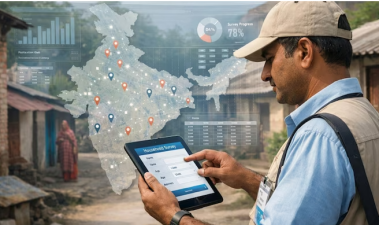
Census 2027 is India’s first fully digital census and uses mobile-based data collection for nationwide enumeration. The exercise has an approved outlay of Rs. 11,718.24 crore and includes caste enumeration after the Cabinet Committee on Political Affairs decision of 30 April 2025.
Two-Phase Census Structure
Census 2027 is being conducted in two phases under the Census Act, 1948 framework. The House Listing and Housing Census began on 1 April 2026 and is scheduled to continue until September 2026, followed by the Population Enumeration phase in February 2027.
Digital Features Of Enumeration
- The census uses mobile devices for data capture and digital transmission of household information.
- The Census Management & Monitoring System (CMMS) portal provides near real-time monitoring of field operations.
- An optional self-enumeration facility is available through the portal se.census.gov.in.
- Each self-enumeration submission generates a Self-Enumeration ID, or SE ID.
- Geo-referenced jurisdictions are used for mapping and supervision of census areas.
Caste Enumeration In Census History
Caste enumeration was last systematically included in the 1931 Census. Census 2027 includes caste data collection as part of the national enumeration exercise.
Language Coverage And Rollout
The digital census provides services in 16 regional languages. The initial rollout was completed in Goa, Karnataka, Odisha, Sikkim, Mizoram, and urban areas such as the New Delhi Municipal Council and Delhi Cantonment Board by 13 April 2026.
Special Provisions For Snow-Bound Regions
The Population Enumeration phase for Ladakh, Jammu and Kashmir, Uttarakhand, and Himachal Pradesh is scheduled for September 2026. These regions have snow-bound terrain and a separate enumeration calendar.
Last Modified: April 25, 2026