
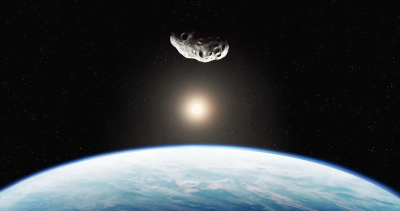
NASA confirmed that the newly discovered near-Earth asteroid, designated 2026 JH2, safely completed an extremely close flyby of Earth on 18 May 2026. Discovered just days earlier on 10 May 2026, the space rock passed at a minimum distance of approximately 91,000 kilometres from the Earth’s centre. This distance equals roughly one-quarter of the average gap between the Earth and the Moon, positioning the object well within the lunar orbital circle. The celestial encounter provided astronomers with a crucial opportunity to gather precise tracking data to refine planetary defence metrics, with live viewing managed globally by the Virtual Telescope Project in Italy.
Discovery and Flyby Parameters
The rapid tracking and calculation of the trajectory of 2026 JH2 highlight the efficiency of global sky survey collaborations.
Initial Detection and Observations
- Discovery Team: The asteroid was first spotted by the Mount Lemmon Survey based in Tucson, Arizona, which operates as a critical component of NASA’s Near-Earth Object (NEO) observations.
- Follow-up Verification: After its initial detection at a faint apparent magnitude of 21, independent validations were completed by specialized centers including the Steward Observatory, Farpoint Observatory, and Magdalena Ridge Observatory.
- Official Designation: The Minor Planet Center officially announced the object and issued its provisional designation on 12 May 2026.
Flight Telemetry Data
The table below details the exact physical and orbital parameters computed by NASA’s Jet Propulsion Laboratory (JPL) during the closest approach:
| Parameter Component | Metric Value / Observation Detail |
| Date & Time of Closest Approach | 18 May 2026 at 21:23 GMT (02:53 AM IST, 19 May) |
| Minimum Safe Flyby Distance | Approximately 91,135 Kilometres (0.0006 Astronomical Units) |
| Lunar Distance Equivalent | ~24% of the average Earth-Moon distance |
| Relative Velocity | 9.14 kilometres per second (approx. 31,248 km/h) |
| Peak Apparent Brightness | Magnitude 11.5 (visible through amateur telescopes) |
| Position in Sky Canopy | Constellation Ursa Major (The Great Bear) |
Classification and Orbital Mechanics
Asteroid 2026 JH2 belongs to a specific family of space rocks that frequently interact with the path of the inner planets.
The Apollo Class Architecture
The Minor Planet Center categorizes near-Earth asteroids into four primary groups based on their orbital characteristics: Apollo, Amor, Aten, and Atira.
- Earth-Crossing Orbits: Apollo asteroids possess a semi-major axis larger than that of Earth (a > 1.0 AU) but their perihelion distance, or closest point to the Sun, is less than Earth’s aphelion distance (q < 1.017 AU). This mathematical profile forces their paths to intersect Earth’s orbit.
- Orbital Profile of 2026 JH2: This specific rock has an eccentric orbit (e = 0.582) with a semi-major axis of 2.419 AU. It takes approximately 3.76 Earth years to complete one full revolution around the Sun, swinging out as far as the inner edge of Jupiter’s orbital zone before returning.
Size and Composition Analysis
The estimated diameter of 2026 JH2 ranges from 15 to 35 metres. This physical scale draws direct parallels to historical atmospheric entry events:
- The Chelyabinsk Comparison: The dimensions match the approximate 20-metre size of the meteor that entered the atmosphere over Russia in 2013. The Chelyabinsk object caused a massive mid-air explosion, creating an airburst shockwave that shattered glass across six cities and injured over 1,200 individuals.
- Absence of Immediate Risk: Despite the physical similarity, orbital physics ruled out any impact threat from 2026 JH2. The object will not make another close pass near Earth until the year 2060, at which point it will remain 17 times farther away.
Planetary Defence Mechanisms and Tracking
Close flybys of non-hazardous objects function as active tactical drills for international planetary defence coordinates.
Tracking Networks
The tracking of 2026 JH2 utilized a network of public and automated astronomical facilities:
- Goldstone and Arecibo Legacy Systems: Ground radar systems track incoming asteroids to resolve their shape, rotation rate, and precise surface composition.
- The Virtual Telescope Project: Based in Manciano, Italy, this robotic telescope facility provided real-time, 300-second exposure tracking. The system kept the fast-moving asteroid centered as a pinpoint dot while letting background stars blur into long streaks, making the feed accessible to the global scientific community.
IASPOINT Booster Facts for UPSC
- Astronomical Unit (AU): One AU represents the mean distance from the center of the Earth to the center of the Sun, valued at roughly 149.6 million kilometres.
- The Torino Scale: This 0-to-10 scale measures the impact hazard associated with near-Earth objects. A rating of 0 indicates zero risk of collision, which applied directly to 2026 JH2.
- Potentially Hazardous Asteroids (PHAs): To be classified as a PHA, an asteroid must have a minimum orbit intersection distance (MOID) of 0.05 AU or less with Earth and possess an absolute magnitude (H) of 22.0 or brighter, corresponding to a diameter of at least 140 metres. 2026 JH2 was too small to meet the PHA criteria.
- Yarkovsky Effect: This weak force acts on asteroids when they absorb sunlight and re-radiate it as heat. Over long periods, this uneven thermal emission acts like a tiny thruster, altering the asteroid’s path and requiring astronomers to continuously update orbital models during close flybys.
- The Tunguska Event (1908): This event remains the largest recorded asteroid impact in modern history, where a space rock estimated at 50 to 100 metres flattened roughly 80 million trees over an area of 2,150 square kilometres in Siberia without leaving a traditional impact crater.