
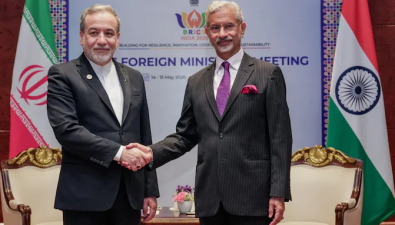
On 15 May 2026, Iranian Foreign Minister Abbas Araghchi urged India to continue investing in Chabahar Port, located in Iran’s Sistan and Baluchestan province on the Gulf of Oman. This diplomatic push follows the expiration of the United States conditional sanctions waiver on 26 April 2026, which has slowed project momentum. India and Iran had previously solidified their maritime partnership in May 2024 by signing a 10-year agreement for India Ports Global Limited to operate the Shahid Beheshti terminal at the port. Despite having invested approximately US120 million to fulfill its equipment procurement commitments, New Delhi made no fresh budgetary allocation for the project in the 2026-27 Union Budget, prompting bilateral discussions to explore alternative operational frameworks. </p> <h4>Geostrategic and Economic Profile of Chabahar</h4> <p> Chabahar Port is situated on the Makran coast of Iran’s Sistan and Baluchestan province, directly adjacent to the Gulf of Oman and the mouth of the Strait of Hormuz. It is the only oceanic port of Iran, providing direct access to the Indian Ocean without entering the Persian Gulf. The port complex consists of two distinct port entities: </p> <ul> <li><b>Shahid Beheshti Terminal: </b> The primary focus of Indian developmental assistance, infrastructure investments, and terminal operations.</li> <li><b>Shahid Kalantari Terminal:</b> The secondary terminal, largely managed and developed natively by domestic Iranian authorities.</li> </ul> <h4>India’s Strategic Objectives and Institutional Framework</h4> <p> India Ports Global Limited (IPGL), a wholly-owned subsidiary of Sagarmala Development Company Limited, acts as the nodal executing agency for India’s commitments. In May 2024, IPGL signed a long-term main contract with the Ports and Maritime Organization (PMO) of Iran to lease and operate the Shahid Beheshti terminal for 10 years. India’s core strategic priorities through Chabahar encompass: </p> <ul> <li><b>Circumvention of Pakistan: </b> The port offers an alternative maritime-cum-land trade route to landlocked Afghanistan and Central Asian Republics, entirely bypassing the terrestrial transit restrictions imposed by Pakistan.</li> <li><b>Countering Gwadar Port: </b> Located approximately 100 kilometers west of Pakistan’s Gwadar Port, which is being developed under the China-Pakistan Economic Corridor (CPEC), Chabahar serves as a strategic maritime counterbalance in the Arabian Sea.</li> <li><b>Integration with INSTC: </b> India aims to formally link Chabahar Port with the International North-South Transport Corridor (INSTC), a 7,200-km multimodal transit network connecting Mumbai to Moscow via Iran and the Caspian Sea.</li> </ul> <h4>Financial Outlays and Recent Budgetary Status</h4> <p> India has completed its initially committed financial obligations toward equipping the Shahid Beheshti terminal. </p> <table> <thead> <tr> <td><strong>Financial Parameter</strong></td> <td><strong>Status and Details</strong></td> </tr> </thead> <tbody> <tr> <td><b>Total Equipment Investment</b></td> <td>US 120 million fully utilized for procurement of heavy port machinery, including mobile harbor cranes.
Geopolitical Challenges and Sanctions Framework
The geopolitical viability of the project has historically run parallel to changes in US sanctions targeting Iran.
- The 2018 Carve-out: The US originally granted a narrow sanctions exemption to Chabahar under the Iran Freedom and Counter-Proliferation Act (IFCA) of 2012, recognizing its utility for the economic reconstruction of Afghanistan.
- Recent Rescission: The US State Department revoked the general exception in September 2025. Following intense diplomatic engagement, the US Department of the Treasury extended a conditional wind-down waiver that officially lapsed on 26 April 2026.
- Risk Mitigation Strategy: To bypass the impact of primary and secondary American financial sanctions, Indian officials are discussing an interim corporate arrangement. This involves a potential temporary transfer of the commercial stake held by India Ports Global Chabahar Free Zone (IPGCFZ) to a local, non-sanctioned Iranian entity, while retaining a contractual pathway to resume direct operations at a later date.
IASPOINT Booster Facts for UPSC
- Zaranj-Delaram Highway: India constructed a 218-km highway in Afghanistan connecting Zaranj (on the Iran-Afghan border) to Delaram, linking Chabahar Port directly to the Afghan Garland Highway network.
- Chabahar-Zahedan Railway Line: A proposed 628-km rail link from Chabahar to Zahedan along the Afghan border. Due to delays caused by US sanctions on steel and rolling stock supply, Iran chose to utilize its own National Development Fund to advance the construction.
- Free Trade Zone: The port is integrated with the Chabahar Free Trade-Industrial Zone (CFZ), allowing tax-free manufacturing and transit processing.
- Tomb of Twin Ports: Geographically, Chabahar sits at the cross-section of the energy-rich Persian Gulf and the broader Indian Ocean sea lines of communication (SLOCs).