
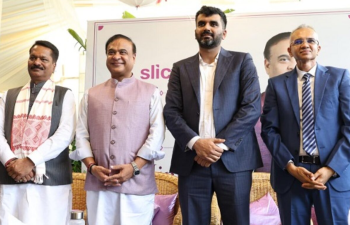
Assam Chief Minister Himanta Biswa Sarma inaugurated India’s first Artificial Intelligence (AI) powered “phygital” banking branch of Slice Small Finance Bank at GS Road in Guwahati. This next-generation facility integrates physical presence with advanced digital infrastructure to streamline banking services. The branch uses AI-enabled self-service kiosks, paperless transactions, and simplified digital onboarding to make financial services highly accessible. This initiative supports the goal of expanding financial inclusion, particularly for small businesses, women entrepreneurs, and historically underserved communities, highlighting the role of technological innovation in strengthening regional financial ecosystems.
Core Architecture of Phygital Banking
Phygital banking combines physical bank branches with digital technology channels to provide a cohesive customer experience. It retains human interface for complex financial advice and trust while deploying digital automation for speed and transactional efficiency.
Key Components of the Guwahati Branch
- AI-Enabled Self-Service Kiosks: Automated systems manage customer queries, minimize wait times, and guide users through banking processes without manual intervention.
- Paperless Operations: Cash deposits, withdrawals, and account statements are entirely digitalized, removing administrative friction and reducing operational costs.
- Direct UPI Credit Interface: Customers access formal credit lines directly through the Unified Payments Interface (UPI) system without needing separate digital applications.
- Instant Digital Onboarding: Document verification, automated data capture, and identity checks are processed via AI algorithms to open accounts within minutes.
Comparative Analysis of Banking Models
| Feature | Traditional Banking | Pure Digital/Neo-Banking | AI-Powered Phygital Banking |
| Physical Infrastructure | High (Brick-and-mortar branches) | Nil (App or web-only) | Optimized (Smart branches with tech kiosks) |
| Primary Interface | Human staff and paper forms | Mobile applications and AI chatbots | Blend of self-service kiosks and human advisors |
| Onboarding Time | 3 to 5 working days | Few minutes to hours | Instant (Under 10 minutes via automated OCR) |
| Target Audience | General public, tech-conservative segments | Tech-savvy, urban smartphone users | Universal (Includes unbanked & semi-urban populations) |
| Trust Factor | High due to physical presence | Lower among rural and older segments | High due to physical location backed by fast tech |
Strategic Role in Financial Inclusion
The deployment of technology-driven banking models addresses critical credit and accessibility gaps in rural and semi-urban economies.
Empowerment of Informal Sectors
Small store owners, micro-entrepreneurs, and informal workers often lack standard credit scores or structured financial documents. AI-driven lending models analyze alternative data points like transaction histories and utility bill records to estimate creditworthiness. This infrastructure allows small businesses to secure short-term working capital on mobile devices quickly.
Bridging the Gender Credit Gap
Women entrepreneurs often face mobility and structural barriers in accessing formal finance. Digital onboarding combined with local smart branches simplifies the loan application and asset-creation process. This direct access bypasses traditional collateral bottlenecks, driving grassroots economic independence.
Technological Drivers of Modern Indian Banking
The scaling of phygital infrastructure is supported by a network of public and private technology platforms in India.
The JAM Trinity and DPI
The foundational layer relies on the JAM Trinity, consisting of Jan Dhan bank accounts, Aadhaar digital identity verification, and mobile connectivity. This is backed by Digital Public Infrastructure (DPI) which facilitates direct benefit transfers, instant biometric authentication, and data sharing under strict user consent frameworks.
Unified Lending Interface (ULI)
The Unified Lending Interface simplifies credit appraisal by connecting diverse data sources. It allows financial entities to instantly access authenticated land records, Goods and Services Tax (GST) data, and financial transactions. This technology lowers documentation requirements and accelerates loan processing cycles for small borrowers.
Banking BHASHINI Initiative
The Reserve Bank of India (RBI) works with the Digital India BHASHINI Division to deploy a specialized language AI model called “Banking BHASHINI.” This framework integrates banking terminology across all 22 scheduled Indian languages, reducing literacy barriers and helping non-English-speaking customers use phygital kiosks and mobile applications.
IASPOINT Booster Facts for UPSC
- Small Finance Banks (SFBs): These are differentiated banking entities registered under the Companies Act, 2013, and licensed under Section 22 of the Banking Regulation Act, 1949. They must extend 75% of their adjusted net bank credit to the Priority Sector Lending (PSL) category.
- Capital Adequacy Requirement: Small Finance Banks are mandated by the Reserve Bank of India to maintain a minimum capital-to-risk-weighted-assets ratio (CRAR) of 15%.
- Slice Small Finance Bank: Formed following the merger of fintech startup Slice (Garagepreneurs Internet Pvt Ltd) with North East Small Finance Bank (NESFB), targeting tech-enabled retail finance.
- MuleHunter.AI: An AI-based regulatory technology tool used by financial institutions and enforcement agencies to track, identify, and deactivate suspicious mule accounts used in cybercrimes and laundering.
- Viksit Bharat 2047 Strategy: India’s long-term national development blueprint that identifies AI deployment across core financial, agricultural, and educational public infrastructures as a major economic growth driver.