
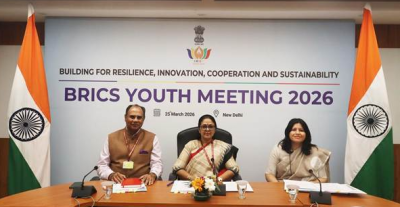
Under India’s BRICS Chairship for 2026, the Department of Youth Affairs is hosting the BRICS Youth Entrepreneurship Working Group Meeting from May 20 to May 21, 2026, in Indore, Madhya Pradesh. Organized under the theme “Building for Resilience, Innovation, Cooperation and Sustainability,” this event serves as a platform for young entrepreneurs and institutional representatives from BRICS member nations. The initiative aligns with India’s foreign policy focus on youth-led development, aimed at establishing collaborative frameworks in digital innovation, green energy, financial inclusion, and sustainable supply chains across the expanded BRICS bloc.
Core Pillars of BRICS Youth Cooperation
The 2026 framework focuses on four distinct areas to build a cross-border startup ecosystem.
- Digital Innovation: Sharing open-source public digital infrastructure, artificial intelligence applications, and e-commerce models to reduce market entry barriers for young businesses.
- Inclusivity and Equity: Creating dedicated support systems, incubation access, and seed funding pathways for women entrepreneurs and rural youth.
- Sustainability: Encouraging startups focused on circular economy principles, climate tech, waste management, and renewable energy solutions.
- Resilient Cooperation: Building institutional mechanisms like joint venture funds, mentor networks, and legal desk support to simplify cross-border regulatory compliance.
The Expanded BRICS Landscape
The expansion of the BRICS grouping alters the demographic and economic matrix of youth entrepreneurship cooperation.
| Country | Key Startup Hubs | Primary Youth Entrepreneurship Focus Area |
| India | Bengaluru, Delhi-NCR, Mumbai | FinTech, DeepTech, Digital Public Infrastructure (DPI) |
| Brazil | São Paulo, Rio de Janeiro | AgTech, Green Finance, Clean Energy |
| Russia | Moscow, Saint Petersburg | Cybersecurity, Software-as-a-Service (SaaS), EdTech |
| China | Shenzhen, Beijing, Shanghai | E-commerce Logistics, Hardware Innovation, AI Automation |
| South Africa | Cape Town, Johannesburg | BioTech, Mobile Health (mHealth), EduTech |
| Egypt | Cairo | E-commerce, Logistics Tech, Financial Inclusion |
| Ethiopia | Addis Ababa | AgriTech, Mobile Payments, Digital Trade Platforms |
| Iran | Tehran | Nanotechnology, Biopharmaceuticals, Localized Software |
| UAE | Dubai, Abu Dhabi | Web3, ClimateTech, Global Venture Capital Access |
Focus Sectors for Joint Ventures
The working group meeting targets sectors where resource pooling yields immediate regional benefits.
Digital Public Infrastructure (DPI)
India offers its Unified Payments Interface (UPI) and Open Network for Digital Commerce (ONDC) architecture as open-access templates. Young entrepreneurs can build localized applications on these frameworks to solve identity verification, digital payment, and e-retail distribution challenges across African and Latin American BRICS markets.
Climate Tech and Circular Economy
Startups from Brazil, India, and South Africa are framing joint research initiatives for biofuel commercialization, electronic waste recycling technology, and localized drip-irrigation hardware.
Skill Standardization and Mobility
The nations are evaluating a unified framework to recognize tech skills and professional certifications. This mechanism will allow skilled youth and founders to operate across member states without repeating compliance testing.
Institutional Mechanisms Supporting Youth Startups
Several structural bodies within the BRICS framework provide funding, mentorship, and market access to young entrepreneurs.
- New Development Bank (NDB): Headquartered in Shanghai, the NBD provides lines of credit to national development banks, which then distribute micro-loans to sustainable youth-led enterprises.
- BRICS Business Council: This council features a dedicated Working Group on Skills Development, Applied Research, and Innovation that links young innovators with large corporate buyers.
- BRICS Startup Forum: Announced by India, this physical and digital platform hosts annual pitch sessions, angel investor meets, and regulatory sandboxes for testing cross-border tech solutions.
Key Challenges in Cross-Border Cooperation
Establishing a synchronized startup ecosystem across nine nations involves distinct structural hurdles.
- Regulatory Divergence: Varying intellectual property laws, data localization mandates, and tax structures complicate product launches in multiple BRICS countries.
- Currency Volatility: Fluctuations in local currencies against the US dollar increase trading risks, driving the current demand for local currency settlement mechanisms in startup trade.
- Geopolitical Friction: Differing strategic priorities among member nations can occasionally slow down institutional policy approvals and visa-free travel regimes for founders.
IASPOINT Booster Facts for UPSC
- Establishment of BRICS: The acronym BRIC was coined by British economist Jim O’Neill in 2001. The grouping was formalized during the first meeting of BRIC Foreign Ministers in 2006. South Africa joined in 2010, turning it into BRICS.
- The 2024 Expansion: Iran, Egypt, Ethiopia, and the United Arab Emirates formally joined the BRICS bloc on January 1, 2024.
- Indore’s Selection: Indore, the host city for the 2026 Youth Working Group meeting, holds the record for being ranked India’s cleanest city for seven consecutive years under the Central Government’s Swachh Survekshan.
- Department of Youth Affairs: Operating under the Ministry of Youth Affairs and Sports, this department implements the National Youth Policy and manages flagship programs like the National Youth Corps (NYC) and the National Programme for Youth and Adolescent Development (NPYAD).
- BRICS Share of Global Indicators: Post-expansion, the BRICS grouping accounts for roughly 30% of the earth’s land surface, 45% of the global population, and over 31.5% of the global GDP (PPP), surpassing the G7’s share.