
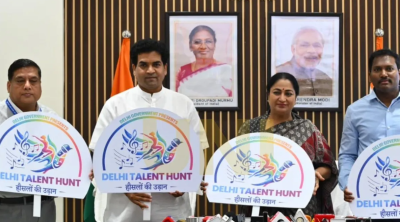
The Delhi government has officially launched the “Talent Hunt Scheme – Hauslon Ki Udaan 2026-27” to discover and nurture the creative capabilities of the youth across the national capital. Announced by Delhi Chief Minister Rekha Gupta on May 20, 2026, the comprehensive initiative aims to bridge social and economic gaps by giving young individuals a platform to display their creative skills. Operating with a dedicated budget allocation of Rs 10 crore, the program targets young residents living across all 70 Assembly constituencies of Delhi, providing them with opportunities for national recognition, skill advancement, and self-reliance.
Core Institutional Framework and Target Demographic
The structural blueprint of the scheme specifies distinct administrative roles and eligibility requirements to streamline execution.
Nodal Department and Implementation
- Administrative Authority: The scheme is managed and implemented directly by the Department of Art, Culture and Languages, Government of Delhi.
- Geographical Scope: The program is operational simultaneously across all 70 Assembly constituencies of Delhi to ensure comprehensive coverage.
- Economic Inclusivity: Registration is entirely free of cost to minimize barriers for participants belonging to economically weaker sections, slums, and underprivileged colonies.
Target Audience Profile
- Age Group: The initiative is designed specifically for individuals aged between 16 and 35 years.
- Expected Volume: The administration projects a total initial participation of more than 25,000 young individuals across the city.
- Official Digital Infrastructure: A dedicated web portal, www.delhitalenthunt.com, serves as the singular gateway for online registration, application status tracking, video uploads, and regular progress updates.
Competition Categories and Assessment Parameters
The talent hunt covers a wide variety of cultural, fine art, and contemporary performance disciplines divided into seven primary segments.
Categorization of Artistic Fields
- Singing: Includes subsections for Classical, Folk, and Non-Classical vocal presentations.
- Dance: Encompasses separate segments for Classical, Folk, and Contemporary or Non-Classical dance forms.
- Fine Arts and Digital Arts: Covers traditional painting, drawing, sketching, and modern digital illustration techniques.
- Sculpture and Pottery: Dedicated to three-dimensional physical arts and traditional craftsmanship.
- Acting and Theatre: Focuses on dramatic performances, monologue delivery, stage presence, and acting skills.
- Instrumental Music: Open to artists playing classical or contemporary musical instruments.
- Music Composition and Poetry: Designed for creative writers, lyricists, and original musical arrangement producers.
Evaluation and Weightage Matrix
To maintain transparency and incorporate public appreciation, the selection process uses a hybrid evaluation mechanism.
- Expert Jury Evaluation: Reparable professionals and domain experts from various creative fields form a dedicated jury panel that holds 75 percent weightage in the final grading.
- Online Public Voting: Registered users and the public can view performance clips on the web portal to vote for their preferred choices, carrying a 25 percent weightage in the evaluation score.
Four-Stage Phased Selection Process
The program operates sequentially through four distinct filtering layers to narrow down initial entries into the top state-level artists by August 2026.
Phase 1: Online Screening
Applicants must record and upload their work videos directly onto the dedicated digital portal during registration. The expert panel will screen the entries to select approximately 24,500 qualified individuals for physical auditions.
Phase 2: Cluster-Level Auditions
The administration divides the city into 35 geographic clusters, with each single cluster covering exactly two adjacent Assembly constituencies. Auditions at this tier help reduce the pool to 2,450 advanced participants.
Phase 3: Zonal-Level Competitions
The qualified performers from the cluster round compete within four major administrative zones (North, South, East, and West). The jury panel evaluates performances to select the best candidates in each of the seven creative categories.
Phase 4: State-Level Grand Finale
The competition concludes with a large-scale State-Level Grand Finale scheduled for August 2026. The finale features exactly 28 top finalists competing before a crowd and noted art personalities.
Financial Rewards and Incentive Structure
The financial incentives under Hauslon Ki Udaan are structured to foster self-employment and sustainable artistic careers among the youth.
| Performance Rank | Cash Prize Amount | Additional Rewards |
| First Position | Rs 2,500,000 (2.5 Lakh) | Commemorative Certificate, Shield, and Medal |
| Second Position | Rs 2,000,000 (2.0 Lakh) | Commemorative Certificate, Shield, and Medal |
| Third Position | Rs 1,500,000 (1.5 Lakh) | Commemorative Certificate, Shield, and Medal |
| Fourth Position | Rs 1,000,000 (1.0 Lakh) | Commemorative Certificate, Shield, and Medal |
IASPOINT Booster Facts for UPSC
- Constitutional Provision for Art and Culture: While Education and Culture are broadly distributed, Article 29 of the Indian Constitution protects the interests of minorities to conserve their distinct language, script, or culture. Seventh Schedule places ‘Theatres and dramatic performances; cinemas’ under the State List (List II).
- Demographic Dividend Linkage: The age bracket of 16-35 directly maps into India’s working-age demographic dividend. Channelling youth towards the creative economy aligns with the broader objectives of national self-reliance (Aatmanirbhar Bharat).
- Creative Economy Sector Valuation: According to UNCTAD, the creative industry and cultural goods market contribute significantly to global trade and offer employment pathways through micro-enterprises and digital content creation.
- Delhi’s Administrative Setup: Under Article 239AA of the Constitution, the National Capital Territory (NCT) of Delhi has a Legislative Assembly with 70 constituencies, where matters of local governance, art, and language development fall under the domain of the elected state cabinet.
- Brand Ambassador Integration: The Delhi government plans to select outstanding finalists from this scheme to serve as official brand ambassadors for various state-run social awareness campaigns, leveraging their local reach to drive public behavior changes.