
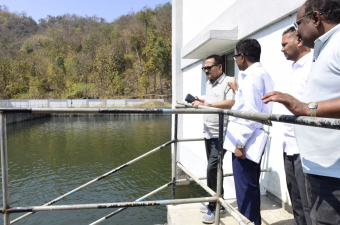
The Gujarat government completed 2.21 crore cubic metres of earthwork from 2022-23 to 2024-25, surpassing its target of 2.03 crore cubic metres to strengthen reservoirs and increase water storage capacity. Spearheaded by the Water Resources Department, this multi-year campaign focused on deepening, desilting, and rejuvenating water channels to secure the state’s long-term agricultural and drinking water needs. By clearing blocks across 1,474 sites, the state government aimed to optimize the flow of critical irrigation water to the farthest agricultural fields, moving the region closer to its strategic goal of becoming a water-surplus state.
Core Objectives and Scope of the Initiative
The campaign combined engineering maintenance with natural resource conservation to revitalize the water supply network.
Infrastructure Restoration and Expansion
- Desilting Operations: Technical teams removed massive accumulations of silt from the beds of reservoirs, canals, rivers, check dams, and local streams.
- Volume Achieved: The department successfully excavated 221.37 lakh cubic metres of earthwork against the initial planned target of 203 lakh cubic metres over the three-year period.
- Tail-End Delivery: Deepening water bodies restored their original carrying capacity, ensuring that canal water reaches far-flung agrarian zones without facing artificial blockages.
Surface Cleaning and Structural Care
- Vegetation Removal: Laborers cleared wild shrubs, dense bushes, and invasive weeds obstructing the water channels.
- Geographical Coverage: The cleanup operations covered a linear distance of 4,223 kilometers and treated a total surface area of 123 lakh square metres.
- Embankment Reinforcement: Heavy machinery worked along the borders of dams and lakes to strengthen weak earthen structures, preventing potential breaches during high-discharge monsoons.
Operational Logistics and Engineering Execution
The execution of the project relied heavily on state-owned machinery networks and specialized engineering divisions.
Fleet Deployment and Workforce Management
- Daily Operations: The state mobilized a heavy fleet of earth-moving machinery, deploying an average of 88 to 96 modern government machines daily.
- Institutional Coordination: The Irrigation Mechanical Circles based in Ahmedabad and Vadodara supervised the mechanical and heavy engineering tasks.
- Continuous Execution: Ground teams operated through adverse weather conditions and varying topographies to maintain the project schedule over three financial years.
Special Engineering Activities
- Salinity Ingress Control: Special attention was directed toward vulnerable coastal pockets to prevent seawater intrusion into sweet-water aquifers.
- Cofferdam Construction: Temporary watertight enclosures were engineered to isolate working areas for deeper structural repairs in active rivers.
- Flood Management: Teams cleared natural drainage lines ahead of monsoons to facilitate floodwater drainage and mitigate emergency overflow threats.
Summary of Rejuvenation Outcomes
| Operational Parameter | Achieved Metrics (2022-23 to 2024-25) |
| Total Earthwork Completed | 2.21 Crore (221.37 Lakh) Cubic Metres |
| Initial Targets Planned | 2.03 Crore (203 Lakh) Cubic Metres |
| Total Operational Sites | 1,474 Locations across Gujarat |
| Water Channels Restored | 4,223 Kilometers in Length |
| Vegetation Clearance Area | 123 Lakh Square Metres |
| Nodal Implementing Agency | Water Resources Department, Government of Gujarat |
IASPOINT Booster Facts for UPSC
- Sujalam Sufalam Jal Abhiyan (SSJA): This earthwork initiative operates under the structural philosophy of SSJA, a community-backed water conservation campaign launched by Gujarat in 2018 to desilt water bodies before the monsoon.
- Constitutional Domain of Water: Water is primarily a State subject under Entry 17 of the State List (List II) of the Seventh Schedule of the Indian Constitution, making state departments central to irrigation planning.
- Irrigation Types in Gujarat: The state relies heavily on surface irrigation via the Sardar Sarovar Project (Narmada Canal network) alongside extensive groundwater extraction and localized check dams.
- Salinity Ingress: The phenomenon occurs when excessive groundwater extraction lowers the water table, causing heavy marine water to flow inland into fresh aquifers, a common ecological issue along Gujarat’s 1,600 km coastline.
- Micro-Irrigation Goals: To maximize the utility of stored water, the state integrates these structural earthworks with the Per Drop More Crop component of the Pradhan Mantri Krishi Sinchayee Yojana (PMKSY).