
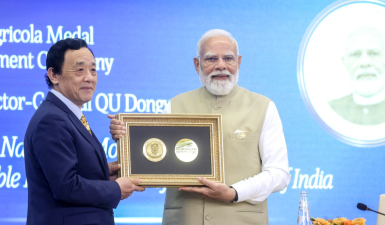
The Director-General of the Food and Agriculture Organization (FAO), Dr. Qu Dongyu, conferred the prestigious Agricola Medal upon Prime Minister Narendra Modi at the FAO headquarters in Rome, Italy. The medal represents the highest honor bestowed by the global body to recognize exceptional leadership in advancing food security, sustainable agriculture, and rural development. Prime Minister Modi dedicated the international honor to India’s millions of farmers, livestock rearers, fishers, agricultural scientists, and field workers. The event also marked a major diplomatic milestone, being the first visit by an Indian Head of Government to the FAO headquarters in three decades.
Overview of the Agricola Medal
The Agricola Medal is designed to honor international leaders who take decisive action to advance global food networks.
Core Mandate and Objectives
- Recognition of Leadership: The medal is awarded by the Director-General of the FAO to heads of state and government who show outstanding commitment to the elimination of hunger and poverty.
- Symbolism of the Award: The word “Agricola” translates to “farmer” in Latin. The medal embodies the absolute connection between sustainable governance and the welfare of agrarian communities.
- Target Pillars: It highlights policy implementations that successfully target structural poverty reduction, rural economic growth, systemic nutrition enhancement, and the creation of resilient agrifood channels.
Strategic Drivers Behind the 2026 Conferment
The selection of the host recipient highlights multiple large-scale, tech-driven, and structural interventions executed within India’s agricultural sector over the past decade.
Social Safety Nets and Financial Inclusion
- Pradhan Mantri Garib Kalyan Anna Yojana (PMGKAY): The operational footprint of the world’s largest food-based social safety net, providing free food grains to over 800 million citizens, was cited as a major intervention against vulnerable food insecurity.
- PM-KISAN Scheme: The programmatic transfer of direct income support benefits directly to the bank accounts of more than 110 million farmers without intermediary leakages.
Technological Interventions in Indian Farming
- Digital Public Infrastructure (DPI): Deploying customized open-source digital tools, Artificial Intelligence (AI) based localized weather and crop advisory networks, and remote-sensing technologies to build modern farming models.
- Mechanization and Modernization: Accelerating precision farming protocols, sensor-based machinery, and the use of drones for targeted nutrient and pesticide spraying.
Climate Resilience and Natural Farming
- Varietal Development: The research and release of approximately 3,000 climate-resilient, biofortified, and stress-tolerant crop varieties over a 10-year period.
- Water Resource Efficiency: Adopting precision irrigation through programmatic frameworks like ‘Per Drop More Crop’ and expanded micro-irrigation systems.
- Regenerative Agriculture: Systematic national backing for chemical-free natural farming and regenerative practices to safeguard soil health and micro-ecosystems.
Global Commitments and the South-South Framework
- International Year of Millets (IYM 2023): Leadership in proposing and driving the global shift toward nutrient-dense, climate-hardy millets in active partnership with the FAO.
- Global South Capacity Building: Extending Indian agricultural science, crop innovations, and tech solutions to developing nations to build institutional food self-reliance.
Historical Context of India-FAO Partnerships
The relationship between India and the FAO features deeply institutionalized collaborations that have shaped domestic and global agricultural architecture.
Prominent Historic Indian Contributions
- Binay Ranjan Sen: Served as the Director-General of the FAO from 1956 to 1967. He was the first head of the organization hailing from a developing nation and directed international policy toward establishing global food aid frameworks, which paved the way for the World Food Programme (WFP).
- Dr. M. S. Swaminathan: Known as the architect of India’s Green Revolution, his institutional collaborations with the FAO helped steer global policy away from reactive food aid toward establishing permanent crop yield sustainability.
IASPOINT Booster Facts for UPSC
Food and Agriculture Organization (FAO)
- Establishment: It was founded on October 16, 1945, in Quebec City, Canada, making India a founding member. The headquarters moved to Rome, Italy, in 1951.
- Status: It functions as a specialized agency of the United Nations that leads international efforts to defeat hunger and improve nutrition.
- World Food Day: Celebrated annually on October 16 to commemorate the founding date of the organization.
- Key Global Publications:
- The State of the World’s Forests (SOFO)
- The State of World Fisheries and Aquaculture (SOFIA)
- The State of Agricultural Commodity Markets (SOCO)
- The State of Food Security and Nutrition in the World (SOFI)
Past Indian Recipients of the Agricola Medal
- Dr. Manmohan Singh (2008): Conferred the medal by then FAO Director-General Jacques Diouf, recognizing governance interventions like the National Food Security Mission, Rashtriya Krishi Vikas Yojana (RKVY), and the National Policy for Farmers.
- Other Global Recipients: Historical awardees include Pope John Paul II, King Bhumibol Adulyadej of Thailand, and former Indonesian President Joko Widodo (2024).
Core Global Standards & Programs Managed by FAO
- Codex Alimentarius Commission: Established jointly by the FAO and the World Health Organization (WHO) to set international food safety and consumer protection standards.
- Globally Important Agricultural Heritage Systems (GIAHS): A program identifying landscapes that preserve traditional farming practices. India hosts designated GIAHS sites including Kuttanad Below Sea Level Farming System (Kerala), Koraput Traditional Agriculture (Odisha), and Saffron Heritage of Kashmir.