
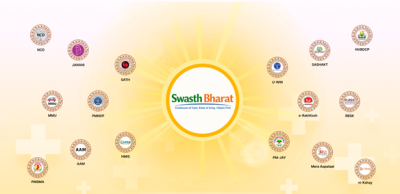
The Union Health Minister launched the Swasth Bharat Portal on May 6, 2026, during the 10th National Summit on Innovation and Inclusivity in New Delhi. Developed by the Ministry of Health and Family Welfare, this Application Programming Interface (API) based aggregator platform integrates fragmented digital health tools under a unified framework. By creating a single interface, the portal resolves data silos, reduces administrative duplication, and cuts public health infrastructure expenses. The platform aligns with national digital public infrastructure guidelines to enhance evidence-based health planning and resource management across India.
Architectural Framework and Technological Design
The portal serves as a central digital layer that connects independent public health databases without replacing their existing operations.
API-Based Federated Architecture
The system uses a federated data architecture powered by secure APIs. This mechanism allows separate health databases to communicate and exchange data in real time. Instead of maintaining distinct databases for independent health programs, the platform plugs existing applications into a central aggregator layer.
Reduction of Siloed Workflows
- Single Login Interface: Healthcare personnel use one set of credentials to access multiple vertical health program dashboards.
- Interoperability: The software layout enables smooth data exchange between distinct state and central health applications.
- Consolidated Analytics: The portal features built-in data visualization tools that generate localized health indicators for district and state administrators.
Strategic Integration with ABDM Registries
The system is built to comply with the Ayushman Bharat Digital Mission guidelines, linking field-level activities with national registries.
Ayushman Bharat Health Account Integration
The portal uses the unique 14-digit ABHA number as the core identifier for patient data. When field staff update health records, the portal securely links the medical event to the citizen’s ABHA profile. This mechanism ensures traceable longitudinal health histories across multiple public facilities.
Connection with National Registries
The software establishes structural links with key national health repositories:
- Healthcare Professionals Registry (HPR): Verifies and connects the digital actions, prescriptions, and reports to certified medical officers, community health officers, and nursing staff.
- Health Facility Registry (HFR): Maps data entry and resource utilisation directly to unique public health facilities, ranging from primary health centers to tertiary hospitals.
Impact on Frontline Health Workers and Operational Efficiency
The unified interface addresses data entry redundancies that affect frontline public health workers, such as Accredited Social Health Activists (ASHAs), Auxiliary Nurse Midwives (ANMs), and Medical Officers.
Mitigation of Administrative Burden
Frontline workers previously used multiple standalone mobile and web apps to log data for separate maternal health, immunisation, and disease surveillance programs. The integrated platform allows a worker to input a beneficiary’s data once, which automatically populates all related program registries.
Projections for Efficiency Gains
| Performance Metric | Expected Target Value | Direct Administrative Impact |
| Data Entry Effort Reduction | 20% to 40% decrease | Eliminates repetitive entry of basic citizen parameters across multiple applications. |
| IT Infrastructure Savings | 20% to 30% reduction | Lowers government spending on independent hosting, computing, and server maintenance. |
| Human Resource Optimization | 20% to 40% lower duplication | Reduces the need for separate software maintenance and data-entry support teams across divisions. |
| Decision-Making Speed | Measurable acceleration | Real-time analytics dashboards supply instant data for rapid epidemiological tracking and planning. |
IASPOINT Booster Facts for UPSC
- Federated Architecture: A data management approach that allows independent databases to operate autonomously while staying connected through a common framework to share information without centralising the physical storage.
- Application Programming Interface (API): A software intermediary that allows two distinct applications to interact with each other, forming the backbone of modern digital public infrastructure.
- Ayushman Bharat Digital Mission (ABDM): Launched in September 2021 under the National Health Authority (NHA), it aims to build the backbone necessary to support the integrated digital health infrastructure of India.
- ABHA ID: A unique 14-digit identification number that identifies a citizen across India’s digital healthcare ecosystem, authenticating and linking their health records with consent.
- 10th National Summit on Innovation and Inclusivity: The official public health forum of the Ministry of Health and Family Welfare where innovations, replicable best practices, and new digital tools are unveiled for national deployment.