
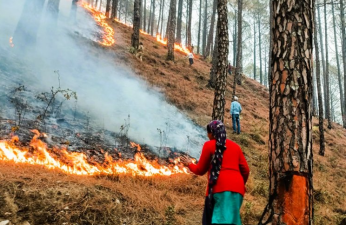
The Uttarakhand government is introducing an incentive-based reward scheme offering financial prizes up to ₹1 lakh to individuals and teams contributing to wildfire prevention and containment. Unveiled alongside the state’s comprehensive Forest Fire Control and Management 2026 strategy, this policy response addresses the severe rise in forest fires across the mountainous terrain. Over the last ten years, Uttarakhand recorded 14,638 forest fire incidents that destroyed 23,682 hectares of woodland and resulted in 35 human fatalities. The strategic transition focuses on community-driven monitoring, upgraded communication tech, and legal crackdowns to minimize response times during peak fire seasons.
Reward Framework and Livelihood Integration
Structured Financial Incentives
The state forest department will distribute three tiers of awards in every district at the end of the fire season to boost grass-roots motivation. Separate evaluation categories will apply to private citizens, local community groups, and frontline government forest personnel:
- First Prize: ₹1,00,000 for exceptional work in active fire extinguishing and prevention.
- Second Prize: ₹75,000 for consistent enforcement of fire lines and reporting.
- Third Prize: ₹51,000 for local support and rapid mobilization.
The Pirul Collection Livelihood Model
Dry pine needles, locally known as Pirul, form a highly inflammable bio-mass layer on the forest floor during summer, acting as a primary fuel source for forest fires. To encourage widespread removal, the state runs the Pine Pirul Collection Scheme, paying residents ₹10 per kilogram for collected needles. The collected biomass feeds into nine operational commercial pellet and briquette manufacturing units. The state processed 13,003 metric tonnes of Pirul over the past four years and set a collection target of 8,555 tonnes for the current year.
Structural Strategy and Technological Infrastructure
Vulnerability and Mapping
Forest Fire Risk Zonation Mapping has identified eight districts in Uttarakhand as exceptionally prone to active wildfires. These divisions receive specialized resource allocation, heightened standby protocols, and focused budget deployments:
| High Vulnerability Districts | Core Regional Features | Forest Cover Type |
| Almora | High accumulation of dry organic pine litter | Chir Pine dominant |
| Pauri Garhwal | Steep slope gradients increasing fire propagation | Pine and Mixed Broadleaf |
| Tehri Garhwal | Low seasonal relative humidity zones | Chir Pine and Scrubland |
| Uttarkashi | Sub-alpine transitions with inaccessible terrain | Coniferous and Pine |
| Nainital | High tourist footfall and urban-forest interfaces | Oak and Pine transitions |
| Pithoragarh | Remote trans-Himalayan border valleys | Alpine and Coniferous |
| Chamoli | Steep valleys prone to high wind velocity | Oak, Pine, and Grasslands |
| Rudraprayag | Narrow river valleys with dense lower slopes | Mixed Sub-tropical to Temperate |
Communication Hardware and Safety Grid
To overcome the limitations of rugged geography, the state has deployed a multi-layered telecommunication grid to report and track smoke plumes in real time. The field layout includes 1,548 walkie-talkie handsets, 488 fixed base stations, 45 wireless repeater towers, 248 vehicle-mounted mobile radios, and 1,507 handheld GPS tracking devices. This network links field teams directly to the centralized command control rooms.
Human Resource Allocation and Safety Insurance
During the current fire season, 11,650 personnel are deployed across the state, including 6,000 regular forest department staff and 5,625 temporary fire watchers. To protect frontline workers from operational hazards, the government provides group accident insurance coverage up to ₹10 lakh per individual. The World Bank-funded U-PREPARE project assists these teams by distributing specialized personal protective equipment, including fire rakes, flame-retardant suits, safety helmets, protective gloves, puncture-resistant boots, and high-intensity headlamps.
Institutional Governance and Legal Reforms
Community Management Networks
The grass-roots management framework relies on 496 localized Forest Fire Protection and Management Committees established at the Gram Panchayat and village cluster levels. To support decentralized governance, village committees that successfully keep their territorial jurisdictions fire-free receive a direct financial grant of ₹30,000 for local development. Additionally, the department operates public awareness drives, conducting 3,235 interactive village programs that reached 81,414 rural residents to explain the hazards of agricultural stubble burning near forest boundaries.
The Legal Triad Crackdown
The state has implemented a zero-tolerance legal policy, shifting from minor fines to a strict triple-law framework to prosecute individuals who intentionally or negligently spark forest fires. Arsonists face joint prosecution under three separate legal structures:
- Indian Forest (Uttaranchal Amendment) Act: Covers illegal entry and intentional damage to state timber assets.
- Wildlife Protection Act, 1972 (Section 9): Invoked because wildfires destroy, displace, and disturb critical wildlife habitats.
- Bharatiya Nyaya Sanhita (BNS): Applied via non-bailable clauses relating to the deliberate destruction of public property and endangering public safety.
Inter-Agency Coordination and Forecasting
The state forest department signed a Memorandum of Understanding (MoU) with the India Meteorological Department (IMD) to receive customized, short-range weather alerts. These include real-time data on wind velocity, dry spells, and temperature spikes, allowing local rangers to predict fire behavior. Senior forest officers serve as District Nodal Officers to coordinate emergency efforts between the State Disaster Response Force (SDRF), district magistrates, and local community volunteers during major outbreaks.
IASPOINT Booster Facts for UPSC
- Legal Status of Wildfires: In 2003, Uttarakhand became the first state in India to formally classify forest fires as a “natural calamity,” allowing the utilization of state disaster relief funds for mitigation.
- FSI Alert Accuracy: According to the Forest Survey of India (FSI), real-time satellite fire alerts are based on thermal anomalies. Field verification by the Uttarakhand Forest Department indicates that only about 14% of FSI satellite alerts correspond to actual forest fires, while the remainder stem from agricultural residue burning, trash clearing, or small domestic bonfires.
- Van Panchayats: Uttarakhand possesses a unique historical institution of community forest management called Van Panchayats, legally recognized under the Forest Panchayat Rules, which date back to 1931.
- Ecological Adaptation: Chir Pine (Pinus roxburghii) is a fire-adapted species with thick bark that resists surface fires, but its resin-rich needles are highly inflammable and alter soil chemistry, blocking the growth of broad-leaved species like Oak (Quercus leucotrichophora).
- National Forest Fire Technical Scheme: A centrally sponsored program under the Ministry of Environment, Forest and Climate Change (MoEFCC) that assists states with modern firefighting equipment, creation of perimeter fire lines, and research.
- Constitutional Obligation: Article 48A of the Directive Principles of State Policy mandates that the State shall endeavor to protect and improve the environment and safeguard the forests and wildlife of the country.