
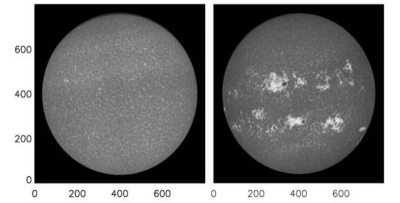
Scientists from the Indian Institute of Astrophysics (IIA) recently analyzed a century-old digital database from the Kodaikanal Solar Observatory (KSO) to study the Sun’s supergranulation patterns. By examining over 34,000 archival Calcium II K (Ca II K) spectral line images spanning from 1907 to 2007, the researchers established a direct relationship between supergranular features and the 11-year solar cycle. The study reveals that supergranular lane widths and intensities vary in tandem with sunspot numbers, offering critical insights into solar magnetic fields and surface convection behavior over long timescales.
Understanding Supergranulation and Solar Cycles
Solar Convection and Supergranules
The solar surface features convective cells driven by the upward movement of hot plasma. Supergranules are large-scale convective structures on the solar photosphere, typically measuring between 30,000 to 35,000 kilometers in diameter. They form a network across the Sun, with lifetimes ranging from 20 to 48 hours. The boundaries of these cells, known as lanes, accumulate concentrated magnetic fields.
The 11-Year Solar Cycle
The solar cycle is a periodic variation in solar activity driven by the Sun’s internal magnetic dynamo. Approximately every 11 years, the Sun’s magnetic field completely flips, causing the north and south poles to switch places. This cycle influences the frequency of sunspots, solar flares, and coronal mass ejections.
Key Findings of the KSO Study
Latitude-Dependent Correlations
The study found that the physical characteristics of supergranular cells change according to latitude. The widths and brightness intensities of the cell lanes show a strong positive correlation with sunspot numbers. These variations peak at specific solar latitudes and exhibit distinct time lags relative to the solar maximum, which is the period of highest activity in the solar cycle.
Impact on Solar Physics
The research provides observational evidence of how magnetic flux interacts with solar surface convection. It helps scientists understand how magnetic field networks modify the structure of the solar atmosphere, which helps improve long-term predictions of solar cycles and variations in total solar irradiance.
Kodaikanal Solar Observatory (KSO) Overview
History and Establishment
KSO is located in the Palani Hills of Tamil Nadu and is operated by the Indian Institute of Astrophysics. It was established in 1899 and began continuous solar observations in 1901. The observatory was set up following the severe Great Famine of 1876–1878 to study the relationship between solar activity and monsoon patterns in India.
Core Instruments and Data Legacy
The observatory houses a unique repository of solar data captured through multiple wavelengths.
| Instrument / Data Type | Spectral Line / Wavelength | Scientific Purpose |
| H-alpha Telescope | Hydrogen-alpha (656.3 nm) | Observes solar flares, filaments, and prominences in the chromosphere. |
| Twin Spectroheliograph | Calcium II K (393.4 nm) & H-alpha | Records calcium plages and chromospheric networks. |
| White-light Photograph | Broadband visible light | Tracks sunspot numbers, areas, and heliographic positions. |
IASPOINT Booster Facts for UPSC
- Evershed Effect: Discovered at KSO by John Evershed in 1909, this phenomenon involves the radial outward flow of gas across the sunspot penumbra (the outer lighter part of a sunspot) parallel to the solar surface.
- Calcium II K Line: This specific violet spectral line corresponds to singly ionized calcium. It is used to image the solar chromosphere because it highlights regions with strong magnetic field concentrations, known as plages.
- Aditya-L1 Connection: Ground-based long-term data from KSO complements space-based observations from India’s Aditya-L1 mission, specifically validating data from the Solar Ultraviolet Imaging Telescope (SUIT) and the Visible Emission Line Coronagraph (VELC).
- Babcock Model: This theory explains the solar cycle as a mechanism where the Sun’s differential rotation winds up magnetic field lines beneath the surface, creating buoyant magnetic loops that emerge as sunspots.