
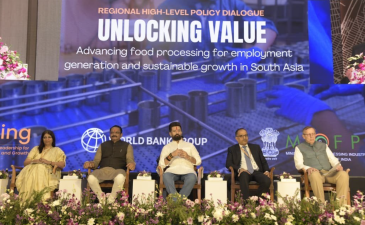
On June 9, 2026, the Ministry of Food Processing Industries (MoFPI), Government of India, in collaboration with the World Bank-led SAPLING initiative, inaugurated the Regional High-Level Policy Dialogue in Ahmedabad, Gujarat. The international forum focused on advancing the food processing sector to drive employment and sustainable economic growth across South Asia. The event brought together approximately 200 stakeholders from various South Asian nations to discuss institutional infrastructure, technology adoption, and cross-border regional cooperation. A key highlight was the release of a comprehensive report detailing India’s progress in food processing efficiency and outlining strategic recommendations to boost value addition in perishable commodities.
Core Objectives and Institutional Framework
The dialogue serves as a collaborative platform to harmonize agricultural and processing policies across the South Asian sub-continent.
The SAPLING Initiative and AgriConnect
The Sustainable Agricultural Production and Livelihoods Innovative Group (SAPLING) is a World Bank-led framework. It aligns with the World Bank’s broader AgriConnect initiative, which seeks to establish resilient, nutrition-focused food systems. The primary goals include:
- Enhancing smallholder farmer incomes through direct market integration.
- Minimizing post-harvest losses via localized processing clusters.
- Generating rural non-farm employment by scaling up agro-processing enterprises.
Regional Stakeholder Engagement
The Ahmedabad dialogue gathered policy makers, agronomists, private food tech enterprises, and cooperative leaders from across South Asia. The discussions centered on creating a unified regional ecosystem capable of handling supply chain disruptions, standardizing phytosanitary regulations, and promoting cross-border trade in processed food products.
India’s Food Processing Trajectory and Empirical Growth
The high-level policy document released during the event highlighted India’s structural shift from primary production to secondary agricultural processing over the last decade.
Surge in Processing Levels
According to the report, India’s overall food processing level experienced a major upward shift:
- Processing Level in 2016: 10%
- Processing Level in 2023: 17%
This statistical growth indicates a steady transition toward reduced food wastage and higher value addition, though it remains lower than global benchmarks of 60% to 70% seen in developed economies.
Focus on Perishable Commodities
The report emphasized that the next phase of growth lies in tapping the vast potential of perishables, specifically horticulture, dairy, marine, and poultry products. It recommended targeted policy interventions to scale up integrated cold chains, mega food parks, and decentralized primary processing centers near farm gates to sustain this momentum.
Key Focus Areas of the South Asia Food Processing Roadmap
| Dimension | Strategic Interventions Discussed | Target Outcomes |
| Technology Adoption | Automation, IoT-enabled cold chain tracking, advanced packaging. | Extension of shelf-life and reduction in transit spoilage. |
| Financial Credit | Tailored lending models for Micro and Small Agro-processing Enterprises. | Faster formalization of the unorganized food processing sector. |
| Nutrition Focus | Bio-fortification processing and clean-label food manufacturing. | Addressing regional malnutrition and hidden hunger challenges. |
| Regional Logistics | Harmonized trade corridors and cross-border customs ease for agri-products. | Smooth intra-regional food supply chains in South Asia. |
IASPOINT Booster Facts for UPSC
- Ministry of Food Processing Industries (MoFPI): A ministry of the Government of India responsible for formulating and administering the rules, regulations, and laws relating to food processing in India.
- Pradhan Mantri Kisan SAMPADA Yojana (PMKSY): A comprehensive central sector umbrella scheme of MoFPI aimed at creating modern infrastructure with efficient supply chain management from farm gate to retail outlet. It includes sub-schemes like Mega Food Parks, Integrated Cold Chain, and Agro-Processing Clusters.
- PM Formalisation of Micro Food Processing Enterprises (PMFME) Scheme: Launched under the Atmanirbhar Bharat Abhiyan, it provides financial, technical, and business support for the upgradation of micro food processing enterprises using the One District One Product (ODOP) approach.
- 100% FDI Allowance: India permits 100% Foreign Direct Investment (FDI) under the automatic route in food processing industries, and 100% FDI under the government-approved route for trading, including through e-commerce, in respect of food products manufactured or produced in India.
- The World Bank Group: An international financial institution that provides loans and grants to the governments of low- and middle-income countries for pursuing capital projects. It consists of five institutions, including the IBRD and IDA.