
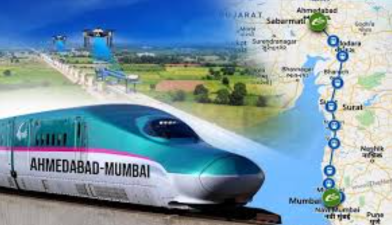
The MAHSR project is India’s first high-speed rail corridor, spanning 508 km across Gujarat (348 km), Maharashtra (156 km), and Dadra and Nagar Haveli (4 km). It connects 12 stations and reduces travel time to under two hours at operational speeds of 320 km/h using Japanese Shinkansen technology.
Technical and Infrastructure Highlights
- Viaducts & Tracks: Nearly 90% of the corridor is elevated, utilizing the Full Span Launching Method for the first time in India alongside J-Slab Ballastless Tracks.
- Undersea Tunneling: Includes a 21 km tunnel section in Maharashtra, featuring a 7 km undersea rail stretch beneath Thane Creek.
- Safety Systems: Features an automated Early Earthquake Detection System (28 seismometers) that triggers emergency braking, plus rainfall and wind monitoring systems.
- Expansion Blueprint: Serves as the model for 7 new high-speed rail corridors (4,000 km) planned under the Union Budget 2026–27’s ₹2.93 trillion railway capex.
IASPOINT Booster Facts
- Implementing Agency: Executed by the National High Speed Rail Corporation Limited (NHSRCL), a joint venture of the Central and State Governments.
- Funding: Japan International Cooperation Agency (JICA) funds 81% of the project via a soft loan at 0.1% interest with a 50-year moratorium.
- First Target: The initial section between Surat and Bilimora (Gujarat) is targeted to launch by August 2027.
- Kavach System: Separate from Shinkansen, a ₹1,20,000 crore budget allocation was made for the indigenous Kavach Automatic Train Protection system on conventional networks.
- Freight Connectivity: The 2026–27 budget announced a new Dedicated Freight Corridor linking Dankuni (West Bengal) to Surat (Gujarat).