
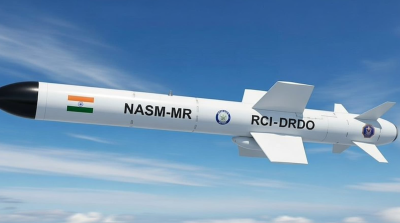
The Defence Research and Development Organisation (DRDO) successfully conducted three consecutive flight tests from the Integrated Test Range (ITR) off the Odisha coast. These trials validated India’s advanced Phase-II Ballistic Missile Defence (BMD) architecture and the maiden flight of the indigenous Naval Anti-Ship Missile-Medium Range (NASM-MR), significantly bolstering national strategic deterrence.
Key Developments
- Multi-Layered Ballistic Missile Defence (BMD): Utilising the AD-1 (Endo-atmospheric) and AD-2 (Exo-atmospheric) interceptors, the tests successfully neutralized target missiles mimicking hostile ballistic threats. This capability places India in an elite group of nations capable of engaging threats up to the Intercontinental Ballistic Missile (ICBM) class.
- NASM-MR: An all-weather, over-the-horizon, subsonic anti-ship cruise missile. It features sea-skimming capabilities (5–10 meters altitude) and advanced terminal guidance to evade enemy radar, designed to replace ageing foreign maritime strike systems.
NASM-MR Technical Specifications
- Operational Range: Approximately 350 km.
- Propulsion: Solid-fuel booster paired with a turbofan engine.
- Flight Profile: Subsonic cruise at roughly Mach 0.9.
- Versatility: Compatible with platforms like the MiG-29K, warships, and submarines.
IASPOINT Booster Facts
- Phase-II BMD: Optimized for hypersonic speeds (Mach 6–7) to counter long-range and ICBM threats.
- Indigenous Ecosystem: Developed by DRDO laboratories (RCI, DRDL, HEMRL) with production supported by domestic MSMEs and private aerospace partners.
- Strategic Milestone: These tests validate India’s ability to defend against multi-vector threats, from sea-skimming anti-ship missiles to exo-atmospheric ballistic strikes.
- Operational Context: During the trials, over 11,000 residents were relocated from the ITR vicinity as a standard safety protocol.