
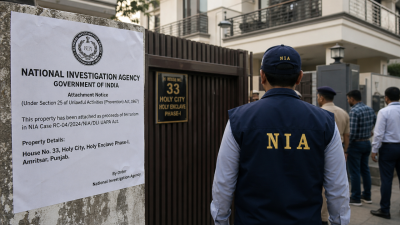
The NIA attached a residential property in Amritsar as “proceeds of terrorism” under UAPA on 16 June 2026. The property is registered in the name of the father of accused Ankush Kapoor, alleged to be a key operative in a transnational narco‑terror network linked to LeT and multiple countries.
What is the current issue?
A transnational narco‑terror network under NIA probe uses narcotics trafficking to generate and launder funds for terrorist activity in India. The agency has attached House No. 33, Holy City, Holy Enclave Phase‑I, Amritsar, registered to the father of accused Ankush Kapoor, who allegedly coordinated smuggling, storage, distribution and laundering.
Why it matters
Narco‑terrorism combines organised crime and terrorism. It undermines border security, finances violent groups, corrodes institutions through corruption, and aggravates public health and social problems in affected regions. The Amritsar action links drug proceeds directly to terror financing and shows the need for law enforcement, financial counter‑measures and international cooperation.
Definition and nature
Definition: Narco‑terrorism denotes the nexus where proceeds from narcotics trade are used to finance terrorist violence, logistics and recruitment. Features: transnational supply chains; use of front companies and informal value transfer systems; overlap of criminal and terrorist networks; exploitation of porous land and maritime borders.
Threats to internal security
- Financing violence: Drug profits allegedly channelled to terrorist groups to procure arms, pay cadres and sustain operations.
- Border destabilisation: Smuggling routes across the Golden Crescent and Golden Triangle facilitate infiltration and logistics for violent actors.
- Local impact: Addiction, crime and loss of state authority in affected districts; recruitment of vulnerable youth.
- Institutional corruption: High illicit profits create risks of corruption within enforcement and administrative structures.
Legal and institutional framework
UAPA: Provides power to designate offences and attach property as proceeds of terrorism. The Amritsar attachment was executed under UAPA. NIA: Central agency for terrorism investigations with power to investigate inter‑state and transnational cases. NIA has arrested Ankush Kapoor and chargesheeted 26 accused in this case. Other agencies: Narcotics Control Bureau (NCB), Directorate of Revenue Intelligence (DRI), Enforcement Directorate (ED), Financial Intelligence Unit‑India (FIU‑IND), state police forces and customs.
| Agency | Primary role |
|---|---|
| NIA | Investigation and prosecution of terror offences; attachment of proceeds under UAPA |
| NCB | Intelligence and interdiction on drug trafficking |
| ED | Investigation of money‑laundering and asset tracing |
| FIU‑IND | Financial intelligence, suspicious transaction reporting |
| Customs/DRI | Interdiction at ports and borders |
Transnational dimensions and international cooperation
The network under investigation reportedly spans Italy, Australia, Iran, Thailand, UAE and Pakistan. Investigations indicate links between Kapoor and a Dubai‑based accused connected to Lashkar‑e‑Taiba. Countering such networks requires mutual legal assistance, extradition, intelligence exchange, joint operations and coordination through UN conventions (e.g., UNTOC) and multilateral fora such as UNODC and FATF mechanisms.
Financing mechanisms and modus operandi
- Revenue generation: Smuggling, storage, transportation and distribution of narcotic substances.
- Layering and integration: Use of cash couriers, hawala, trade mis‑invoicing, front companies and informal networks to launder proceeds.
- Channel to terror: Laundered proceeds diverted to pay operatives, procure materials, and sustain terror infrastructure within India.
- Technologies used: Use of complex value‑transfer mechanisms; increasing use of cryptocurrencies and dark‑market platforms (monitoring required).
Operational and policy challenges
- Jurisdictional gaps: Differing laws, capacities and priorities among foreign partners impede swift action.
- Detection difficulty: Cash‑intensive crimes and informal transfer systems evade conventional financial controls.
- Resource constraints: Need for specialised investigators, forensic labs and cyber capabilities.
- Corruption and local protection: Financial inducements can blunt enforcement at tactical levels.
- Community silence: Stigma and fear reduce local cooperation for intelligence gathering.
Way forward — practical measures
- Strengthen intelligence fusion: Enhance coordination centres that combine NIA, NCB, ED, FIU‑IND, customs and state police intelligence.
- Financial counter‑measures: Improve STR/CTR compliance, target hawala networks, fast‑track asset confiscation and use UAPA provisions to attach proceeds promptly.
- Border and maritime control: Deploy layered surveillance, increase coastal security assets, use technological sensors and risk‑based cargo screening.
- International cooperation: Negotiate MLATs, extradition protocols, joint investigation teams, and bilateral intelligence‑sharing with countries identified in probes.
- Capacity building: Expand training in narcotics forensics, financial investigations, cryptocurrency analysis, and cross‑border case management.
- Community measures: Public health responses to addiction, demand reduction, and local witness protection to improve reporting.
- Legal calibration: Periodic review of statutory tools and procedural speed for attachment, prosecution and mutual legal assistance.
Model Questions
- Discuss the multi‑faceted threat posed by narco‑terrorism to India’s internal security, with reference to recent developments. [GS‑III: Internal & External Security]
- Examine the efficacy of UAPA and NIA in tackling transnational narco‑terror networks in India. [GS‑II: Governance]
- The transnational nature of narco‑terror networks necessitates international cooperation. Analyse the challenges and recommend measures for effective global collaboration. [GS‑II: International Relations]
- Analyse financial mechanisms used by narco‑terror networks and suggest measures to disrupt them in the Indian context. [GS‑III: Economic Development]
Narco‑terrorism funds violent actors, weakens border control and fuels local criminality. It enables procurement of arms, sustains cadres and corrupts institutions. The Amritsar case shows drug proceeds linked to LeT‑connected actors and transnational networks spanning several countries. Response requires interdiction of supply chains, financial disruption, strengthened policing and community engagement to reduce demand and improve local intelligence.
UAPA permits designation of offences and attachment of proceeds, as in the recent Amritsar attachment. NIA centralises complex investigations across states and internationally. Strengths include specialised powers and prosecutorial reach. Gaps include procedural delays in asset forfeiture, need for faster MLATs, and greater coordination with agencies such as NCB, ED and FIU‑IND. Enhanced inter‑agency protocols and capacity building are required.
Challenges include divergent laws, slow MLATs, extradition hurdles and different enforcement capacities. Political sensitivities and uncooperative jurisdictions complicate action. Measures: negotiate expedited MLATs and extradition terms, form joint investigation teams, share financial intelligence via FIUs, coordinate through UNODC/FATF frameworks, and pursue bilateral law‑enforcement agreements with countries identified in probes.
Mechanisms include cash smuggling, hawala, trade mis‑invoicing, front companies and layering of funds, plus use of cryptocurrencies. Disruption requires stronger AML/CFT systems, improved STR analysis by FIU‑IND, hard asset confiscation under UAPA/MLA laws, targeted action on hawala operators, tighter scrutiny of remittances and enhanced cooperation with international financial regulators.