
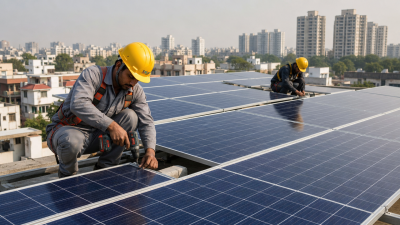
India’s rooftop solar capacity has surged to 25.7 GW, with 2.7 GW added in Q1 2026. Growth is heavily concentrated: Gujarat (6,882 MW) and Maharashtra (5,442 MW) together account for nearly half the capacity, exposing regional imbalances and governance challenges for national decarbonisation targets.
What is the issue?
Current status
- Scale: Cumulative rooftop capacity 25.7 GW; Q1 2026 additions 2.7 GW (125% YoY).
- State leaders: Gujarat 6,882 MW, Maharashtra 5,442 MW, Rajasthan 2,090 MW, Kerala 1,850 MW.
- Scheme impact: PM Surya Ghar Muft Bijli Yojana (residential subsidy up to Rs 78,000, target 1 crore homes) accounted for 82% of Q1 residential growth; new registrations paused from 6 June 2026.
- Policy change: Domestic Content Requirement (DCR) mandated for rooftop projects from 1 June 2026.
Why it matters
- Environment: Rooftop solar is essential for delivering NDC 3.0 commitments — 47% reduction in emissions intensity of GDP and 60% non-fossil capacity by 2035.
- Energy security: Decentralised generation reduces peak demand on DISCOMs and lowers import dependence when coupled with domestic manufacturing.
- Economy and jobs: DCR aims to expand domestic module production and create employment in manufacturing and installation.
- Governance: Uneven implementation reveals state capacity gaps and requires better inter-agency coordination.
Drivers of recent growth
- Central subsidy: PM Surya Ghar lowered upfront cost for households and triggered rapid residential uptake.
- Market readiness: States with mature installer networks, active financing channels and faster DISCOM approvals recorded faster deployment.
- Private demand: Commercial and industrial consumers continue to install rooftop systems for cost savings and CSR commitments.
Regional disparity — causes and evidence
- Leading states: Gujarat and Maharashtra benefit from established installer ecosystems, easier project finance, standardised processes and proactive DISCOM support.
- Lagging states: Eastern and north-eastern states face weak DISCOM capacity, limited financing options, low consumer awareness, and administrative delays despite good solar resource.
- Operational bottlenecks: Example — over 3,500 PM Surya Ghar applications pending in Tamil Nadu (many stalled >15 days) due to consumer inaction and staff shortages.
- Quarterly pattern: Q1 2026 top contributors by state share were Maharashtra (17%), Uttar Pradesh (16%), Gujarat (15%).
Policy and regulatory framework
- PM Surya Ghar Muft Bijli Yojana: Fiscal subsidy for residential rooftop systems has driven household adoption but faces implementation delays and a temporary registration freeze.
- DCR mandate: From 1 June 2026 DCR requires domestic modules for rooftop projects, intended to grow domestic manufacturing and reduce import dependence.
- National targets: NDC 3.0 (approved March 2026) makes rooftop deployment a contributor to non-fossil capacity and emissions-intensity goals.
- State regulations: Net-metering, simplified approval timelines and tariff design vary by state and shape local uptake.
Implementation challenges
- DISCOM capacity: Slow approvals, staffing gaps and lack of standard procedures create delays and discourage consumers.
- Finance: Limited access to affordable credit in poorer states and upfront cost barriers for low-income households.
- Consumer-side: Low awareness, reluctance to proceed after registration, and concerns about maintenance and product quality.
- Supply-side: Installer shortages in lagging regions and transition issues after DCR introduction.
- Integration: Need for household-level storage and grid-interactive solutions to maximise self-consumption and grid stability.
Institutional roles and governance
- Central ministries: MNRE sets policy, implements schemes and monitors targets.
- State governments: Design state-level norms, enable DISCOM processes and run awareness drives.
- DISCOMs: Approve connections, implement net-metering and manage technical interconnection — their efficiency is decisive.
- Local bodies and financial institutions: Mobilise community outreach and provide last-mile finance; role increases in remote areas.
| Challenge | Policy response / Measure |
|---|---|
| Regional capacity gaps in DISCOMs | Standardise and time-bound approval processes; central support for staff training; performance-linked grants. |
| Financing for low-income households | Targeted credit lines, credit guarantees, on-bill financing and pay-as-you-go models; link with Jan-Dhan or SHG channels. |
| Consumer awareness and trust | Mass outreach campaigns, standard consumer contracts, warranty enforcement and a single-window grievance portal. |
| Supply bottlenecks after DCR | Phased DCR enforcement, production-linked incentives for domestic manufacturers, and logistics support for installers in remote states. |
| Grid integration and storage needs | Promote household and community storage subsidies; tariff reform to encourage self-consumption; pilot V2G and aggregation models. |
Way forward — targeted measures
- Regional strategy: Central scheme funds tied to state performance and specific targets for eastern and north-eastern states.
- Capacity building: Training for DISCOM staff and local installers; deploy technical assistance teams for scheme rollout.
- Finance innovation: Use credit guarantees, microfinance, and PAYG models to bridge upfront cost barriers.
- Operational standardisation: Uniform application templates, maximum processing timelines and digital tracking of installations.
- Manufacturing-policy alignment: Combine DCR with incentives for cell/module manufacturing, while managing near-term supply risks.
- Monitoring and evaluation: Real-time dashboards, independent audits and periodic state-level reviews to correct course.
Model Questions
1. Analyse the factors contributing to India’s lopsided rooftop solar growth and explain policy measures to ensure equitable adoption across states. [GS-III: Economic Development]
India’s disparity stems from mature installer networks, easier finance, proactive DISCOM procedures and consumer awareness in leading states versus weak DISCOMs, limited credit and low awareness in eastern/north-eastern regions. Policy measures: time-bound standard approvals, targeted subsidies and credit lines for lagging states, capacity building for installers and DISCOM staff, digital single-window approvals, and outcome-linked central funding to incentivise state performance.
2. Critically evaluate the impact of the PM Surya Ghar Muft Bijli Yojana on rooftop solar expansion and identify implementation bottlenecks with corrective steps. [GS-II: Governance]
The scheme accelerated residential uptake and delivered 82% of Q1 residential additions by lowering upfront costs. Bottlenecks: application backlogs, consumer dropout, staff shortages and registration pause. Corrective steps: restart registrations with capacity expansion, digital tracking, on-ground consumer facilitation, training for DISCOM staff, streamlined vendor on-boarding and clearer timelines for approvals and installations.
3. Discuss how widespread rooftop solar adoption supports India’s NDC 3.0 targets and assess the role of the Domestic Content Requirement (DCR) in that context. [GS-III: Environment & DM]
Rooftop solar decentralises generation, reduces fossil-based electricity demand and contributes to non-fossil capacity targets under NDC 3.0, aiding emissions-intensity reduction. DCR aims to build domestic manufacturing, reducing import dependence and creating jobs. Trade-offs: short-term supply constraints and cost pressures. Policy must pair DCR with production incentives, phased implementation and support for logistics and quality standards.
4. Examine the role of state-level governance and institutional mechanisms in rooftop solar deployment. How should stakeholders coordinate for effective implementation? [GS-II: Governance]
State governance determines approval speed, net-metering rules and outreach. Effective deployment requires DISCOM capacity, state energy departments, local bodies, financiers and installers to coordinate. Mechanisms: inter-departmental task forces, single-window portals, state performance metrics, capacity building programmes, and central technical assistance teams. Regular monitoring and grievance redressal are essential for timely course correction.
Last Modified: June 24, 2026