
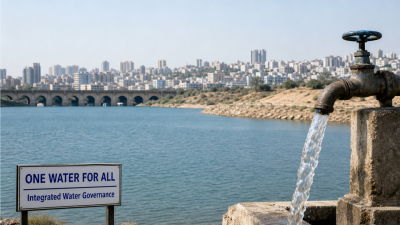
India is experiencing acute water stress across cities, farms and forests due to monsoon deficits and an intensifying El Niño. Urban rationing in Mumbai and Pune, rising groundwater extraction in forest areas, and a skewed funding profile for water infrastructure make integrated governance urgent for livelihoods, biodiversity and resilience.
What is the issue
A “One Water for All” approach proposes unified water governance across urban, rural and forest landscapes. It seeks to manage water on hydrological — not administrative — boundaries through watershed restoration, catchment engineering and coordinated policy, finance and operations.
Why it matters
- Governance: Sectoral silos (urban, rural, forest) impede coherent planning and disaster response.
- Economy: Water scarcity disrupts agriculture, industry and urban services; limits growth and increases costs.
- Society: Tribal and forest-dependent communities face service gaps and increased conflict over resources.
- Environment: Forest ecosystems and biodiversity decline when hydrology is altered by over‑extraction.
- Security: Human–wildlife conflict and interstate tensions can rise where resources are scarce.
- International relations: Global forums stress implementation, finance and cross‑border basin governance lessons.
Current status: crisis, schemes and funding
Crisis signals: Urban centres report emergency measures — reservoir shortfalls, water bans and rationing. Forest areas see rising groundwater extraction after agricultural modernisation under forest land rights rules. Disaster funding currently excludes designated wildlife areas, compelling forest departments to finance emergency water supplies.
| Scheme / Instrument | Primary focus | Approx. central funding share | Gap |
|---|---|---|---|
| Jal Jeevan Mission | Rural drinking water | Major (part of 65–70% rural allocation) | Limited focus on catchment/forest hydrology |
| PMKSY (Per Drop More) | Agricultural irrigation | Included in rural allocation | Promotes modernisation without integrated catchment limits |
| AMRUT 2.0 | Urban water management | 20–25% urban allocation | City‑centric; weak upstream/forest linkages |
Forest and tribal gap
- Forest areas and tribal populations receive minimal eco‑budget allocations.
- Rule 16 implementation under the Forest Rights Act has enabled agricultural upgrades on forestlands, increasing extraction pressure.
- NDMA guidelines exclude wildlife areas from NDRF/SDRF relief, creating an institutional blind spot for drought response in forests.
Core tenets of the One Water for All framework
- Hydrological planning: Plan by catchment/basin rather than by administrative boundary.
- Integrated governance: Shared mandates among Jal Shakti, environment/forest agencies, state governments and local bodies.
- Equitable finance: Rebalance funding to include forests and tribal communities.
- Nature‑based solutions: Prioritise ecological restoration and watershed health.
- Demand management: Supply augmentation plus behavioural and allocation reforms.
Smart water management: techniques and technologies
- Catchment engineering: Small check dams, contour bunding, recharge trenches and managed aquifer recharge to restore groundwater‑surface water connectivity.
- Rainwater harvesting and storage: Household, community and landscape scale systems in urban, rural and forest settings.
- Rotational pumping: Scheduled extraction regimes to allow aquifer recovery, especially near forest zones.
- Decentralised treatment and reuse: Urban reuse for non‑potable needs to reduce freshwater demand.
- Digital tools: Remote sensing, GIS, IoT sensors and data analytics for basin monitoring, allocation and early warning.
- Nature‑based restoration: Afforestation with native species, wetland rehabilitation and floodplain reconnection.
Institutional and legal reforms required
- Unified coordinating mechanism: State‑level basin authorities or inter‑state/landscape bodies with clear mandates and funding lines.
- Policy revision: Amend disaster finance rules to include wildlife and forest water needs; revise incentives that encourage over‑extraction in forest areas.
- Financing instruments: Create blended finance windows, water resilience funds, use climate finance and MDB loans for integrated projects.
- Capacity and data: Strengthen state forest departments and local bodies for water interventions; invest in hydrological data systems.
- Rights and participation: Institutionalise community and tribal participation in planning and benefit‑sharing.
Implementation challenges
- Administrative fragmentation: Multiple ministries and departments with overlapping mandates.
- Funding bias: Current allocation favours rural and urban infrastructure; forest catchments remain underfunded.
- Operational capacity: Limited technical staff in forest and local bodies for catchment engineering and monitoring.
- Conflicting objectives: Agricultural intensification in forests versus conservation and groundwater sustainability.
- Data gaps: Incomplete basin‑level water accounting and austere real‑time monitoring.
- Finance shortfall: Investment needs for resilience exceed available public and private finance.
International context and best practices
- From international forums: Global meetings call for a shift from dialogue to implementation and for unlocking investment for water resilience.
- Basin governance lessons: Mekong discussions show the need to combine environmental justice with technical water allocation for dependent communities.
- Implementation points: Use of blended finance, transboundary cooperation mechanisms, technology transfer for monitoring and community‑centred restoration models.
- SDG progress: Global reports indicate slow progress on many water targets; India must support measurable, time‑bound integrated projects to meet commitments.
Way forward: prioritized actions
- Reform finance allocation: Mandate a percentage of water programme funds for catchment and forest interventions; create a dedicated Forest Water Resilience Fund.
- Create basin authorities: Legally empower multi‑stakeholder basin bodies to plan allocations, investments and emergency measures.
- Include wildlife areas in disaster funds: Amend NDMA/NDRF/SDRF guidelines to finance drought relief in forest landscapes.
- Scale smart technologies: National roll‑out of remote sensing, IoT sensors and decision support systems for water accounting.
- Adopt rotational pumping rules: Regulate groundwater extraction near forests through permits and community oversight.
- Mobilise finance: Use climate and MDB funds, green bonds and private capital for integrated projects with measurable ecological outcomes.
- Community engagement: Formalise co‑management with tribal and local communities, tie benefits to restoration outcomes.
Model Questions
1. Critically analyse the necessity and challenges of implementing a “One Water for All” integrated water governance approach in India. [GS-III: Environment & DM]
One Water is necessary to manage water by hydrological boundaries, protect forest catchments, reduce urban–rural conflicts and enhance resilience to monsoon deficits and El Niño. Challenges include administrative fragmentation, funding bias favouring rural/urban infrastructure, weak capacity in forest departments, legal gaps (disaster funds excluding wildlife areas), data deficits and a need for blended finance and community participation for equitable, sustainable outcomes.
2. Examine whether current Indian water resource schemes adequately address the water crisis and the implications for tribal populations and forest ecosystems. [GS-II: Governance]
Major schemes (Jal Jeevan Mission, PMKSY, AMRUT 2.0) concentrate funding on rural and urban infrastructure (approx. 65–70% and 20–25% respectively). They insufficiently address forest catchments and tribal needs. Consequences include increased groundwater extraction in forest areas, exclusion from disaster relief, rising human–wildlife conflict and ecological degradation. Governance reforms and earmarked funding for forests and tribal communities are required.
3. Discuss the role of “smart” water management in enhancing India’s water resilience. Suggest technological and ecological interventions. [GS-III: Science & Technology]
Smart management reduces reliance on continuous groundwater pumping via catchment engineering, managed aquifer recharge, rainwater harvesting and rotational pumping. Technology inputs include remote sensing, IoT sensors, GIS and data analytics for basin accounting and demand management. Ecological measures include wetland restoration, native afforestation and floodplain reconnection. Combined, these lower extraction, improve storage, and enable evidence‑based allocation and early warning.
4. How can international cooperation and best practices inform India’s “One Water for All” strategy? [GS-II: International Relations]
International forums stress moving from dialogue to implementation, basin‑level governance, environmental justice and finance mobilisation. India can adopt blended finance models, technology transfer for monitoring, institutional designs for basin authorities, and community‑centred restoration lessons from Mekong dialogues. Participation in global platforms enables access to climate finance, technical partnerships and proven project structures for scaling integrated water resilience.
Last Modified: July 1, 2026