
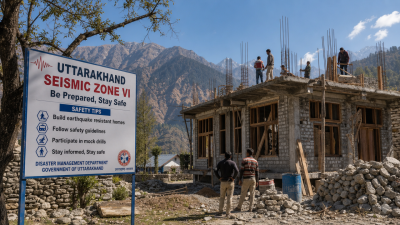
Uttarakhand has been classified as Seismic Zone VI under the 2025 Wadia Institute–BIS map. Recent seismic activity, expansion of warning networks and state-wide drills have made earthquake risk and preparedness urgent governance and development issues for the Himalayan region.
What is the issue and why it matters
Uttarakhand faces elevated seismic hazard due to plate convergence beneath the Himalaya. The Zone VI classification affects land use, infrastructure planning, hydropower and tourism projects, housing policy and disaster budgeting. Higher seismic risk raises potential for large human and economic losses, long-term displacement, ecological disturbance and inter-state resource management challenges.
Geodynamic factors and seismic zoning
Plate and fault mechanics
The Indian Plate continues to under-thrust the Eurasian Plate along active thrust systems. Stress accumulation in the Himalayan hinterland increases the probability of large earthquakes. Local faults, slope instability and seismic amplification on weak soils raise exposure in valley and piedmont settlements.
Seismic zoning change
Wadia–BIS map: The 2025 seismic zoning reclassified the entire state as Zone VI. Recent seismicity: India recorded 704 earthquakes by 30 June 2026, concentrated in Himalayan and north-eastern regions. A magnitude 2.9 quake was recorded near Uttarakhand on 1 July 2026. These trends require revised risk assessments and regulatory responses.
Implications for regional development and environmental sustainability
- Land-use and planning: Restrict development on unstable slopes and river terraces; map microzonation for towns and critical infrastructure.
- Infrastructure projects: Reassess siting and design of hydropower, roads and bridges; require independent seismic safety clearances for large projects.
- Housing and urbanisation: Enforce seismic-compliant construction in urban expansion zones; prioritise retrofitting of schools, hospitals and lifeline structures.
- Ecology and hazard interaction: Account for earthquake-triggered landslides, glacial lake outburst floods (GLOFs) and sediment mobilisaton in environmental impact assessment.
- Economic resilience: Factor in higher contingency funds, insurance schemes and phased investment to reduce post-disaster fiscal shock.
Current preparedness and mitigation measures
- Early warning and sensors: IIT Roorkee developed the BhuDEV earthquake early warning app. State plans to expand sensors from 169 to 500 under the EEWS and National Earthquake Risk Mitigation Programme at a cost of ₹153.44 crore.
- Mock drills and capacity building: The state conducted a mock drill across 66 locations in all 13 districts. Mussoorie ran a landslide simulation on a key road to prepare for monsoon hazards.
- Resilient housing: Construction of 1,872 earthquake-resistant houses is underway in Bagwala, Rudrapur, Udham Singh Nagar under the Prime Minister’s Urban Housing Scheme.
- Regulatory update: A 14-member expert committee, chaired by R Pradeep Kumar (Director, CSIR-CBRI Roorkee), is reviewing state building bylaws to incorporate earthquake-resistant and climate-responsive designs.
- Technical advisories: Experts recommend construction on solid ground, avoidance of unstable soil, and use of traditional Himalayan techniques where suitable.
Role of science, technology and traditional knowledge
Modern systems
Early warning systems (EEWS) combine seismic sensors, rapid signal processing and alert distribution. BhuDEV aims to deliver rapid alerts to residents. Expanded sensor density reduces detection-to-alert latency and improves location accuracy. Scientific hazard mapping and microzonation inform design spectra for codes.
Traditional methods and hybrid design
Local techniques such as Kath-Kuni and Dhajji-Dewari offer ductility and use of local materials. These methods perform well under lateral loads when executed properly. Hybrid solutions pair engineered seismic details (ductile connections, reinforcements) with traditional layouts to retain cultural and material advantages.
Implementation needs
Training for engineers, masons and local governments. Standardised guidelines for hybrid construction. Integration of EEWS with municipal emergency response plans and public alert protocols.
Institutional and policy reforms
- Building code enforcement: Make revised bylaws mandatory at municipal and panchayat level; link approvals to geotechnical clearance.
- Retrofitting policy: Prioritise schools, hospitals, bridges and power substations; provide financial incentives and technical support.
- Funding and insurance: Create dedicated disaster resilience funds and promote disaster insurance for households and infrastructure.
- Inter-departmental coordination: Establish joint cell for seismic risk in state disaster management authority to coordinate urban development, environment and infrastructure agencies.
- Community engagement: Scale community-based preparedness, local hazard mapping and volunteer responder training.
Challenges and operational priorities
| Challenge | Operational priority / Way forward |
|---|---|
| Enforcement gaps for building rules | Strengthen local approval processes; build vetting capacity in municipalities; digital permit tracking. |
| Retrofitting cost and logistics | Phased retrofitting, public‑private financing, grants for critical public buildings. |
| Technical skill shortage | Training programmes for masons, architects and engineers; curricula in polytechnics and professional bodies. |
| Hazard interaction (earthquake + landslide/GLOF) | Integrate multi-hazard assessment into project approvals and land-use plans; maintain hazard buffers. |
| Public awareness and trust in warnings | Regular drills, clear alert hierarchies, multi-channel dissemination including local languages. |
National perspective and scalable measures
Policy responses in Uttarakhand should feed into a national framework: pan-India microzonation for Himalayan and north-eastern belts; harmonised building standards reflecting new hazard levels; accelerated EEWS deployment; regional data-sharing mechanisms; conditional central financing for resilient infrastructure; and cross-state drills and mutual aid pacts for surge response.
Model Questions
1. Analyse the geodynamic drivers behind Uttarakhand’s reclassification to Seismic Zone VI and discuss the implications for regional development and environmental sustainability. [GS-III: Environment & DM]
A concise answer should note Indian Plate underthrusting of the Eurasian Plate and active thrusts causing stress accumulation; include increased seismicity data. Discuss land‑use reform, stricter siting and design norms for hydropower and transport, retrofitting priority for lifeline structures, integration of ecological assessments to address landslides and GLOFs, and fiscal planning for resilience and phased development.
2. Assess the efficacy of Uttarakhand’s disaster preparedness measures and identify institutional and policy reforms to improve earthquake risk reduction. [GS-II: Governance]
Evaluate mock drills across 66 locations, Mussoorie landslide exercise, BhuDEV and sensor expansion plans, and housing under PM scheme. Recommend stronger bylaw enforcement, municipal technical capacity, dedicated financing for retrofitting, local-level preparedness cells, legal linkage of approvals to geotechnical clearance, and community training to close response gaps.
3. Examine how science, technology and traditional Himalayan construction methods can be combined to build earthquake-resilient infrastructure in Uttarakhand. [GS-III: Science & Technology]
Explain EEWS and BhuDEV role in rapid alerts and need for denser sensors. Describe Kath‑Kuni and Dhajji‑Dewari benefits (ductility, local materials). Propose hybrid standards: engineered connections, seismic detailing, microzonation‑based design spectra, skill training for masons, and certification pathways for hybrid construction.
4. Given rising national seismicity, propose a comprehensive framework for enhancing disaster resilience across vulnerable regions of India. [GS-III: Environment & DM]
Include pan‑India hazard mapping, uniform seismic design codes adapted to updated zones, expansion of EEWS and sensor networks, conditional central financing for resilient infrastructure, institutionalised inter-state coordination, insurance and contingency funds, capacity building at local levels, and community-based mitigation integrated with climate adaptation measures.
Last Modified: July 6, 2026