
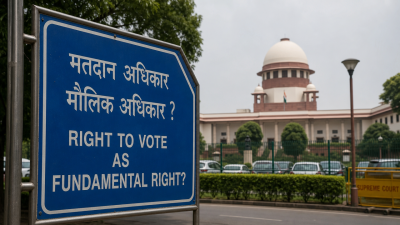
India’s Supreme Court continues to treat the right to vote as a statutory entitlement while judicial decisions have constitutionalised important electoral safeguards. The debate has returned to prominence due to recent judicial comments and political concerns about electoral rolls and ECI credibility.
What is the current issue?
The Supreme Court maintains that voting is a statutory right created by laws framed under the Constitution. Simultaneously, several judgments have read peripheral voting-related protections into Article 19(1)(a) and Article 326. Recent judicial remarks supporting a fundamental-right status and allegations about Special Intensive Revision (SIR) of rolls have reignited the debate over legal classification and institutional accountability.
Why this matters for governance and democracy
- Governance: Legal status determines the standard of protection, remedies available and the scope of judicial review over electoral laws and administration.
- Democratic legitimacy: The effective exercise of suffrage affects representative legitimacy and public trust in elected institutions.
- Institutional accountability: Questions about the Election Commission’s credibility and roll revision processes directly impact enfranchisement and political stability.
Legal status: statutory right versus fundamental right
Traditional position: The Court, starting with N.P. Ponnuswami v. Returning Officer and followed in later cases, has held that the core right to vote is a creature of statute. This preserves Parliament’s power to regulate electoral qualifications, rolls and procedures through ordinary legislation.
Judicial evolution: constitutionalisation of aspects
- Right to information about candidates: Association for Democratic Reforms (2002) read disclosure requirements into democratic participation under Article 19(1)(a).
- Right to informed choice: PUCL v. Union of India (2003) affirmed that information and opportunity to decide are part of political expression.
- Right to reject candidates: The NOTA ruling (2013) characterised rejection as political expression protected by Article 19(1)(a), and protected ballot secrecy.
- Recent tenor: Article 326 provides a constitutional guarantee of universal adult suffrage for Lok Sabha and State Assembly elections. Some judges, notably in Anoop Baranwal (2023), have explicitly favoured recognising voting as a fundamental right; other judgments, including Ram Chandra Choudhary (2026), have reaffirmed the statutory classification in specific contexts.
Constitutional foundation: Article 326
Article 326 mandates elections to Lok Sabha and State Assemblies on the basis of adult suffrage. Its text establishes entitlement to vote as a constitutional guarantee for parliamentary and assembly elections, creating a tension between statutory regulation and a constitutional source of suffrage.
Arguments for recognising the right to vote as a fundamental right
- Alignment with basic structure: Democracy and free elections are recognised elements of the Constitution’s basic structure; making voting a fundamental right would align legal form with constitutional substance.
- Enhanced protection: Fundamental-right status would attract stricter judicial scrutiny of restrictions and stronger remedies against disenfranchisement.
- Resolve legal inconsistencies: It would harmonise the statutory basis with the constitutional guarantees and the constitutionalised precedents that protect voter-related freedoms.
- Protect effective participation: Constitutional status could raise standards for roll maintenance, access to polling and safeguards for marginalised groups.
Arguments against recognising voting as a fundamental right
- Parliamentary flexibility: Statutory classification preserves legislative space to frame electoral rules responsive to administrative needs and changing conditions.
- Risk of judicialisation: Fundamental-right recognition could expand courts’ role in detailed electoral administration, causing delays and frequent litigation.
- Existing constitutional protection: Article 326 already guarantees universal adult suffrage for specific elections; critics argue this suffices and further elevation may create legal complexity.
Implications of recognition
| Dimension | If statutory | If fundamental |
|---|---|---|
| Source | Representation of the People Acts and subordinate rules | Constitutional text and enforceable by courts under Articles 32/226 |
| Remedies | Statutory complaints, election petitions, administrative redress | Constitutional remedies, direct writs and higher scrutiny |
| Legislative scope | Broad for Parliament/State legislatures | Constrained by fundamental-right jurisprudence |
| Judicial role | Limited to statutory interpretation and procedure | Expanded oversight over electoral rules and administration |
Role of recent judgments
- Constitutionalisation trend: Courts have repeatedly protected elements of voting through Article 19(1)(a) while stopping short of declaring the right to vote itself as fundamental in many rulings.
- Divisions within the Court: Some judges favour fundamental-right recognition to protect democratic participation; other decisions preserve statutory control, especially in specialised forums like co-operative society elections.
Contemporary institutional concerns
- Election Commission credibility: Opposition parties have alleged lack of transparency and procedural issues affecting trust in the ECI’s conduct of roll revision and polls.
- Special Intensive Revision (SIR): Allegations exist that SIR has led to large-scale deletions from the rolls and potential disenfranchisement; these raise questions about procedural safeguards and oversight.
- Practical impact: Credibility deficits and roll errors have immediate consequences for voter participation and perceived legitimacy of outcomes.
Way forward (practical and legal)
- Judicial clarity: A constitution bench may be needed to settle the statutory-versus-fundamental question with clear tests for when constitutional protection applies.
- Legislative reform: Amendments to the Representation of the People Acts and detailed rules for roll revision (including SIR safeguards) to ensure transparency, notice and remedies.
- Institutional strengthening: Measures to enhance ECI independence and transparency: statutory safeguards for tenure, finance and investigative capacity; public reporting on roll changes.
- Administrative safeguards: Automated roll reconciliation, mandatory publication of deletions with hearing opportunities, strengthened grievance redressal and voter education (SVEEP) to prevent inadvertent disenfranchisement.
- Targeted protections: Special arrangements for marginalised groups, migrants, service voters and persons with disabilities to secure effective access to franchise.
Model Questions
1. Trace the evolution of the right to vote in India from a statutory entitlement to the constitutionalised aspects recognised by the Supreme Court. Analyse arguments in favour of recognising voting as a Fundamental Right. [GS-II: Constitution of India & Polity]
The right to vote began as a statutory entitlement under the Representation of the People Acts; N.P. Ponnuswami affirmed this. Subsequent judgments (ADR 2002, PUCL 2003, NOTA 2013) constitutionalised information, informed choice and ballot secrecy via Article 19(1)(a). Pro-recognition arguments cite democracy as basic structure, Article 326’s guarantee, legal inconsistencies, and the need for stronger remedies against disenfranchisement.
2. Critically evaluate the likely institutional and legal implications if the right to vote is declared a Fundamental Right in India. [GS-II: Governance]
Recognition would provide constitutional remedies and higher scrutiny for restrictions, strengthening citizen protection. It could constrain Parliament’s regulatory flexibility and invite judicial intervention into detailed electoral administration. Likely outcomes include increased litigation, stricter standards for roll maintenance and access, and a shift in balance between judicial oversight and administrative autonomy for election management.
3. Examine Article 326 as the constitutional foundation for universal adult suffrage and assess how Supreme Court jurisprudence has treated this Article in relation to voting rights. [GS-II: Constitution of India & Polity]
Article 326 guarantees elections by adult suffrage for Lok Sabha and Assemblies, creating a constitutional entitlement to vote. Courts have relied on it while still characterising core suffrage as statutory. However, judgments have invoked Article 326 alongside Article 19(1)(a) to protect voter-related freedoms. Recent judicial opinions show movement toward treating voting as a constitutional right, though authoritative resolution remains unsettled.
4. Discuss how concerns about the Election Commission’s credibility and roll revision practices (such as SIR) affect the exercise of the right to vote. Recommend reforms to preserve enfranchisement. [GS-II: Governance]
Credibility deficits and flawed SIR processes can lead to wrongful deletions, disenfranchisement and reduced public trust, undermining electoral legitimacy. Reforms should include statutory safeguards for roll revision, mandatory public notices and hearings before deletions, independent audits, enhanced ECI transparency and grievance mechanisms, and targeted outreach to restore and protect access for vulnerable groups.
Last Modified: July 7, 2026