
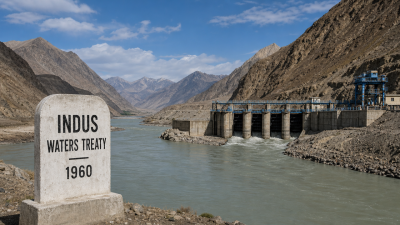
The eastern Indus tributaries (Ravi, Beas, Sutlej) have recorded a 20% decline in catchment precipitation since 1951, with falling groundwater and reduced dam inflows. These hydro-climatic shifts intersect with ongoing diplomatic and legal contestation over the Indus Waters Treaty and regional disaster risks.
What is the issue
The Indus Waters Treaty (1960) allocates the three eastern rivers to India and the three western rivers mainly to Pakistan. Recent hydro-climatic evidence shows sharp declines in precipitation, groundwater and reservoir inflows in India’s eastern catchments. India has sought treaty review citing climate change, demographic pressure and rising water demand; Pakistan has not replied to India’s notices.
Why it matters
- Governance: Treaty allocations fixed in 1960 may not reflect current hydrology or demand patterns.
- Economy: Reduced irrigation water and hydropower inflows affect agriculture, food security and power supply.
- Society: Groundwater depletion and variable flows raise rural distress and urban supply challenges.
- Security: Transboundary tensions and arbitration outcomes complicate bilateral relations.
- Environment & Disaster Risk: Longer dry spells punctuated by intense rainfall increase flood, landslide and glacier hazards in the HKH region.
Hydro‑climatic evidence
| Parameter | Eastern rivers (Ravi, Beas, Sutlej) | Western rivers (Indus, Jhelum, Chenab) |
|---|---|---|
| Precipitation trend (1951–2024) | Decline ~20% | Reduction ~6% (statistically non‑significant) |
| Groundwater status | Significant depletion in Sutlej and Ravi sub‑basins | Relatively stable in Chenab, Jhelum and Indus basins |
| Reservoir inflows | Marked decline (Pong inflows down ~34% between 1951–2020); Bhakra, Thein reduced | Major dams (Mangla, Tarbela) broadly stable |
Implications for the Indus Waters Treaty
- Allocation mismatch: Treaty’s fixed division assumes historical flows. Declining eastern flows reduce consumptive availability for India while western flows remain comparatively stable.
- Equitable utilisation: Climate‑driven asymmetry challenges notions of reasonable and equitable use among riparians.
- Operational stress: Lower inflows complicate reservoir operations, irrigation scheduling and hydropower planning under current treaty rules.
- Bilateral process: India served notices seeking review; Pakistan has not responded. Recent arbitration on pondage limited unilateral suspension claims, a ruling India rejected.
Legal and institutional dynamics
- Key institutions: Indus Waters Treaty framework, Permanent Indus Commission (PIC), Court of Arbitration (CoA).
- Recent rulings: CoA award on maximum pondage found treaty does not permit unilateral “abeyance.” This increases legal clarity but leaves substantive allocation issues unresolved.
- Dispute drivers: Differing treaty interpretations, asymmetric hydrology and lack of a permanent scientific mechanism for climate adjustments.
- International actors: Technical organisations (for example ICIMOD) and multilateral data platforms can support joint monitoring and scenario analysis.
Water security, disaster risk and infrastructure
- Agriculture: Reduced river and groundwater resources threaten cropping patterns, irrigation reliability and rural incomes.
- Energy: Declining reservoir inflows lower hydropower generation potential and affect grid stability.
- Disaster risk: Scientists warn of longer dry spells interspersed with intense storms, raising flood, landslide and glacier‑related hazards across the HKH.
- Infrastructure resilience: Existing dams and conveyance systems require reassessment for altered flow regimes and extreme event loads.
Policy and governance options
Domestic measures (India)
- Demand management: Improve irrigation efficiency (micro‑irrigation), crop diversification, and water pricing where appropriate.
- Groundwater governance: Strengthen implementation of the Model Bill on groundwater, accelerate metering and recharge measures, expand aquifer mapping by CGWB.
- Storage and conjunctive use: Optimise existing reservoirs, plan downstream storage, and develop managed aquifer recharge and small‑scale storage to buffer variability.
- Data and forecasting: Upgrade hydrometeorological networks, glacier monitoring and seasonal forecasts; integrate CWC, IMD and research institutions for operational advisories.
Bilateral and treaty‑level measures
- Joint scientific panel: Create a standing technical body under the PIC with independent climate, hydrology and glacier experts to provide shared data and projections.
- Flexible protocols: Negotiate mechanisms for provisional reallocations, drought/flood contingency clauses and joint reservoir operation rules under extreme events.
- Data sharing: Institutionalise real‑time flow and reservoir data exchanges, flood warnings and joint assessments of glacier hazards.
- Dispute prevention: Use confidence‑building measures and third‑party technical mediation before legal escalation.
Institutional and legal reforms
- Treaty review pathway: Pursue bilateral negotiations within the treaty’s dispute‑resolution framework while keeping technical dialogue separate to avoid politicisation.
- Complementary laws: Strengthen national water governance instruments (National Water Policy, River Basin Management) to improve preparedness for altered flows.
- Regional cooperation: Engage regional bodies and scientific networks (ICIMOD, SAARC technical mechanisms) for shared HKH hazard management.
Model Questions
1. Critically analyse the impact of climate change on the eastern tributaries (Ravi, Beas, Sutlej) of the Indus basin and discuss how these changes challenge the sustainability of the Indus Waters Treaty. [GS-III: Environment & DM]
Recent evidence shows ~20% decline in eastern catchment precipitation, groundwater depletion in Sutlej and Ravi, and major declines in reservoir inflows (Pong ≈34% fall). These reduce India’s consumptive water, strain irrigation and hydropower, and create allocation mismatches with a treaty based on historical flows. Climate asymmetry argues for adaptive protocols, joint scientific assessment and provisional allocations to maintain equitable, sustainable transboundary management.
2. Examine the geopolitical and legal complexities arising from India’s call to review the Indus Waters Treaty and Pakistan’s responses, including recent arbitration outcomes. [GS-II: International Relations]
India’s notices for treaty review cite climate change, demographics and demand; Pakistan has not replied. Pakistan raised concerns about abrupt flow variations (Chenab). Court of Arbitration ruled on maximum pondage, rejecting unilateral suspension claims; India disputed this. The situation combines technical uncertainty, divergent legal interpretations and limited bilateral trust, complicating renegotiation and increasing reliance on arbitration and confidence‑building mechanisms.
3. Discuss the multi‑dimensional challenges posed by evolving hydro‑climatic patterns in the Hindu Kush Himalaya to water security and disaster management in the Indus basin. [GS-III: Environment & DM]
HKH trends show longer dry spells and sudden intense rainfall, raising flash floods, landslides and glacier hazards. Consequences include variable river inflows, stressed irrigation and hydropower, and heightened disaster response needs. Effective response requires integrated forecasting, basin‑centred risk mapping, resilient infrastructure design, transboundary early‑warning systems and community‑level adaptation to protect livelihoods and critical services.
4. What ethical and governance principles should guide renegotiation or adaptive management of transboundary water treaties like the Indus Waters Treaty in the face of climate change? [GS-IV: Ethics, Integrity and Aptitude]
Principles should include equitable and reasonable utilisation, no significant harm, precaution, transparency and intergenerational equity. Governance must ensure inclusive consultation, scientific evidence, accountability and mechanisms for emergency cooperation. Ethical duty to protect vulnerable downstream communities requires adaptive clauses, data sharing, joint monitoring and dispute‑avoidance processes that balance national interests with humanitarian and environmental responsibilities.
Last Modified: July 10, 2026