
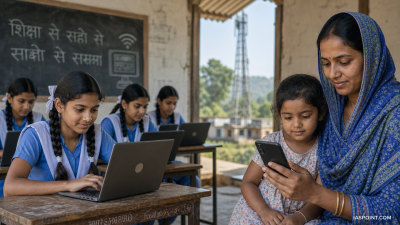
Recent UDISE+ data shows internet connectivity in government schools rose from 46.2% to 63.1%, narrowing the gap with aided and private schools; overall 67.4% of Indian schools report functional internet, with Goa and Andhra Pradesh at the top of coverage.
What is the current issue?
School‑level internet access has improved, but access quality and utilisation vary widely. Connectivity alone does not ensure learning outcomes. Persistent gaps exist by state, locality, gender and socio‑economic status. Policy must move from connection counts to effective, inclusive digital learning ecosystems.
Why it matters
- Governance: Digital access links to online assessments, administrative systems and delivery of entitlements.
- Economy: Digital skills contribute to employability and productivity; schools are primary sites for human‑capital formation.
- Society: Digital exclusion reproduces existing inequities, especially for girls and marginalised communities.
- Security & Rights: Poor design risks privacy breaches, cyber‑safety threats and discriminatory outcomes.
Infrastructure and regional parity
UDISE+ 2025–26 reports 67.4% of schools with internet; government school connectivity rose to 63.1%, reducing the gap with private/aided schools to 16 percentage points. State variation is large: Goa (100%) and Andhra Pradesh (99.2%) contrast with several states far below the national average. Constraints include grid reliability, last‑mile broadband, device shortages and weak maintenance regimes.
Gender digital divide and inclusion
UNESCO’s report Technology on Her Terms estimates 244 million fewer women use the internet globally. In educational settings this gap limits girls’ access to content, assessments and blended learning. Interventions combine infrastructure with pedagogy and outreach. Examples: the UNESCO–Beijing Normal University project training ICT teacher‑educators in Ghana and Tanzania; NIIT Foundation’s Digital Bus delivering digital and financial skills to women; Chile’s Connected Communities reaching Indigenous women.
Economic implications and state interventions
Digital school infrastructure is an economic multiplier through improved learning, digital literacy and alignment with labour‑market needs. Market failures — low commercial incentives in remote/poor areas — justify public interventions. Instruments include subsidised broadband (models similar to Chicago Connected), public Wi‑Fi schemes (PM‑WANI‑style frameworks), national digital education architecture (for content and interoperability), and targeted device provisioning under Samagra Shiksha or allied programmes.
Ethical, legal and rights‑based considerations
Digital exclusion undermines equal opportunity and the Right to Education. State obligations include ensuring minimum standards of connectivity, device access, gender‑sensitive outreach and child safety. Regulatory safeguards must protect data privacy and cyber‑safety for children under the Digital Personal Data framework and relevant IT rules. Inclusion requires proactive targeting of marginalised groups to prevent technology from deepening disadvantage.
Operational challenges
- Power & last‑mile connectivity: Intermittent electricity and low fibre penetration reduce effective use.
- Hardware & maintenance: Device lifecycle, repair capacity and replacement funds are inadequate.
- Teacher capacity: Lack of ICT pedagogy training limits classroom integration of digital tools.
- Affordability & devices: Household device ownership and internet affordability constrain out‑of‑school access.
- Local content & languages: Limited quality content in regional languages reduces relevance.
- Safety, privacy & governance: Weak protocols for child protection, data handling and procurement transparency.
- Monitoring: Inputs reported in UDISE+ need complementary outcome indicators to measure learning gains.
Policy mix: practical measures
| Dimension | Action |
|---|---|
| Connectivity | Prioritise fibre/BharatNet links to schools, school‑centric public Wi‑Fi points, and backup power solutions. |
| Devices & affordability | Device subsidies, community device pools, and low‑cost leasing models for households and schools. |
| Teacher training | Scale ICT pedagogical training, including gender‑transformative methods; institutionalise continuous professional development. |
| Content & assessment | Integrate DIKSHA/NDEAR resources with state curricula; local language materials; online formative assessments. |
| Inclusion | Targeted outreach for girls, marginalised communities and remote areas; mobile models like Digital Bus and community hubs. |
| Governance & safeguards | Standardise procurement, maintenance funds, data protection rules for learners, and school cyber‑safety protocols. |
| Monitoring | Use UDISE+ inputs plus learning outcome indicators and periodic third‑party audits for service quality. |
Implementation instruments and partnerships
- Central schemes: Align Samagra Shiksha financing with dedicated digital lines and device grants.
- State plans: State cluster plans for broadband, local content and teacher education.
- Public‑private partnerships: Performance‑based contracts for connectivity and maintenance, with social‑impact clauses.
- Community models: Mobile classrooms, school as community hub, and local NGOs for outreach to girls and marginalised groups.
- International cooperation: Technical support and capacity building models from UNESCO projects and UN‑backed initiatives.
Model Questions
1. Analyse the challenges in bridging the digital divide within India’s public education system and propose governance measures to address them. [GS-II: Governance]
Public data shows rising connectivity but wide state and intra‑state variation. Key challenges: last‑mile broadband, unreliable power, device shortages, weak maintenance, and limited teacher ICT skills. Governance measures: dedicate funds in Samagra Shiksha for digital hardware and O&M; state cluster plans for broadband; PPPs with service level agreements; institutionalise ICT pedagogy training; use UDISE+ plus outcome metrics and third‑party audits to ensure service quality and equity.
2. Discuss how the gender digital divide impedes women’s empowerment and outline effective global and local strategies to reduce this gap. [GS-I: Indian Society]
The gender digital gap limits access to education, livelihoods and public services. Strategies: gender‑transformative teacher training, targeted digital skills programmes for girls (school and community), mobile outreach models (Digital Bus), subsidies for devices and data for women, local language content and safe online spaces. International cooperation can support capacity building and best practices, while monitoring must track gender‑disaggregated usage and outcomes.
3. Evaluate the role of digital infrastructure in schools as an economic multiplier and explain why state intervention is necessary. [GS-III: Economic Development]
School digital infrastructure enhances human capital, digital literacy and alignment with labour‑market needs, yielding higher productivity and employability. Market failures—low commercial incentives in remote/poor areas—mean private provision is insufficient. State intervention is necessary for subsidised broadband, device programmes, and public platforms (content and assessments). Public investments create positive externalities and reduce long‑term inequality, provided they couple infrastructure with pedagogy and maintenance funding.
4. Examine the ethical obligations of the state and society in ensuring universal digital access in education. [GS-IV: Ethics, Integrity and Aptitude]
Universal digital access links to equal opportunity and the Right to Education. Ethically, the state must ensure baseline connectivity, device access, child safety and data protection for learners. Society (schools, families, NGOs) must support inclusive uptake and challenge gender and caste‑based barriers. Policies should prioritise the most marginalised, ensure transparent allocation of resources, and embed safeguards against privacy breaches and discriminatory outcomes.
Last Modified: July 13, 2026