
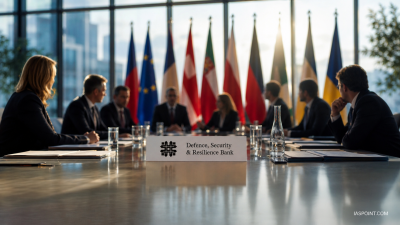
The Defence, Security and Resilience Bank (DSRB) has moved from concept to founding phase after a multilateral declaration at the NATO summit in Ankara and the finalisation of Articles of Agreement in Montréal. Canada will host headquarters (Toronto) with a European hub in Luxembourg; the bank aims to mobilise up to £100 billion (about USD 134 billion) and begin operations by 2027.
What the DSRB is
The DSRB is a treaty-based multilateral financial institution dedicated to financing defence procurement, military supply chains, and resilience projects among allied countries. It combines sovereign credit backing with private banking participation to issue triple‑A‑rated bonds and provide long‑term, low‑cost credit and institutional guarantees for defence‑related industrial scale‑up.
Why it matters for governance, economy and security
- Governance: Introduces a formal multilateral mechanism for collective defence financing, requiring intergovernmental coordination, treaty governance and oversight mechanisms.
- Economy: Channels large private capital into defence industry scaling, affecting national budget choices and investor exposure to defence sectors.
- Security: Aims to shorten procurement cycles and reduce supply‑chain fragility for allied militaries, enhancing collective readiness.
Institutional genesis and leadership
The bank was advanced by a development group led by Rob Murray, now CEO of the DSRB Development Group, who previously led NATO innovation initiatives. Founding countries include Canada, Albania, Belgium, Greece, Latvia, Luxembourg, Romania, Türkiye and Ukraine. Major global and Canadian banks have committed as private financial backers to mobilise liquidity and provide underwriting capacity.
Financial model and instruments
- Capital target: Up to £100 billion (≈ USD 134 billion) raised through sovereign backing and private subscriptions.
- Credit structure: Sovereign shareholders provide credit support enabling triple‑A bond issuance to access low‑cost capital.
- Instruments: Long‑dated bonds, project loans, guarantees, and blended‑finance structures to de‑risk private lending to defence and dual‑use firms.
- Private banking role: Global banks act as underwriters, arrangers and loan partners to channel institutional and market liquidity.
Operational scope and priority uses
- Defence procurement finance: Loans and guarantees for acquisition programmes to reduce immediate fiscal pressure on member states.
- Supply‑chain resilience: Financing for critical inputs, dual‑use technologies and logistics networks to prevent bottlenecks in crises.
- Industrial scaling: Credit lines for SMEs and manufacturing expansion to raise domestic industrial readiness within allied states.
- Innovation support: Investment in commercialisation of defence‑relevant technologies linked to NATO innovation initiatives.
| Stakeholder | Role | Implication |
|---|---|---|
| Founding sovereigns | Provide credit support, governance vote | Collective underwriting raises borrowing capacity |
| Private banks | Underwrite bonds, syndicate loans | Channels large market liquidity; introduces profit motive |
| Defence industry / SMEs | Borrowers for capacity expansion | Faster industrial scaling and export potential |
Geopolitical and ethical implications
Institutionalising defence finance among allied states creates a block‑centred funding channel. This can accelerate capability consolidation within member states and complicate access to advanced technologies for non‑aligned countries. The integration of commercial banks raises ethical questions: profit incentives may bias capital allocation, create systemic incentives for sustained demand, and require strict governance to prevent conflicts of interest and mission creep.
Risks, governance and safeguards
- Mission creep risk: Mandate expansion into offensive programmes unless limited by charter and lending criteria.
- Transparency and oversight: Need for parliamentary reporting, independent audit, and conflict‑of‑interest rules for bank trustees and private partners.
- Human rights and environmental safeguards: Lending policies must include compliance checks to avoid financing projects that breach international norms.
- Financial risk: Contingent liabilities for sovereign backers require clear risk‑sharing and loss‑absorption rules.
Implications and policy options for India
Strategic autonomy: The DSRB may tighten technology and finance channels within allied networks, affecting non‑aligned procurement options. India should examine access pathways for joint projects and export partnerships. Domestic finance architecture: India can study a specialised defence financing vehicle—national defence bonds or a sovereign‑backed defence bank—to provide long‑term patient capital for defence production without unduly straining annual budgets. Supply‑chain and standards alignment: Strengthen domestic MSME financing, compliance standards and ESG frameworks so Indian suppliers can participate in allied supply chains while protecting strategic technologies. Engagement strategy: Pursue pragmatic engagement with DSRB member states through bilateral credit guarantees, co‑investment deals and technology partnerships while preserving export control and strategic independence.
Practical steps for India’s policymakers
- Create a defence finance rubric: Legal framework for issuing defence bonds, underwriting terms and parliamentary oversight.
- Strengthen public‑private financing: Incentives for domestic banks to co‑finance defence SMEs and co‑fund innovation incubators modelled on DIANA.
- Negotiate access clauses: Bilateral agreements with DSRB members to permit joint ventures and selective participation.
- Embed safeguards: Mandatory human‑rights, environmental and export‑control checks in any cross‑border financing.
Model Questions
1. Analyse the geopolitical implications of the establishment of the Defence, Security and Resilience Bank for global security architecture and its likely effects on non‑aligned nations. [GS-II: International Relations]
The DSRB formalises allied defence finance, creating a block‑based funding channel that concentrates capability and supply‑chain resilience among members. For non‑aligned states it may restrict access to finance and advanced platforms, force alignment choices, and increase strategic fragmentation. Responses include diversified procurement, bilateral credit lines, and diplomatic engagement to preserve strategic autonomy while participating selectively in cooperative projects.
2. Evaluate how the DSRB’s financing model addresses the tension between rising defence budgets and fiscal sustainability in democratic states. [GS-III: Economic Development]
By using sovereign credit to issue triple‑A bonds, the DSRB provides long‑term low‑cost capital and guarantees that reduce immediate budgetary pressure. This spreads cost over long durations and attracts private capital for capital‑intensive defence projects. Fiscal risks remain if sovereigns assume contingent liabilities; robust risk‑sharing, transparency and clear lending criteria are necessary to preserve fiscal sustainability.
3. Discuss the ethical challenges of integrating private commercial banking interests with sovereign defence preparedness and suggest safeguards. [GS-IV: Ethics, Integrity and Aptitude]
Private banks seek returns, creating incentives to sustain demand for defence financing and potential conflicts between profit and public interest. Ethical challenges include mission creep, reduced scrutiny and prioritising profitable projects over public needs. Safeguards: independent oversight, strict conflict‑of‑interest rules, transparent procurement criteria, human‑rights and environmental checks, and parliamentary reporting to align finance with public accountability.
4. Assess the role of a targeted defence bank in mitigating supply‑chain vulnerabilities and enhancing defence industrial capacity during geopolitical crises. [GS-III: Internal & External Security]
Targeted defence finance de‑risks investment in critical inputs, supports SME scaling, and funds stockpiling and logistics, reducing bottlenecks in crises. It can accelerate dual‑use technology commercialisation and shorten procurement timelines. Downsides include possible concentration of advanced capabilities and dependence on allied networks; balanced policies should combine financing with domestic capability development and diversified supplier bases.
Last Modified: July 13, 2026