
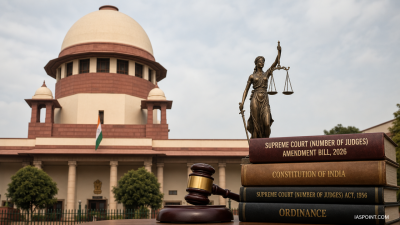
The Union Law Minister introduced the Supreme Court (Number of Judges) Amendment Bill, 2026 in the Lok Sabha on 20 July 2026. The Bill seeks to raise the sanctioned strength of Supreme Court judges from 33 to 37 (excluding the Chief Justice), bringing total sanctioned strength to 38.
What is the current issue
The Bill amends the Supreme Court (Number of Judges) Act, 1956. It follows Union Cabinet approval and replaces a May 2026 Ordinance. The stated objective is to reduce a backlog of about 92,385 cases and improve court functioning by expanding bench capacity.
Why this matters for governance and access to justice
- Governance: Legislative control over court size affects judicial capacity and the adjudicatory workload at the highest level.
- Access to justice: A larger sanctioned strength aims to shorten delays, thereby protecting the right to speedy justice under Article 21.
- Institutional balance: Changes made by ordinary law preserve parliamentary primacy on court size while appointments remain a judicial process, affecting separation of powers.
Constitutional and legislative framework
Legal basis: Article 124(1) establishes the Supreme Court and permits Parliament to determine its strength by ordinary legislation. The Supreme Court (Number of Judges) Act, 1956 fixes sanctioned strength and can be amended by a simple majority. Ordinance route: A temporary change was earlier made by an ordinance under Article 123; the Bill seeks parliamentary approval to replace that ordinance. Appointment process: The selection of judges operates through the Collegium system and the Memorandum of Procedure (MoP); legislative increase does not alter the appointment mechanism.
Historical evolution of sanctioned strength
- Initial strength at commencement: CJI + 7.
- Incremental increases through statutory amendments (notably 1956, 1960, 1977, 1986, 2009, 2019).
- 2019 raise brought sanctioned strength to 34 (including CJI); 2026 proposal raises it to 38.
Administrative rationale and pendency analysis
Current driver: A backlog exceeding 92,000 cases at the apex court level imposes delays and increases litigant cost. Limitations of mere expansion: Sanctioned strength is only an upper limit. The intended benefit materialises only if vacancies are filled promptly and case-management practices change. The Supreme Court functions extensively as a court of appeal via Article 136 SLPs, increasing routine workload.
Challenges in translating sanctioned strength into working capacity
- Vacancies: Delays between creation of posts and appointments reduce working strength.
- Appointment friction: Differences between Collegium recommendations and Executive responses, and delays in MoP-based clearances, prolong vacancies.
- Bench constitution practices: Frequent constitution of larger benches for non-constitutional matters reduces availability of judges for routine dockets.
- Human resource constraints: Limited pool of eligible, experienced jurists for elevation to the apex court.
Structural and procedural reform options
- Bifurcation of functions: Implement Law Commission recommendations (229th Report) to divide constitutional work from routine appellate business—Constitutional Division and Appellate Division.
- Regional appellate benches: Establish regionally located benches to decentralise appellate work and reduce travel and pendency pressures.
- National Court of Appeal: Create an intermediate appellate institution to filter routine appeals currently reaching the Supreme Court.
- Appointment and administrative reforms: Revise and operationalise the MoP with strict timelines; ensure prompt Executive clearance for Collegium recommendations; maintain an appointment calendar to fill vacancies quickly.
- Case-management measures: Time-limits for oral arguments; stronger reliance on written submissions; stricter screening of SLPs; roster reforms to reduce ad hoc larger benches.
- Strengthen lower judiciary and ADR: Enhance capacity and infrastructure of high courts and subordinate courts; incentivise mediation and pre-litigation settlement to reduce appellate inflow.
- Technology and performance metrics: Expanded e-filing, virtual hearings, analytics for case prioritisation, and transparent performance indicators for judicial administration.
Institutional and implementation considerations
- Coordination: Legislative enlargement must be paired with administrative planning for timely appointments and infrastructure.
- Training and support: New judges require administrative support, clerks and research capacity; budgetary allocations must reflect these needs.
- Monitoring: Periodic review of sanctioned versus working strength and pendency trends to assess impact.
Ethical and governance implications
- Right to speedy justice: Persistent delay undermines Article 21 and imposes disproportionate burdens on vulnerable litigants.
- Public trust: Unaddressed backlogs erode confidence in judicial effectiveness and the rule of law.
- Responsibility: The state and judiciary share duties to ensure accessible, timely adjudication; transparency in appointments and accountability in administrative decisions are required.
Model Questions
1. Analyse the constitutional and legislative framework governing changes to the sanctioned strength of the Supreme Court. How does this process balance legislative authority and judicial independence? [GS-II: Constitution of India & Polity]
The Constitution (Article 124(1)) permits Parliament to fix Supreme Court strength by ordinary law. Amendments to the Supreme Court (Number of Judges) Act require a simple parliamentary majority; no constitutional amendment is needed. Judicial independence is maintained because appointments occur via the Collegium and MoP. Thus Parliament controls structure; the judiciary retains selection autonomy, producing a functional balance between institutional competence and democratic oversight.
2. With pendency exceeding 92,000 cases, evaluate whether increasing sanctioned judge strength is a sustainable solution to Supreme Court backlog. Suggest alternative structural reforms. [GS-II: Governance]
Raising sanctioned strength increases potential bench capacity but is insufficient alone. Vacancy delays, appointment friction and appellate overload limit impact. Sustainable measures include creating regional appellate benches, a National Court of Appeal, bifurcating constitutional and appellate work, strengthening lower courts, enhancing ADR, strict case filtering, time-limited hearings and better use of technology to reduce inflow and speed adjudication.
3. Discuss challenges in timely filling of Supreme Court vacancies and their impact on the efficacy of legislative increases in judge strength. [GS-II: Constitution of India & Polity]
Challenges include Collegium-Executive differences, slow vetting and clearance under the MoP, lack of a fixed appointment timeline, and a limited eligible pool. These produce a gap between sanctioned and working strength, negating benefits of legislative increases. Remedies are a revised MoP with deadlines, improved coordination, transparent timelines for clearances, and proactive succession planning to ensure new posts translate into sitting judges.
4. Examine the ethical and governance consequences of sustained case backlog at the apex court and propose measures to uphold the right to speedy justice. [GS-IV: Ethics, Integrity and Aptitude]
Extended delays breach the right to speedy justice under Article 21, causing financial and emotional harm, especially to vulnerable litigants, and diminishing institutional legitimacy. To uphold timely justice, adopt clear performance metrics, transparent appointment procedures, strengthen lower courts and legal aid, expand ADR, and enforce strict timelines for hearings. These measures distribute responsibility between state and judiciary and restore public confidence.
Last Modified: July 20, 2026