
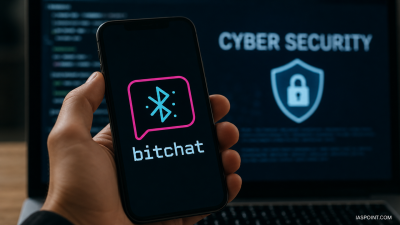
India’s Cybercrime Coordination Centre (I4C) ordered GitHub to disable access to the Bitchat repositories after assessing that the Bluetooth Low Energy mesh app’s decentralised, serverless design impedes lawful interception and can be misused to coordinate unlawful activities. The directive was made public by the developer.
What is the current issue
Bitchat is an open‑source peer‑to‑peer messaging app using BLE mesh to relay encrypted messages between nearby devices without internet, registration, phone numbers or central servers. I4C directed GitHub to disable three Bitchat repositories within a strict notice period, invoking intermediary liability provisions.
Why it matters for governance and security
Decentralised offline messaging can:
- Impede investigations — no central logs or metadata for lawful interception and attribution.
- Bypass controls — operate during internet shutdowns or network disruptions used to maintain public order.
- Enable anonymity — absence of KYC or identifiers lowers attribution, raising risks of coordination by organised crime, terrorists or malicious actors.
Technical architecture and operational features
Core design
– Peer‑to‑peer message relaying over Bluetooth Low Energy (BLE) mesh. Messages hop between devices, extending reach beyond single‑device Bluetooth range. – End‑to‑end encryption implemented locally; no central servers for routing or storage. – Typical hop range 30–100 metres; network reach increases with device density.
Dual‑use nature
– Useful for disaster response, humanitarian communication and dissent in authoritarian contexts. – Equally usable to coordinate illicit assemblies, smuggling, or misinformation at a local level.
Security vulnerabilities and cyber risks
- Key exchange weaknesses — bootstrap of trust is difficult without a central certificate authority, creating opportunity for man‑in‑the‑middle attacks.
- Known vulnerability — a man‑in‑the‑middle flaw in Bitchat was identified by researchers in 2025; developer added a disclaimer warning against production use without review.
- Node injection and replay — malicious devices can join the mesh to forward, alter or replay messages if authentication is weak.
- Forensic gaps — absence of server logs reduces digital evidence for retrospective investigations.
Legal and regulatory framework
– I4C and Ministry role: I4C operates under the Ministry of Home Affairs and coordinates cybercrime response and takedown notices. – Statutory basis: The takedown invoked Section 79(3)(b) of the Information Technology Act, 2000 (intermediary liability loss of safe harbour on failure to disable access after government notice) and Rule 3(1)(d) of the IT Rules, 2021 (intermediary due‑diligence). – Intermediary action: Platforms like GitHub (a Microsoft subsidiary) are required to act on lawful government directives within the stipulated timeframe; the Bitchat notice specified rapid disablement.
Enforcement challenges
- Replication and mirrors — open‑source code can be forked and re‑hosted across multiple global repositories, making single‑site takedowns insufficient.
- Jurisdictional limits — hosting, contributors or mirrors may sit outside national jurisdiction.
- Technical detection — detecting local BLE mesh use at scale is complex and raises privacy concerns if done indiscriminately.
Operational and technical responses
- Device forensics — strengthen capacities to extract application artefacts from seized devices and reconstruct mesh interactions.
- Local radio monitoring — targeted monitoring of BLE frequency anomalies in disturbed areas, limited by privacy safeguards and legal authorisation.
- Rapid intermediary channel — maintain formal rapid‑action channels with major code hosting platforms and cloud providers for takedown and de‑ranking of suspect repositories.
- Security audits — mandate independent security review for offline comms apps used in sensitive deployments; public disclosure of critical vulnerabilities.
Technical mitigations for developers
- Authenticated pairing — use authenticated, user‑verified pairing or out‑of‑band confirmation to prevent MITM.
- Ephemeral session keys — limit key lifetime and use forward secrecy to reduce exposure if a node is compromised.
- Device identity attestation — device‑level attestation to bind keys to hardware identifiers while preserving user privacy where possible.
- Transparent warnings and documentation — clear disclaimers, threat models and deployment guidance for open‑source projects.
Policy options and legal reform considerations
- Targeted amendments — introduce provisions addressing serverless and decentralised software distribution within intermediary liability law to cover replicated open‑source code.
- Intermediary registry — a notified point of contact for major global platforms to speed compliance and takedown coordination.
- International cooperation — use mutual legal assistance, platform agreements and multilateral fora to manage cross‑border hosting and code mirrors.
- Standards and best practice — develop technical standards for secure offline messaging (pairing, key management) and a voluntary code for open‑source developers.
Ethical trade‑offs
– Balancing privacy and public safety requires narrow, legally supervised mechanisms for access in serious crime while preserving legitimate privacy uses (disaster communication, whistleblowing). – Developers and policymakers must weigh anonymity benefits for vulnerable users against enabling malicious coordination. Measures should aim for proportionality, judicial oversight and transparency.
Model Questions
1. Analyse how peer‑to‑peer, decentralised communication technologies that operate without cellular networks or internet access present challenges to India’s internal security framework. [GS-III: Internal & External Security]
Peer‑to‑peer apps bypass telecom metadata, centralised logs and lawful interception, impairing attribution and evidence collection. They can operate during internet shutdowns and enable anonymous, local coordination. The Bitchat action shows the operational gap. Responses include device forensics, targeted BLE activity detection, legal provisions for serverless software, rapid intermediary cooperation and international measures against cross‑hosted code mirrors.
2. Examine the legal and regulatory mechanisms available to the Indian government to enforce compliance on global open‑source hosting intermediaries. [GS-II: Governance]
The government can use Section 79(3)(b) of the IT Act and Rule 3(1)(d) of the IT Rules to require intermediaries to disable access on notice; I4C invoked these powers in the Bitchat case. Challenges include mirrors, cross‑border hosting and decentralised distribution. Remedies: formal takedown protocols with major platforms, an intermediary registry, rapid notice channels and legal amendments for serverless and open‑source replication.
3. Explain the technical architecture of BLE mesh network‑based messaging applications and evaluate inherent security vulnerabilities. [GS-III: Science & Technology]
BLE mesh uses device‑to‑device links and multi‑hop relaying to form ad‑hoc networks within 30–100 metres per hop. Risks include weak key exchange, lack of a central trust authority, and exposure to man‑in‑the‑middle, replay or node‑injection attacks. Mitigations: authenticated pairing, out‑of‑band verification, ephemeral session keys, device identity attestation, standard cryptographic protocols and independent security review.
4. Discuss the ethical dilemmas faced by developers of decentralised, anonymous communication tools that offer strong privacy yet can facilitate misuse. [GS-IV: Ethics, Integrity and Aptitude]
Developers must balance privacy for dissenters and disaster victims with risks of harm from criminals and terrorists. Ethical measures include privacy‑preserving accountability (selective audit keys, court‑ordered access), clear user warnings, mandatory security testing, and voluntary codes of conduct for open‑source projects. Policy must ensure proportional, legally supervised access while minimising erosion of civil liberties.
Last Modified: July 25, 2026