
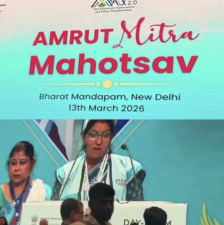
The Ministry of Housing and Urban Affairs hosted the AMRUT Mitra Mahotsav in New Delhi to show the role of women Self-Help Groups in strengthening urban water services under AMRUT 2.0. The event brought together more than 1,000 women and 300 officials from 30 States and Union Territories. It focused on women-led participation in water governance, service delivery, and community mobilisation in cities.
Women SHGs in Urban Water Management
AMRUT Mitras are women SHG members engaged in urban water-related activities. Their work includes water quality testing, billing and collection, community outreach, faecal sludge management, and operation and maintenance of water assets. These roles have helped women become active partners in urban service delivery rather than passive beneficiaries.
Focus on Jan Bhagidari and Livelihoods
The initiative links water management with Jan Bhagidari, or people’s participation. It aims to improve transparency, strengthen citizen engagement, and build stronger links between urban local bodies and communities. The model has also created livelihood opportunities for women by integrating them into local water systems and service operations.
Expansion Under AMRUT 2.0
The government plans to expand the AMRUT Mitra model from 1,900 cities to 5,000 cities. More than 45,000 SHG members are already active across 1,910 cities in 34 States and Union Territories. The expanded role of AMRUT Mitras will include treated wastewater reuse, digital water management, smart metering, data-based monitoring, and city-level IEC campaigns on water conservation. The event also featured a photo exhibition, panel discussion, testimonial sessions, and the launch of a Best Practices Compendium.
Last Modified: April 29, 2026