
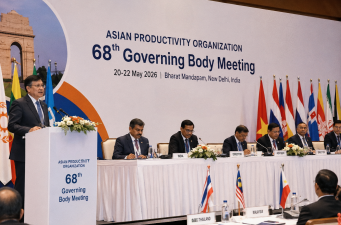
India is hosting the 68th Session of the Asian Productivity Organization (APO) Governing Body from May 20 to 22, 2026, at Bharat Mandapam in New Delhi. The three-day event brings together over 60 senior delegates and policymakers from 20 member economies to deliberate on regional growth strategies, institutional reforms, and sustainable socioeconomic development. Organized under India’s current chairmanship of the APO Governing Body, the session features key discussions on the APO Vision 2030 roadmap and budget proposals for the 2027–28 biennium. It serves as a major platform for strengthening economic cooperation and innovation across the Asia-Pacific region.
Overview of the 68th Governing Body Session
The annual Governing Body Meeting is the apex institutional forum for decision-making, strategic oversight, and governance within the APO structure.
Core Agenda and Discussions
- Vision 2030 Roadmap: Reviewing and implementing strategic frameworks to drive long-term productivity and digital transformation across member states.
- Leadership and Governance: Electing the new APO Chair and Vice Chairs for the 2026–27 tenure, alongside evaluating election procedures for the Secretary-General position.
- Financial and Institutional Reforms: Reviewing the APO Annual and Financial Report, allocating budgets for upcoming bienniums, and planning measures to upgrade institutional efficiency.
- Observer Participation: The 2026 session includes active participation from non-member observer nations, specifically Bhutan, Kazakhstan, and Uzbekistan, along with representatives from the Global Green Growth Institute.
APO National Awards Programme
The inaugural session highlights the presentation of the APO National Awards. These honors recognize outstanding contributions under two specific categories:
- APO National Award for Productivity Advocates: Conferred upon individuals driving impactful public policy and promotional initiatives to embed productivity into national growth strategies.
- APO National Award for Productivity Technical Experts: Awarded to professionals demonstrating technical excellence, innovative methodologies, and visible improvements in operational efficiency across member industries.
Genesis and Structure of the Asian Productivity Organization
The APO is a regional, intergovernmental organization dedicated to improving productivity-led socioeconomic development through mutual cooperation.
Institutional Foundation
- Establishment: Founded on May 11, 1961, through an international convention to foster non-political, non-profit, and non-discriminatory cooperation.
- Secretariat Headquarters: Located in Tokyo, Japan, managing everyday administrative tasks, program deployment, and technical research support.
- National Productivity Organizations (NPOs): Each member economy designates a specific national body to act as the nodal implementation agency for APO projects. In India, this role is performed by the National Productivity Council (NPC).
Membership Profile
The organization comprises 21 member economies spanning East Asia, Southeast Asia, South Asia, and the Pacific.
| Region | Member Economies |
| Founding Members (1961) | India, Japan, Republic of Korea, Republic of China (Taiwan), Nepal, Pakistan, Philippines, Thailand |
| Subsequent Inductions | Bangladesh, Cambodia, Fiji, Hong Kong, Indonesia, Islamic Republic of Iran, Lao PDR, Malaysia, Mongolia, Singapore, Sri Lanka, Turkey, Vietnam |
India’s Leadership and Institutional Framework
India holds a foundational position within the APO and currently steers its highest decision-making apparatus.
Current Leadership Position
India assumed the Chairmanship of the APO Governing Body during the 67th session in May 2025. Amardeep Singh Bhatia, Secretary of the Department for Promotion of Industry and Internal Trade (DPIIT) under the Ministry of Commerce and Industry, serves as the current Chair of the Governing Body.
The National Productivity Council (NPC)
- Administrative Control: Established in 1958, the NPC is an autonomous organization under the DPIIT, Ministry of Commerce and Industry.
- Tripartite Structure: The council functions through a tripartite institutional framework encompassing equal representation from government authorities, employers’ associations, and trade union organizations.
- Primary Mandate: Delivering consultancy, training, and research services across diverse sectors including agriculture, industrial engineering, energy management, and environmental sustainability.
IASPOINT Booster Facts for UPSC
- Giri-Durga Classification vs Architecture: While ancient texts classify forts based on geographical defense barriers, the choice of Bharat Mandapam for the 68th session mirrors India’s modern capacity for hosting high-level multilateral diplomatic events.
- Productivity-Led Growth Concept: Economists measure this parameter using Total Factor Productivity (TFP). TFP tracks the portion of economic output growth that is not caused by traditional inputs like heavy capital accumulation or extra labor, reflecting technological progress and efficiency.
- The Tokyo Secretariat: Unlike many UN bodies situated in Western Europe or North America, the APO was one of the earliest post-WWII intergovernmental organizations to permanently set up its secretariat base within Asia.
- DPIIT’s Broader Role: Apart from managing productivity frameworks via the NPC, DPIIT is the nodal department for monitoring Foreign Direct Investment (FDI) policy, Intellectual Property Rights (IPR) via the CGPDTM, and startup ecosystem initiatives like Startup India.
- Hong Kong Membership Status: Hong Kong joined the APO in 1963. Following its sovereignty transition in 1997, its direct administrative representation underwent structural suspensions, though it remains listed within the historical economic footprint of the convention.