
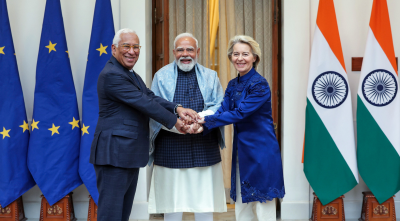
The Centre for Trade and Investment Law (CTIL) and the Federation of Indian Chambers of Commerce and Industry (FICCI) jointly organized a high-level conference on next-generation Free Trade Agreements (FTAs) in New Delhi on 19 May 2026. The event evaluated the rapidly evolving India-Europe trade architecture, focusing on the milestone India-EU FTA. This agreement opens preferential tariff treatment to 99.5% of Indian exports by value and addresses critical contemporary trade dimensions beyond traditional tariff line reductions. Discussions focused on enhancing market access, building domestic industry preparedness, and strengthening regulatory compliance structures to counter complex non-tariff barriers, sustainability mandates, and digital trade rules.
Structure of India’s Trade Engagements with Europe
India actively pursues a multi-track trade diplomacy strategy in Europe, targeting three distinct institutional blocs to deepen its integration into western value chains.
The Three Core European Trade Tracks
- The India-European Union FTA: A comprehensive economic pact covering goods, services, and investment protections. It connects India with the 27-member EU single market block.
- The India-UK Free Trade Agreement: A bilateral negotiation focused on minimizing high tariffs on labor-intensive goods, expanding financial services access, and creating streamlined mutual recognition agreements for professional qualifications.
- The India-EFTA Trade and Economic Partnership Agreement (TEPA): Concluded with the four-nation European Free Trade Association (Iceland, Liechtenstein, Norway, and Switzerland), featuring an unprecedented $100 billion investment commitment over 15 years tied to domestic job creation.
Key Dimensions of Next-Generation FTAs
Modern trade agreements extend far past simple border tariff elimination, introducing rigorous disciplines that regulate how goods are manufactured, digital data is handled, and domestic industries comply with environmental standards.
Core Pillars of Next-Gen Trade Architecture
- Beyond Border Reductions: Shifting policy focus away from import duties toward harmonizing domestic standards with global market entry rules.
- Services and Digital Economy Engagement: Expanding cross-border supply frameworks for information technology, financial technology, and business consulting services, alongside establishing rules for cross-border data flows and electronic commerce.
- Integration into Value Chains: Enhancing the long-term capacity of Micro, Small, and Medium Enterprises (MSMEs) to transition from raw material suppliers into high-value manufacturing partners for European firms.
Non-Tariff Barriers and Regulatory Compliances
As traditional customs duties fall toward zero, market access is increasingly dictated by domestic regulatory structures within the importing nations.
Sanitary and Phytosanitary (SPS) Measures
These represent mandatory food safety and animal health standards enforced by foreign nations. Indian agricultural, marine, and horticultural exports frequently face stringent chemical residue limits and complex inspection protocols before entering European distribution channels.
Technical Barriers to Trade (TBT)
TBTs encompass national technical regulations, product testing mechanisms, and labeling procedures. Indian engineering goods, electronics, and medical instruments must secure specific certifications to meet European safety and quality criteria.
Strengthening Standards Infrastructure
Addressing these friction points requires major domestic investments:
- Testing and Certification Capabilities: Establishing a network of internationally accredited laboratories inside India to perform testing that satisfies destination market parameters before export.
- Digital Compliance Tools: Deploying advanced electronic traceability systems across supply chains to verify product origins and regulatory conformity in real-time.
Environmental and Carbon-Related Trade Measures
Climate change policies are rapidly restructuring international trade law through unilateral border adjustment mechanisms designed to penalize carbon-intensive production processes.
Overview of the EU’s Carbon Border Adjustment Mechanism (CBAM)
CBAM is an environmental border tax levied by the European Union on carbon-intensive goods imported into the bloc. It aims to prevent “carbon leakage,” where EU firms move production to countries with weaker emissions rules.
Sectoral Impact Matrix for Indian Industry
| Sector Affected | Nature of CBAM Challenge | Domestic Adaptation Strategy Required |
| Iron and Steel | Faces higher import costs due to heavy reliance on coal-based blast furnaces. | Fast-tracking transitions toward green hydrogen and scrap-metal recycling technologies. |
| Aluminum | High embedded emissions from electricity grid consumption during smelting. | Securing dedicated renewable energy supply lines and optimizing plant energy efficiency. |
| Cement | Calcination processes emit high volumes of process-related carbon dioxide. | Developing low-carbon blended cement formulations and alternative binders. |
| Fertilizers | Production of ammonia-based fertilizers involves high fossil fuel consumption. | Investing in green ammonia production facilities driven by solar and wind power. |
IASPOINT Booster Facts for UPSC
- Preferential Trade Coverage: The India-EU FTA provides duty-free or preferential entry for 97% of EU tariff lines, translating to direct cost advantages for 99.5% of Indian export value.
- Labor-Intensive Windfalls: Over $33 billion worth of Indian exports in critical employment-generating sectors—including apparel, textiles, leather, footwear, and toys—will see historical EU import tariffs ranging from 4% to 26% drop directly to zero upon entry into force of the agreement.
- Services Sub-sector Coverage: The India-EU framework encompasses 144 out of 155 EU services sub-sectors, establishing dedicated legal mobility provisions for IT professionals, corporate transferees, and a historic regulatory annexure recognizing traditional Ayurveda practitioners.
- Combined Economic Footprint: The combined marketplace of India and the European Union represents roughly 2 billion consumers and an aggregate market value exceeding $24 trillion, accounting for approximately 25% of global Gross Domestic Product (GDP).
- Centre for Trade and Investment Law (CTIL): Established by the Ministry of Commerce and Industry within the Indian Institute of Foreign Trade (IIFT), CTIL serves as a specialized think tank providing sound legal analysis, dispute design support, and capacity-building assistance on World Trade Organization (WTO) laws and FTA negotiations.
- Trade Remedies Advisory Cell: Operating under CTIL, this dedicated cell advises domestic MSMEs on utilizing trade defense instruments—such as anti-dumping duties, countervailing measures, and safeguard investigations—to shield local production from unfair foreign trade practices.