
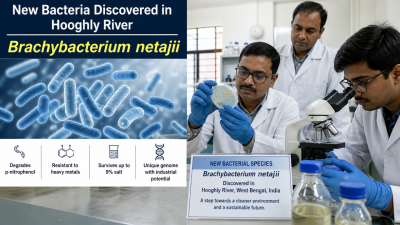
A new bacterial species, Brachybacterium netajii, was isolated from the Hooghly River (Ganga distributary) and reported on 27–28 June 2026; it degrades p‑nitrophenol and tolerates multiple heavy metals.
Key biological features
- Taxonomy: A novel species in the genus Brachybacterium, designated Brachybacterium netajii.
- PNP degradation: Demonstrates ability to metabolise p‑nitrophenol (PNP), a toxic industrial chemical.
- Heavy‑metal resistance: Shows tolerance/resistance to arsenic, cadmium, lead and mercury.
- Halotolerance: Survives in salinities up to 9% (w/v) salt.
- Unique lipids: Contains distinctive fatty acids C11:0 and C10:0 2‑OH absent in closest relatives.
- Genomic islands: Genome harbours unique genomic islands encoding industrial enzymes and ectoine biosynthesis.
- Etymology: Species name honours Subhas Chandra Bose (“Netaji”).
Biotechnological relevance
- Bioremediation potential: Candidate for cleanup of PNP‑contaminated effluents and co‑contaminated heavy‑metal sites.
- Ectoine: Ectoine production confers osmotic and stress protection; relevant for survival in polluted or saline environments.
Distribution, isolation and collaborators
- Source: Isolated from sediment/water in the Hooghly River, West Bengal.
- Research collaboration: Indian and Japanese teams including Netaji Mahavidyalaya, University of Burdwan, IIT (BHU) and Hiroshima University.
IASPOINT Booster Facts
- Genomic islands (definition): Horizontally acquired DNA segments often encoding adaptive traits such as biodegradation enzymes or stress‑tolerance factors.
- PNP (exam note): Nitroaromatic compound used in dyes/pesticides; classified as an environmental pollutant due to toxicity and persistence.