
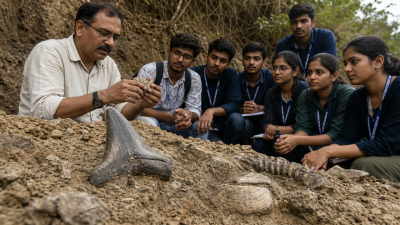
On 18 June 2026 researchers led by Dr. Debabrata Nandi reported discovery of ~15‑million‑year‑old shark fossils at the Baripada Fossil Bed in Mayurbhanj district, Odisha.
The Fossil Assemblage
- Fossil types: Shark teeth, vertebrae, fish bones, mollusc shells and microscopic marine organisms (microfossils).
- Taxonomic utility: Teeth morphology is key for identifying shark groups and estimating trophic structure.
Location & Geological Context
- Site extent: Baripada Fossil Bed from Dera (Kuliana block) to Pratappur (Badasahi block), Mayurbhanj, Odisha.
- Age: Miocene epoch, ~15 million years ago (Miocene: 23–5.3 Ma).
- Palaeoenvironment: Marine assemblage indicates shallow sea inundation; modern Bay of Bengal coastline lies ~60 km seaward of Baripada.
Research & Institutional Details
- Discovering team: Department of Remote Sensing & GIS, North Orissa University (Maharaja Sriram Chandra Bhanja Deo University) during an educational field visit.
- Follow-up: Palaeontologists from multiple institutions engaged for identification and ecosystem reconstruction.
Conservation & Policy Linkages
- Geo‑heritage status: Baripada zone being proposed for protection and development as a fossil park.
- Agency role: Geological Survey of India declares National Geological Monuments and advises on geo‑heritage management.
IASPOINT Booster Facts
- Miocene significance: interval of modern marine shark diversification and major sea‑level fluctuations.
- Microfossils: used to infer palaeosalinity and palaeotemperature of ancient seas.
- Fossil parks: state/GSI initiatives commonly used to conserve in‑situ fossil deposits and promote research and education.