
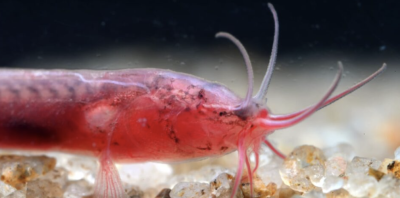
A new subterranean fish, Gitchak nakana, has been discovered from a dug-out well in Assam. It is the first aquifer-dwelling, or phreatobitic, fish recorded from Northeast India. The species is a miniature, blind and pigmentless cobitid loach with strong adaptations to life underground. The discovery adds a new genus and species to scientific knowledge of India’s subterranean biodiversity.
Discovery and Habitat
The fish was collected on three occasions from the same well in a village near the foothills of the Shillong Plateau in western Assam. The site lies close to the Brahmaputra Valley. The habitat suggests a groundwater aquifer environment rather than a cave system. This makes the find especially important, as aquifer-dwelling fishes are far rarer than cave fishes worldwide.
Distinctive Biological Features
Gitchak nakana shows several troglomorphic traits linked to subterranean life.
- It is blind and lacks pigmentation.
- It is a miniature cobitid loach.
- It has a complete absence of a skull roof.
- The brain is covered only by skin on the dorsal side.
These features are not known in other cobitid genera and support its classification as a new genus and species.
Scientific Significance
More than 300 fish species are known from subterranean habitats across the world, but fewer than 10 per cent live in groundwater aquifers. The discovery therefore fills an important gap in knowledge of underground fauna. It also shows that the Shillong Plateau and adjoining areas may contain more undocumented subterranean species than previously recognised.
Implications for Biodiversity and Conservation
The find strengthens the case for studying and protecting fragile groundwater ecosystems in Northeast India. Such habitats are often overlooked, yet they may support highly specialised and endemic life forms. The discovery also adds to earlier records of subterranean fishes from the Shillong Plateau, including cave-dwelling species and Neolissochilus pnar, while extending scientific understanding of loach evolution and underground adaptation.
Last Modified: April 28, 2026