
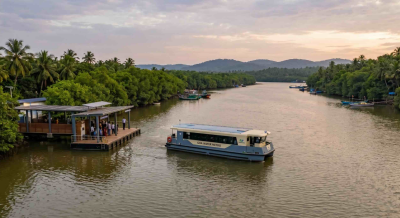
The Goa government has proposed a massive water metro project modeled on the operational Kochi water metro system to enhance state-wide inland water transport. The River Navigation Department submitted the detailed feasibility report on 7 May 2026, which was prepared by Kochi Metro Rail Limited (KMRL) after a comprehensive year-long study. Estimated to cost Rs 3,146 crore, the initiative aims to create a highly organized, modern, and eco-friendly maritime transit network. The project plans to establish an expansive 111-kilometer transportation matrix across the state’s navigable river systems to benefit local commuters and tourists.
Technical and Operational Blueprint
Project Network and Fleet Size
The infrastructural framework of the proposed Goa water metro is designed as a unified public transport network. It will span eight specific river routes covering a total length of 111 kilometers. The physical infrastructure includes the construction of 32 passenger ferry terminals equipped with floating concrete pontoons to ensure disability-friendly access. The operational fleet will comprise 87 modern vessels. Dedicated boat parking and servicing facilities are proposed along the Mandovi river at Betim, Chorao, and Old Goa to prevent terminal congestion and facilitate non-operational berthing.
Key Transit Corridors
The network targets high-demand passenger and tourist paths to optimize statewide mobility. Primary routes will link urban and transit nodes including:
- Panaji
- Vasco da Gama
- Dona Paula
- Several isolated inland islands (such as Chorao and Vanxim)
A ninth route utilizing sea corridors is under evaluation to link external coastal hotspots. One high-traffic corridor mapped in the first phase runs from Panaji through Reis Magos, Fort Aguada, and Baga Creek up to the Chapora Viewpoint. A secondary major route will connect Panaji to Britona, Chorao Island, Amboi, Vanxim, and Naroa.
Economic Viability and Traffic Projections
Financial and Economic Returns
The feasibility report highlights strong economic viability for the project across a 30-year lifecycle. The financial internal rate of return (FIRR) for the high-density Panaji corridor is calculated at 12.58 percent, while other branches like the Panaji-Chorao-Naroa line show an FIRR of 7.86 percent. The overall economic internal rate of return (EIRR) stands at 15.83 percent. This high EIRR reflects the wider socio-economic advantages of the project, including carbon emission cuts, fuel savings, and reduced road maintenance costs.
Ridership Trajectory
The water metro is designed to cater to both daily local commuters and regional tourists. The system handles initial projected demands with an expected growth curve over the next two decades.
| Projection Year | Estimated Daily Passenger Ridership |
| 2025 (Baseline) | 43,240 passengers |
| 2041 (Target) | Over 59,000 passengers |
Funding, Inter-Ministerial Coordination, and Challenges
Administrative Approvals
The state government is initiating steps to seek structural central financial assistance to fund the project. Formal presentations and aid requests are being directed to the Prime Minister’s Office (PMO) and the Union Ministry of Ports, Shipping, and Waterways. This lines up with ongoing efforts to rename the state’s River Navigation Department to the Inland Waterways Department to better coordinate major infrastructure transitions.
Technical and Environmental Challenges
The KMRL feasibility report points out unique physical challenges compared to inland backwater systems. The system will face open sea-river confluence conditions, particularly near the mouth of the Mandovi river by Fort Aguada. Strong wave actions, cross-currents, and tidal variations require the construction of specialized breakwater structures. These additions will increase initial capital layout and long-term maintenance costs.
IASPOINT Booster Facts for UPSC
- Kochi Water Metro Benchmark: Launched in Kerala, the Kochi Water Metro is Asia’s first integrated water transport system of its scale. It uses specialized battery-powered electric hybrid boats and concrete floating pontoons that adjust automatically with tidal changes.
- Draft National Water Metro Policy, 2026: The Union Ministry of Ports, Shipping, and Waterways recently circulated this policy framework to standardize vessel designs, terminal architecture, and green propulsion systems (electric/hybrid) across 18 selected Indian cities with navigable channels.
- Harit Nauka Guidelines: These central guidelines prioritize the transformation of domestic inland water transit using zero-emission or low-emission fuels, aiming to lower the overall carbon footprint of urban passenger transport.
- Inland Waterways Authority of India (IWAI): Created in 1986 under the IWAI Act, this statutory body handles the development and regulation of National Waterways (NWs) for shipping and navigation. It is headquartered in Noida, Uttar Pradesh.
- National Waterways Act, 2016: This legislation declared 111 inland waterways across India as National Waterways to boost fuel-efficient and cost-effective cargo and passenger transit. In Goa, parts of the Mandovi River (NW-68), Zuari River (NW-111), and Cumberjua Canal (NW-27) are designated under this framework.