
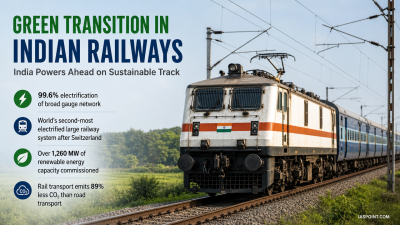
As of 22 July 2026 Indian Railways has achieved 99.6% electrification of its broad‑gauge network, making it the world’s second‑most electrified large railway system. The transition combines mass electrification with about 1,260 MW of commissioned renewable capacity and large diesel savings.
Current significance
What is current
- Network scale: 99.6% broad‑gauge electrified; remaining 0.4% covers difficult alignments.
- Renewable capacity: ~1,161 MW solar and 103 MW wind commissioned within the railway portfolio.
- Fuel impact: Diesel use for traction fell from 293 crore litres (2015–16) to 108 crore litres (2024–25), saving nearly 185 crore litres.
- Global position: Second only to Switzerland (100%); other major systems are lower (China 82%, Spain 67%, Japan 64%, France 60%, UK 39%).
- Official disclosure: Data presented in Lok Sabha by the Union Railway Minister.
Why this matters for governance and policy
- Climate commitments: Supports India’s longer‑term net‑zero objective and the Indian Railways’ Net‑Zero Carbon by 2030 ambition for direct emissions.
- Energy security: Large reduction in diesel lowers import exposure and fiscal pressure from fuel subsidies and exchange rate shocks.
- Public service delivery: Electrification improves speed, haulage capacity and reliability for freight and passenger services.
- Intergovernmental coordination: Requires alignment between Ministry of Railways, state discoms, power regulators and nodal renewable agencies.
Environmental and economic implications
- Emission profile: Electric traction eliminates tailpipe emissions on routes. Rail transport emits about 89% less CO2 per tonne‑kilometre than road transport.
- Indirect emissions: Majority of traction electricity is grid‑supplied; grid generation remains dependent on fossil fuels, so scope‑2 emissions persist until grid decarbonises.
- Operational economics: Electric locomotives lower energy and maintenance costs per gross tonne‑kilometre, improving operating ratio over time.
- Macroeconomic effect: Reduced diesel imports eases current account pressure and improves energy security for transport logistics.
Administrative, policy and delivery enablers
- Scale‑up since 2014: 48,072 route km electrified between 2014–2026 versus 21,801 km in the six decades before 2014.
- Mandates: All new lines and multi‑tracking projects sanctioned with integrated electrification infrastructure.
- Procurement and execution: Use of EPC contracts, standardised designs, delegated financial powers to zones, and performance monitoring accelerated delivery.
- Institutional actors: Central Ministry of Railways, zonal railways, RVNL, RITES and PSUs for project execution; power sector bodies for supply arrangements.
Technology, energy integration and grid challenges
- Grid dependence: Traction load is linked to the national grid. Until the grid’s fuel mix shifts, indirect emissions remain material.
- Intermittency: Solar and wind integrated into railway energy must be backed by storage, hybrid PPAs or flexible grid supply to meet round‑the‑clock traction demand.
- Infrastructure upgrades: Need for traction substations, SCADA, upgraded protection and higher‑capacity feeders for high‑speed and heavier freight operations.
- Technical pockets: Tunnels, high‑altitude sections and dense forest corridors pose clearance and environmental constraints for overhead equipment.
- Regulatory barriers: Open‑access procurement and cross‑subsidy charges from state discoms complicate direct green power sourcing for traction.
Fiscal and investment considerations
- Capital intensity: OHE, substations and renewables require high up‑front capital. Lifecycle savings accrue from lower fuel and maintenance costs.
- Financing routes: Central budget allocations, multilateral finance, green bonds and public‑private partnerships are in use or available.
- Tariff and PPAs: Long‑term PPAs and bundled hybrid projects (solar+wind+storage) reduce exposure to spot market volatility.
Operational and social aspects
- Service quality: Electrification enables faster acceleration, better timetable adherence and higher axle loads for freight.
- Employment: Construction and renewable installation generate local jobs; skills upgradation needed for electrical maintenance.
- Land use: Railway land parcels offer deployment sites for solar; clearances and community consultation are required for larger installations.
Way forward — practical options
| Dimension | Action |
|---|---|
| Renewable supply | Scale hybrid PPAs with storage; use vacant railway land for captive solar; explore wheeling/open access with concession on cross‑subsidy charges. |
| Non‑electrified pockets | Deploy battery and hydrogen fuel‑cell traction for last‑mile or environmentally restricted stretches. |
| Grid emissions | Coordinate with central and state power planners to prioritise renewable dispatch to traction loads and support grid decarbonisation targets. |
| Technical systems | Upgrade traction substations, implement SCADA and predictive maintenance, and standardise designs for rapid electrification in complex terrain. |
| Finance & governance | Use green financing instruments, outcome‑based contracts, and strengthen inter‑ministerial coordination for PPAs and land‑use approvals. |
Model Questions
1. Examine how the Indian Railways’ near‑universal electrification and renewable capacity addition contribute to India’s net‑zero goals and national energy security. [GS-III: Environment & DM]
Indian Railways’ 99.6% electrification and ~1,260 MW renewables reduce direct diesel use, lowering fuel imports and operational costs. Rail’s lower CO2 intensity per tonne‑km improves modal emissions profile. However, traction remains grid‑dependent; grid decarbonisation and round‑the‑clock renewable supply (PPAs, storage) are required to cut scope‑2 emissions and deliver full contribution to national net‑zero objectives and energy security.
2. Analyze administrative and policy changes since 2014 that enabled rapid electrification of the Indian Railways. [GS-II: Governance]
Post‑2014 acceleration resulted from mandated integrated electrification for new projects, delegated powers to zonal railways, standard designs, and adoption of EPC contracts. Strong central monitoring, assured funding and institutional roles for execution PSUs streamlined delivery. Remaining governance work includes faster clearance for renewables on railway land and resolving state‑level open‑access regulatory issues for direct power procurement.
3. Assess the role of parliamentary oversight and ministerial disclosures in tracking large infrastructure targets such as railway electrification. [GS-II: Governance]
Parliamentary disclosures provide transparency on progress, enable scrutiny of budgets and timelines, and force inter‑agency accountability. Written statements and Lok Sabha replies inform members and public, facilitating corrective action. Legislative oversight links national targets with state priorities and helps monitor compliance with environmental and fiscal commitments tied to large infrastructure programmes.
4. What are the key technical and regulatory challenges in powering an almost fully electrified railway network from renewables, and what strategies can address them? [GS-III: Science & Technology]
Challenges include grid intermittency, storage costs, infrastructure upgrades (substations, SCADA), land for renewables and open‑access regulatory barriers. Strategies: hybrid solar‑wind PPAs with BESS, captive solar on railway land, targeted deployment of battery/hydrogen traction for non‑electrified stretches, upgrade traction infrastructure, and regulatory reforms to ease cross‑state wheeling and open‑access procurement.
Last Modified: July 23, 2026