
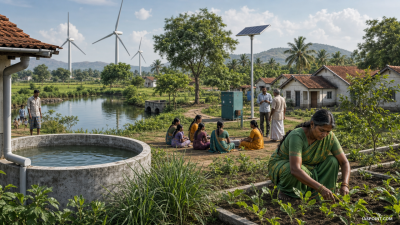
Killai in Cuddalore district became Tamil Nadu’s first fully operational Climate Resilient Village on 22 July 2026 under the Tamil Nadu Climate Change Mission. The project combines ecosystem restoration, decentralised renewable energy and community-led action to reduce coastal climate risks and protect local livelihoods.
What and why it matters
Killai provides a tested model for village-level adaptation along India’s coastline. It addresses cyclone impacts, sea‑level rise, saline intrusion, coastal erosion and biodiversity loss while protecting fishing livelihoods. The model is relevant for governance, fiscal planning, disaster management and coastal ecological restoration.
Core components of the Killai Climate Resilient Village
- Institutional framework: Implemented under the Tamil Nadu Climate Change Mission and executed by the District Climate Change Mission with panchayat and community participation.
- Finance: Project cost ₹230.15 lakh funded by District Climate Change Mission allocations and Corporate Environmental Responsibility (CER) contributions.
- Canal restoration: Ecological restoration of a 3‑km stretch of the Buckingham Canal; desilting, removal of over 750 kg of plastic waste and clearing of Prosopis juliflora were completed.
- Mangrove afforestation: More than 3,000 native mangrove saplings planted along canal banks to stabilise shoreline and enhance biodiversity.
- Renewable energy: Solar panels on public buildings, solar street lights, solar parks, solar driers and solar cold storage to support local economy and resilience.
- Community action: Engagement of fishing and tribal communities for restoration, maintenance and livelihood interventions.
Ecosystem-based adaptation (EbA) and coastal protection
EbA uses natural systems to reduce vulnerability. Mangroves retain sediment, stabilise shorelines, reduce wave energy and act as buffers against storm surges. Canal desilting restores hydrology and fish habitat. Removal of invasive Prosopis juliflora permits reestablishment of native vegetation. EbA contributes to biodiversity recovery, fishery productivity and long‑term reduction in protection costs compared with hard infrastructure alone.
Decentralised governance and implementation architecture
- District-level role: District Climate Change Mission translates state policy into local plans, mobilises funds, and coordinates line departments.
- Horizontal coordination: Panchayats, fisheries, forestry, public works and local NGOs implement integrated activities and manage assets.
- Community ownership: Local stakeholders provide labour, monitor mangrove nurseries and take responsibility for upkeep, improving asset longevity.
- Inter‑jurisdictional issue: Buckingham Canal crosses Tamil Nadu and Andhra Pradesh; full network restoration requires inter‑state coordination and shared management protocols.
Renewable energy and livelihood resilience
Decentralised solar systems reduce dependence on fragile grid supply during cyclones and outages. Solar driers and cold storage lower post‑harvest losses for fishers. Solar street lights and public‑building panels support services and safety. Effective outcomes require local technical capacity, maintenance budgets, battery lifecycle planning and integration with local micro‑enterprise models to ensure economic sustainability.
Climate finance and role of Corporate Environmental Responsibility (CER)
Blended finance enabled the Killai project. Public funds from DCCM covered core planning and implementation; CER provided supplementary capital. This approach accelerates field projects and reduces immediate fiscal pressure. For scale‑up, states need standardised CER channels, transparent project appraisal, long‑term O&M commitments and performance monitoring to avoid one‑off interventions without sustained funding.
Challenges to scalability and long‑term sustainability
- Ecological maintenance: Prosopis regrowth risk; mangrove survival needs continuous care and hydrological monitoring.
- Technical capacity: Ongoing O&M for solar installations, cold storage and driers requires trained local technicians and spare‑parts supply chains.
- Finance continuity: CER is episodic; replicability needs predictable public budgets or recurring private finance mechanisms.
- Governance coordination: Inter‑departmental and inter‑state alignment is essential for waterway and coastal zone management.
- Social safeguards: Tenure issues, equitable benefit-sharing and inclusion of vulnerable groups must be addressed to prevent local conflicts.
Practical measures to replicate and sustain the model
- Capacity building: Train panchayat task forces in mangrove nursery management, solar O&M and simple monitoring protocols.
- Standard operating guidelines: Develop CRV manuals covering ecological restoration, invasive‑species control, solar asset lifecycle and financial templates.
- Financing mechanisms: Institutionalise CER routing to District Climate Change Missions; combine with state allocations, NAFCC, and local revenue models (user charges for cold storage).
- Scheme alignment: Link CRV actions to ICZM/Integrated Coastal Zone Management, MGNREGS for labour-intensive tasks, NAPCC and state SAPCC priorities.
- Monitoring and evaluation: Use simple ecological and socioeconomic indicators—mangrove survival, catch per unit effort, post‑harvest loss reduction, energy uptime—to measure outcomes.
Model Questions
1. Analyse how ecosystem-based adaptation models can secure vulnerable coastal communities against climate hazards. Discuss with reference to the Killai Climate Resilient Village framework. [GS-III: Environment & DM]
EbA uses natural systems to reduce hazard exposure and support livelihoods. Killai combined canal desilting, invasive‑species removal and planting of 3,000+ native mangroves to stabilise shorelines, retain sediment and restore fish habitat. EbA lowers long‑term protection costs, enhances biodiversity and livelihoods, and requires hydrological restoration, community stewardship and monitoring to ensure survival and function across India’s coastline.
2. Examine the role of decentralised governance and district‑level planning in implementing localised climate action plans in India. [GS-II: Governance]
District Climate Change Missions convert state policy into local action by coordinating panchayats, line departments and communities. In Killai, DCCM led planning, mobilised funds and integrated fisheries, forestry and public works. Decentralisation improves contextual design, accountability and community ownership. Success requires capacity building, inter‑departmental protocols, transparent finance flows and mechanisms for inter‑state coordination where resources cross jurisdictions.
3. Evaluate the integration of localised renewable energy systems with climate‑resilient infrastructure to support rural coastal economies. [GS-III: Economic Development]
Local solar installations—panels on public buildings, solar driers and cold storage—ensure energy availability during grid failures and reduce post‑harvest losses for fishers. This raises incomes, lowers spoilage and supports market access. The model needs sustainable O&M funding, technician training, battery lifecycle plans and business models (ESCo/PPP) to maintain service reliability and economic viability at village scale.
4. Assess the utility of combining public funds with Corporate Environmental Responsibility to address the climate finance gap at the grassroots level. [GS-III: Environment & DM]
Blended finance pools DCCM public funds with CER contributions, as in Killai (₹230.15 lakh). This accelerates projects and shares cost burden. Effective use requires standardised CER channels, project appraisal, conditionality for O&M, transparent accounting and long‑term commitments. Without these, CER may produce short‑term gains but fail to secure enduring asset maintenance and community benefits.
Last Modified: July 23, 2026