
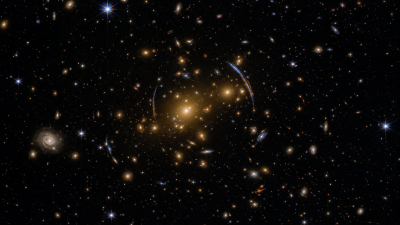
On 18–19 June 2026, NASA’s Hubble Space Telescope released new images of the merging galaxy clusters CL0016+1609 (MACS J0018.5+1626) and MACS J1141.6‑1905.
The Observations
- CL0016+1609 / MACS J0018.5+1626: Intense X‑ray emitter; X‑ray data show it comprises two clusters merging along our line of sight.
- MACS J1141.6‑1905: Image released 19 June 2026; located ~4 billion light‑years away in Crater; X‑ray brightness indicates large hot intracluster gas and high total mass.
- Instruments used: Hubble’s Advanced Camera for Surveys (ACS) for visible imaging and Wide Field Camera 3 (WFC3) for infrared.
Scientific Features
- Gravitational lensing: Visible and IR imaging reveal lensing distortions used to map dark matter distribution; dark matter itself remains invisible to Hubble.
- Merger geometry: Combination of X‑ray morphology and lensing mass maps constrains merger axis and dynamics for CL0016+1609.
- Intracluster medium (ICM): X‑ray traces hot ICM; brightness and temperature structure diagnose shocks and energy dissipation during mergers.
Survey and Data Context
- RELICS: Reionization Lensing Cluster Survey provided first Hubble IR images of 46 massive clusters and identified ~300 high‑redshift lensed candidates.
- Multiwavelength data: Joint X‑ray, radio, optical and IR observations separate baryonic gas, galaxies and dark matter for robust mass estimates.
IASPOINT Booster Facts
- Strong vs weak lensing: Strong lensing produces arcs/multiple images; weak lensing yields statistical shear for large‑scale mass mapping.
- Hubble capabilities: ACS optimised for wide‑field visible imaging; WFC3 extends sensitivity into near‑IR for high‑z source detection.
- Cosmological role: Cluster mergers test structure formation and probe dark matter properties via offset between mass and baryons.