
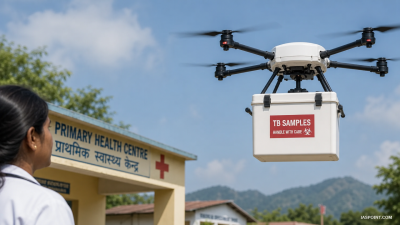
The Indian Council of Medical Research (ICMR) tested drone‑assisted transport of tuberculosis sputum samples under its i‑DRONE initiative in Yadadri‑Bhuvanagiri district, Telangana; a study of 840 participants using a hub‑and‑spoke model reduced median diagnostic turnaround time from 15 days to 5 days and cut mean out‑of‑pocket costs from about ₹9,451 to ₹91.
i-DRONE pilot: operational data
- Location & sample size: Yadadri‑Bhuvanagiri (Telangana); 840 participants.
- Network: Hub‑and‑spoke linking 11 Primary Health Centres, 60 sub‑centres and 4 TB Units.
- Outcome — time: Median turnaround time for TB diagnosis fell from 15 days to 5 days.
- Outcome — cost: Mean out‑of‑pocket diagnostic expenditure fell from ~₹9,451 to ~₹91 during drone phase.
- Specimen type: Sputum samples transported from peripheral facilities to diagnostic centres by UAVs.
Technical and logistical features
- Drone logistics: Use of unmanned aerial vehicles (UAVs) for transport of medical samples and diagnostics.
- Hub‑and‑spoke model: Centralises laboratory access and reduces last‑mile travel for patients and samples.
- Operational needs: Requires sample integrity protocols, chain‑of‑custody, flight permissions and BVLOS planning for remote routes.
TB and programme linkages
- Pathogen: Tuberculosis is caused by Mycobacterium tuberculosis.
- National programme: India implements the National Tuberculosis Elimination Programme (NTEP).
- Diagnostic relevance: Timely sputum transport is critical for bacteriological confirmation and treatment initiation.
IASPOINT Booster Facts
- ICMR: Apex biomedical research agency under the Department of Health Research.
- Regulation: UAV operations in India require clearance under national civil aviation rules (Drone Rules, 2021).
- Statistic note: Median is less sensitive to outliers than mean and commonly used for time metrics in operational studies.