
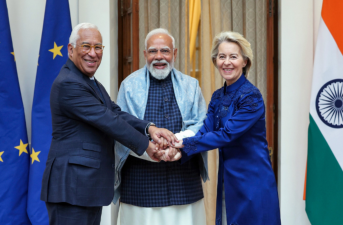
The free trade agreement between India and the European Union marks a turning point in India’s contemporary trade diplomacy. Its significance lies not merely in the economic weight of the two partners, but in the fact that India has negotiated on near-equal terms with one of the world’s most powerful trading blocs. Unlike India’s recent FTAs with smaller economies, this agreement reflects maturity, strategic restraint, and an ability to resolve long-standing disagreements without compromising core interests.
Why the India–EU FTA stands out
India has concluded eight FTAs in the last four years, but taken together, those partners accounted for only about 16% of India’s total trade in 2024–25. By contrast, the European Union alone accounted for nearly 12% of India’s trade. This makes the deal far more consequential in both economic and geopolitical terms.
Under the agreement, the EU will eliminate tariffs on 99.5% of Indian exports, with most duties dropping to zero immediately upon implementation. India, in turn, has offered tariff concessions on 97.5% of EU exports. The breadth and depth of liberalisation signal high ambition on both sides, while still preserving sensitive sectors.
Managing sensitive sectors with pragmatism
One of the strengths of the agreement is its calibrated approach to politically sensitive areas. India successfully excluded strategic agricultural sectors and dairy from the deal, protecting farmers and rural livelihoods. The EU, similarly, ring-fenced several of its own sensitive agricultural products. This mutual accommodation reflects a realistic understanding that free trade agreements must balance openness with domestic stability.
Automobiles and wine: resolving old roadblocks
The most notable breakthrough concerns automobiles and auto parts — the very issue that derailed India–EU FTA talks in 2013. Instead of an all-or-nothing approach, the two sides adopted a quota-based system. This protects India’s domestic manufacturers in the lower and mid-price segments, while giving European luxury carmakers meaningful access to the Indian market.
A similar logic applies to wine tariffs. Quota-based concessions offer French winemakers — a key EU demand — access to India’s market, while still shielding India’s emerging domestic wine industry. These solutions demonstrate how large economies can overcome entrenched disputes through flexibility rather than maximalism.
Beyond tariffs: mobility, defence, and technology
The FTA has been complemented by separate agreements on mobility, defence cooperation, and technology. Together, these deepen the partnership beyond trade in goods, signalling a broader strategic convergence. For India, this aligns trade policy with long-term objectives in manufacturing, innovation, and security partnerships with Europe.
Unresolved concerns: CBAM and competitiveness
Despite the gains, some concerns remain. India could not secure concessions under the EU’s Carbon Border Adjustment Mechanism. While CBAM currently applies to only six products, it is designed to eventually cover most industrial goods. This could raise the cost of Indian exports to Europe.
The partial relief is that CBAM applies uniformly to all countries, and India has negotiated a “most-favoured” safeguard: any concession granted by the EU to a third country will automatically extend to India. Still, the mechanism underscores how climate policy is increasingly shaping global trade.
Manufacturing reforms as the real test
The FTA opens a potential pathway for India to attract foreign investors seeking a cost-effective export base for Europe. However, this opportunity will materialise only if India accelerates reforms that enable large-scale manufacturing — including land, labour, logistics, and regulatory certainty. Trade agreements can create market access, but competitiveness must be built at home.
Implementation delays and geopolitical urgency
The agreement now faces procedural delays. The FTA text must be translated into 27 European languages, cleared by individual EU member states, and approved by the European Parliament. This process will take time. India has a strong incentive to push for faster ratification, especially as exporters face rising tariff pressures in the U.S. market. Delayed implementation could blunt the economic gains so carefully negotiated.
What to note for Prelims?
- The EU will eliminate tariffs on 99.5% of Indian exports under the FTA.
- India has excluded agriculture and dairy from the agreement.
- CBAM is an EU mechanism linking climate policy with trade.
What to note for Mains?
- Analyse why the India–EU FTA is more significant than India’s recent trade agreements.
- Discuss how quota-based solutions helped resolve long-standing trade disputes.
- Examine the implications of CBAM for developing countries like India.
- Evaluate the link between trade agreements and domestic manufacturing reforms.
Overall, the India–EU FTA reflects a shift in India’s trade strategy — from defensive caution to confident engagement. The agreement shows that India can negotiate firmly with powerful partners, protect core interests, and still pursue deeper integration with global markets. The challenge now lies in timely implementation and domestic readiness to convert negotiated access into real economic gains.
Last Modified: January 30, 2026