
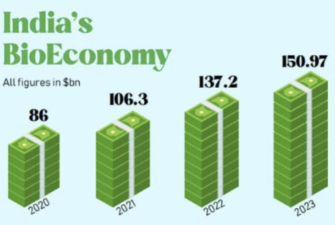
India’s bioeconomy has expanded rapidly, crossing $195 billion in 2025 from about $10 billion in 2014. The growth reflects stronger policy support, rising startup activity, and wider use of biotechnology in healthcare, agriculture, climate solutions, and sustainable manufacturing. The development was brought into light at the 14th Foundation Day of the Biotechnology Industry Research Assistance Council (BIRAC) in New Delhi.
Bioeconomy Growth in India
India’s bioeconomy has recorded sharp expansion over the past decade. It rose from around $165 billion to $195 billion in the last year alone, marking annual growth of 17-18 per cent. The sector now contributes nearly 5 per cent to India’s GDP. More than 11,800 biotech startups are active across the country, driving innovation and commercialisation.
Role of BIRAC in Innovation
BIRAC has played a key role in building India’s biotechnology ecosystem. It supports the transition from research to market-ready products through funding, incubation, and mentorship. Its programmes have helped strengthen industry-academia collaboration and have contributed to affordable healthcare solutions, sustainable technologies, and job creation.
Policy Push and Future Targets
The BioE3 policy, short for Biotechnology for Economy, Environment and Employment, is designed to promote sustainable biomanufacturing and bio-based industries. It focuses on precision biotherapeutics, smart proteins, climate-resilient agriculture, bio-based chemicals, and carbon capture technologies. The government’s ₹1 lakh crore Research, Development and Innovation Fund is also expected to support deep-tech ventures and long-term innovation.
Inclusive Biotechnology Ecosystem
The sector is also being expanded beyond major urban centres. Efforts are under way to nurture scientific talent in tier-2 and tier-3 cities, with special attention to students, researchers, and women entrepreneurs. The India Bioeconomy Report 2026 underlined the sector’s rapid expansion since 2020 and its growing importance in India’s development strategy.
Last Modified: April 29, 2026