
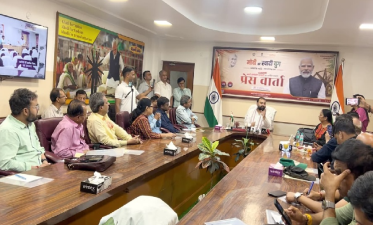
The Khadi and Village Industries Commission (KVIC) achieved a historic milestone by registering a record turnover of ₹1,87,105 crore in the financial year 2025-26. This performance marks a 501% increase in sales compared to the financial year 2013-14, establishing a new record in rural entrepreneurship. KVIC Chairman Manoj Kumar announced that production has simultaneously expanded by 380%, accompanied by a 56% growth in employment generation over the last 12 years. The sector has transitioned from providing traditional goods to a modern driver of self-reliance, with strategic plans underway to launch a revamped e-commerce platform targeting younger consumers.
Performance Metrics and Sectoral Breakdown
The growth trajectory of KVIC spans both the dedicated Khadi textiles segment and the broader village industries sector.
Production and Sales Disaggregation
- Overall Turnover: Total sales crossed ₹1.87 lakh crore in 2025-26 against ₹31,154 crore in 2013-14. Overall production expanded to ₹1,25,296 crore from ₹26,109 crore in the same period.
- Khadi Textiles Segment: Textile production rose from ₹811 crore in 2013-14 to ₹3,974 crore in 2025-26, registering an increase of nearly 390%. Sales in this segment surged by 628%, jumping from ₹1,081 crore to ₹7,869 crore.
- Village Industries Segment: Production within village units climbed to ₹1,21,322 crore from ₹25,298 crore in 2013-14. Corresponding sales figures grew by 496%, reaching ₹1,79,236 crore in the 2025-26 fiscal year.
Employment and Social Empowerment
- Workforce Expansion: Total cumulative employment under KVIC activities reached 2.04 crore individuals in 2025-26, up from 1.30 crore in 2013-14.
- Gender Inclusivity: Women represent approximately 80% of the overall workforce in the Khadi and village sector. Furthermore, women comprised nearly 59% of all trainees under various KVIC skill development initiatives during the year.
- Artisan Remuneration: The wage structure for rural artisans has been revised upward, moving from ₹4 per hank in 2013-14 to the current rate of ₹15 per hank, a rise of approximately 275%.
Key Growth Drivers and Government Schemes
The expansion of rural manufacturing has been supported by targeted flagship programs implemented by KVIC to establish micro-enterprises and distribute modern toolkits.
Prime Minister’s Employment Generation Programme (PMEGP)
The PMEGP is a credit-linked subsidy scheme managed by KVIC at the national level to generate self-employment. During the financial year 2025-26, the scheme facilitated the setup of 66,494 new micro-units. This expansion was backed by the disbursement of ₹2,457 crore in margin money subsidy against institutional bank loans totaling ₹7,375 crore. These newly established units generated direct employment opportunities for over 7.31 lakh individuals.
Gramodyog Vikas Yojana (GVY)
The GVY focuses on the promotion and development of traditional village industries through capacity building. Under this initiative, KVIC distributes specialized toolkits, advanced machinery, and honeybee boxes to rural artisans, potters, leather workers, and beekeepers to optimize production efficiency and standardise product quality.
Growth Comparison: FY 2013-14 vs FY 2025-26
| Parameter | Financial Year 2013-14 | Financial Year 2025-26 | Percentage Growth |
| Total Sales Turnover | ₹31,154 crore | ₹1,87,105 crore | 501% |
| Total Production Value | ₹26,109 crore | ₹1,25,296 crore | 380% |
| Khadi Textile Sales | ₹1,081 crore | ₹7,869 crore | 628% |
| Village Industry Sales | ₹30,073 crore | ₹1,79,236 crore | 496% |
| Cumulative Employment | 1.30 crore people | 2.04 crore people | 56% |
| Artisan Remuneration | ₹4 per hank | ₹15 per hank | 275% |
Institutional Profile of KVIC
Statutory Genesis
The Khadi and Village Industries Commission is a statutory body established by an Act of Parliament, the Khadi and Village Industries Commission Act of 1956. It functions under the administrative control of the Ministry of Micro, Small and Medium Enterprises (MoMSME).
Core Objectives
The functions of KVIC are structured around three primary goals:
- Social Objective: Providing sustainable employment opportunities to rural populations.
- Economic Objective: Producing saleable articles to boost rural income and self-reliance.
- Wider Objective: Creating a strong rural community spirit and building a non-urban industrial base.
IASPOINT Booster Facts for UPSC
- Nodal Ministry: KVIC operates directly under the Ministry of Micro, Small and Medium Enterprises (MoMSME), serving as the apex organization for Khadi and village industries inside India.
- Definition of Khadi: Under the KVIC Act of 1956, Khadi is defined as any cloth woven on handlooms from cotton, silk, or woolen yarn hand-spun in India, or from a mixture of any two or all of such yarns.
- The PMEGP Core Structure: PMEGP was created in 2008 by merging two separate schemes: the Prime Minister’s Rozgar Yojana (PMRY) and the Rural Employment Generation Programme (REGP). KVIC is the single nodal executing agency at the national level, while State KVIC Directorates, State Khadi and Village Industries Boards (KVIBs), and District Industries Centres (DICs) implement it locally.
- Geographical Indication (GI): Khadi fabric from specific regions, such as Pokhran Khadi from Rajasthan and Ponduru Khadi from Andhra Pradesh, holds distinct traditional value, and KVIC owns the “Khadi” trademark globally.
- Interest Subsidy Eligibility Certification (ISEC): This is the principal funding mechanism for the Khadi programme. It mobilizes funds from banking institutions to fill the gap between actual requirement and budgetary allocation by providing loans at a concessional interest rate of 4%.
- SFURTI Scheme: KVIC executes the Scheme of Fund for Regeneration of Traditional Industries (SFURTI) to organize traditional industries and artisans into clusters, making them competitive and sustainable.