
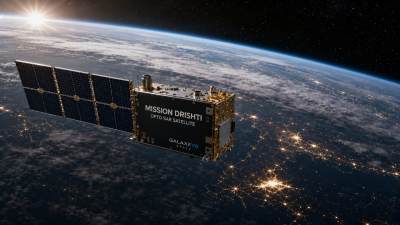
On 7 July 2026 GalaxEye Space announced loss of communication with Mission Drishti, its maiden 190 kg OptoSAR Earth‑observation satellite, after a geomagnetic solar storm disrupted a critical onboard subsystem during the final stage of LEOP.
Mission snapshot
- Launch: 3 May 2026 on a SpaceX Falcon 9 rideshare from Vandenberg Space Force Base.
- Platform: 190 kg, India’s largest privately developed EO satellite; first to integrate optical and SAR sensors on a single bus.
- Pre‑anomaly status: Deployment, attitude control, onboard computing and communications validated over a multi‑week operating phase.
- Follow‑up plans: GalaxEye intends design revisions, increased in‑house manufacturing and two further OptoSAR launches within 24 months.
Cause and failure mode
- Trigger: Intense geomagnetic solar storm (CME/proton event) during LEOP.
- Effect on spacecraft: Extreme radiation compromised a critical subsystem; communications became intermittent then ceased; recovery deemed unlikely.
OptoSAR technology
- Optical sensors: Visible/IR bands provide spectral and colour information.
- SAR sensors: Active microwave imaging (commonly X, C, L bands) delivers day/night, all‑weather surface structure and roughness data.
- Synergy: Combined datasets enable co‑registered spectral and structural analysis from a single platform.
LEOP, space weather and mitigation
- LEOP: Launch and Early Orbit Phase — critical commissioning window for deployment, orbit insertion and initial commissioning.
- Radiation effects: Single‑event effects (SEU, SEL), total ionising dose (TID) and displacement damage can disable electronics.
- Mitigations: Radiation‑hardened components, shielding, redundancy, watchdogs and error‑correcting codes are standard countermeasures.
IASPOINT Booster Facts
- Noaa G‑scale: Geomagnetic storms classified G1–G5 by NOAA based on Kp index and expected impacts.
- SAR resolution: Range from metres to sub‑metre depending on frequency band, incidence angle and processing.
- Commercial space trend: Private EO firms increasingly combine multi‑sensor payloads to maximise data value per platform.